


 3
3
A breakaway bitcoin chain is now so short of miners that its own mechanism for fixing that is six years away.
The chain that broke away from bitcoin on Saturday has not moved since. It is still sitting on block 961,633, its second. Bitcoin has since climbed to block 961,959, leaving the fork 326 blocks behind.
The split happened because of a proposal called BIP-110, which would stop people storing pictures, text and other non-payment data in bitcoin transactions for a year. Changing bitcoin's rules requires miners to agree, and they register that agreement by marking the blocks they produce. BIP-110 needed 55% of blocks over a two-week stretch. It got about 2.6% at its peak.
But rather than accept that, the proposal had a second route built into it. At block 961,632, computers running BIP-110 software began rejecting every block that did not carry the mark, regardless of what miners had decided.
Almost no blocks carry it, so those computers rejected the chain nearly all of bitcoin's mining power was building and started following one made only of blocks that did.
Bitcoin's ledger is a chain of blocks, each one a batch of transactions added by miners, firms running warehouses of specialised computers that compete to produce the next one. They are paid in newly issued bitcoin plus the fees attached to those transactions, and a block arrives roughly every ten minutes.
That ten-minute pace is not automatic. The network sets a difficulty level, which is how much computing work a miner must do to produce a valid block, and recalculates it every 2,016 blocks. If blocks have been arriving too fast, the work gets harder. Too slow, and it gets easier.
At normal speed, 2,016 blocks takes about two weeks.
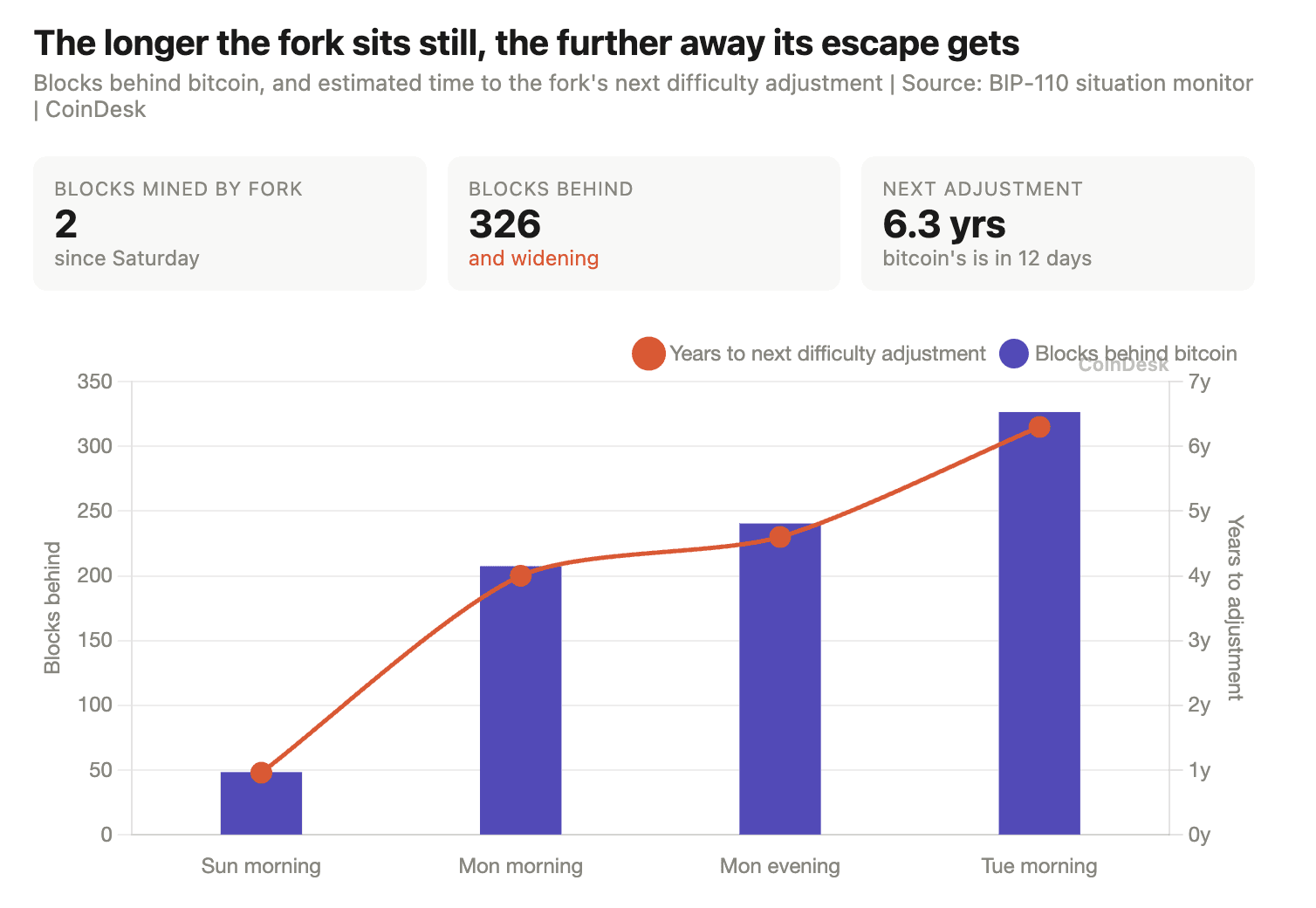
Two blocks were produced on that chain. Then it stopped, because mining it costs exactly what mining bitcoin costs — as both chains having inherited the same difficulty when they parted, while paying in a coin that has no market, no exchange listing and no buyers.
It also cannot make mining easier on itself without first completing 2,016 blocks at its current pace. A live monitor now estimates that adjustment at 6.3 years away, up from 350 days on Sunday.
The number is calculated from recent block times, so every idle hour pushes it further out. Bitcoin's next adjustment is due in 12 days.

 news.bitcoin.com

 bitcoinworld.co.in + 1 more

