

 1
1


 14
14
Samsung Electronics will begin adding stablecoin accounts, cross-border transfers and in-store payments to Samsung Wallet this year, starting with a limited group of countries, the company told Sandmark in a written response to questions on 8 Aug.
The reply, translated from Korean, is the first time Samsung has attached a timeline to the stablecoin plan it set out at Galaxy Unpacked in London on 22 Jul. Stablecoins are tokens designed to hold a fixed value, almost always one US dollar, and are used mainly to move money rather than to bet on its price.
Samsung Wallet, the group's single app for payment cards, IDs, digital keys and boarding passes, operates in 61 countries and has more than 19mn monthly active users in South Korea alone, according to market tracker Wiseapp Retail Goods. Samsung shipped 241.2mn smartphones worldwide in 2025, according to International Data Corporation (IDC), a US market research firm that tracks technology shipments and market share.
A Samsung spokesperson said: "Starting with select countries within this year, we plan to sequentially introduce stablecoin account opening, cross-border remittance and payment functions inside Samsung Wallet. Global expansion will proceed at an appropriate time after closely reviewing each country's regulations and market environment."
Galaxy Unpacked is Samsung's twice-yearly product showcase, where it introduces new smartphones, wearables and related services.
What Galaxy phones can already do
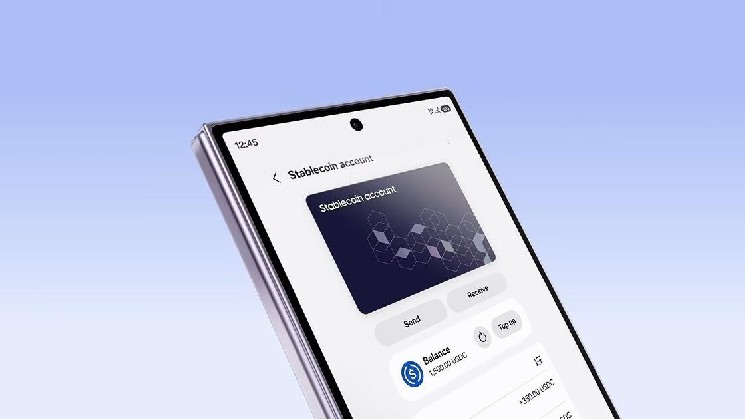
The Unpacked presentation showed a Samsung Wallet mockup holding 1,500 USD Coin ($USDC) alongside Send, Receive and Top-up buttons. Most of those actions already exist. Samsung Blockchain Wallet, released in 2019 and protected by Samsung Knox, which keeps private keys in an isolated area of the phone's hardware, ships on Galaxy devices in markets including the US, the UK, Germany, Switzerland, Australia, Singapore and the Philippines, according to Samsung's developer documentation.
That app is non-custodial, meaning the user holds the keys and Samsung cannot touch the funds. It supports Bitcoin (BTC), Ether (ETH) and Tron (TRX), so $USDC issued on Ethereum and Tether (USDT) issued on Tron can already be held and sent by anyone willing to add the tokens by hand.
Samsung's tie-up with US crypto exchange Coinbase also lets US Galaxy owners see their Coinbase balances inside Samsung Wallet and fund purchases on the exchange through Samsung Pay, Samsung's contactless payment service.
The shift towards holding customer money
What the statement adds are three functions the current app does not offer: an account-opening flow, cross-border remittance and in-store payments through Samsung Wallet.
Opening an account requires identity and anti-money-laundering checks, known in the industry as know-your-customer (KYC), and and cross-border remittance, the business of sending money abroad, typically by workers to family at home, is almost always handled by a licensed operator under local rules. Both point to a custodial product, where a regulated firm holds the balance on the customer's behalf, rather than the self-custody wallet Samsung ships today. That is a different business, with different licences and different liabilities.
In-store payments would run over Samsung Pay, which replaces a card number with a substitute code to authorize transactions on Visa, Mastercard and local card networks at any contactless terminal. Samsung Pay has been folded into Samsung Wallet across most markets where the wallet operates, so a stablecoin balance could in principle settle merchant payments over the same acceptance footprint as a debit card.
Partners, rules still undecided
Alongside the stablecoin plan, Samsung used Unpacked to introduce the Samsung Galaxy Card, a Barclays and Visa credit card it described as "the first financial service built on Samsung Wallet". The company has not said whether stablecoin balances will interact with the Galaxy Card rails.
The $USDC on the mockup drew attention from Circle, the token's issuer, whose CEO Jeremy Allaire reposted the screen on X after the event. Samsung has not confirmed Circle as a partner, and a token appearing on a marketing slide is not a commercial agreement.
Samsung did not identify the initial countries, the stablecoins to be supported or the partner issuers in the same response. South Korea's Financial Services Commission, the country's main financial regulator, said on 29 Jul it is preparing a consolidated Digital Asset Basic Act that would fold 10 separate crypto and stablecoin bills into one framework covering issuance and distribution.
How it fits Samsung's wider crypto push
Open Standard, the independent company behind the Open USD (OUSD) dollar stablecoin due later this year, named Samsung Electronics among more than 140 partners on 30 Jun. Samsung Electronics told South Korean business paper Chosun Biz on 3 Jul that it had held no official consultations and did not know what role it would play. Sandmark has previously reported on how many of that roster had actually committed to issuance. Samsung Card is separately listed among the Korean card issuers in the consortium.
The firmer commitment is on the infrastructure side. Samsung Securities, Samsung SDS and Samsung Card agreed in May to acquire a combined 4% stake in Dunamu, which operates South Korean crypto exchange Upbit, for $408mn, and Samsung SDS CEO Lee Jun-hee framed the deal on the group IT arm's second-quarter earnings call on 30 Jul as a move into stablecoin and AI-payment infrastructure.
Where this differs from Xiaomi, Apple
Samsung is not the first handset maker to put crypto on a phone. Xiaomi, the third-largest smartphone maker by shipments with 165.5mn units in 2025, agreed in December 2025 to pre-install a wallet built on the Sei blockchain across new devices sold outside mainland China and the US, and to accept stablecoins at more than 20,000 of its retail stores, with pilots originally targeted for Hong Kong and the EU in the second quarter of 2026. Neither company has announced that those pilots have gone live.
That is a third-party crypto app travelling alongside the phone. Samsung is describing something narrower and more demanding: dollar balances inside the app that already holds a user's bank cards, with Samsung or a licensed partner opening the account. Apple has announced no equivalent function for Apple Wallet, where crypto reaches users through Apple Pay funding third-party apps rather than through Apple itself. Earlier efforts, including HTC's 2018 blockchain handset and Samsung's own 2019 keystore, drew little mainstream use.

 bitcoinworld.co.in
 coindesk.com
