



 3
3
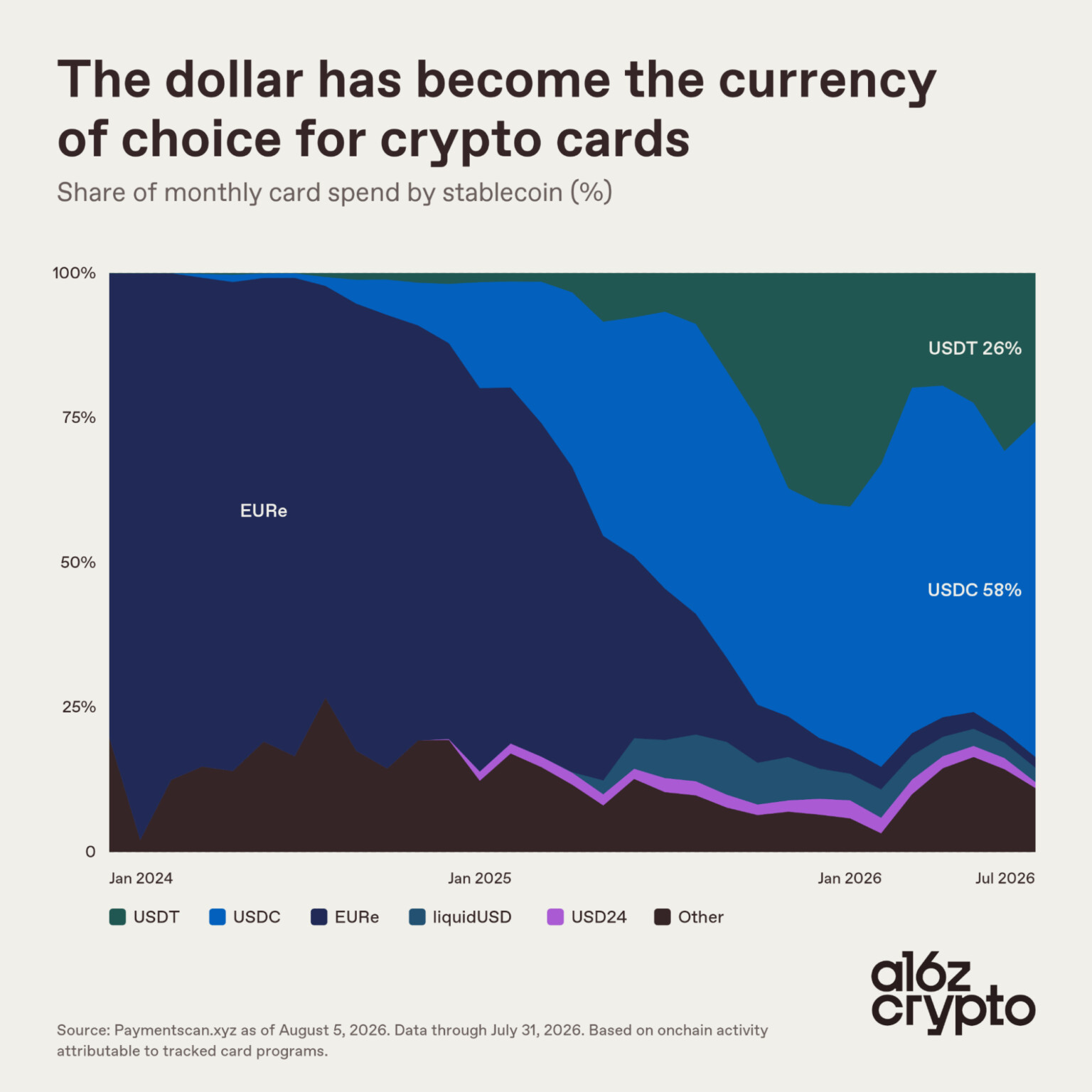
Crypto payment card spending shot up to $759 million in July, about 2.5 times the level a year earlier. $USDC, backed by dollars, now accounts for 58% of that volume, according to figures cited by a16z crypto.
Dollar stablecoins displace euros in under two years
Cardholders made ~9 million purchases in July, compared with about 5.2 million in the same month last year. That works out to an average purchase of ~$86.
These cards allow holders to spend stablecoins anywhere a traditional card is accepted. At checkout, the crypto is converted into local currency, and the merchant receives an ordinary card payment.
Users either hold stablecoins on-chain in self-custody or deposit them with the card issuer. No traditional bank account is needed.
The figures are mostly drawn from on-chain data that is indexed directly. RedotPay, the largest by volume, reports stablecoin spending only rather than it being observed on-chain.
As of early 2024, euro-backed stablecoins led the way, with about 88% of card volume settled in EURe, much of it on the Gnosis chain. By July the share of EURe had collapsed to around 2%.
$USDC’s 58% share is up from around 48% a year ago, based on data from a16z crypto. During the same period, USDT increased to around 26% from around 7%. Almost all card spending is in digital dollars now.
Optimism, Solana, and Base carry stablecoin volume
Gnosis Pay launched the first Visa card directly linked to a self-custodial wallet, and in early 2024, nearly all card spending was on the Gnosis chain.
As of July, Optimism accounted for about 29% of the card spend. Solana and Base were near 19% each. Gnosis was down to around 2%. The cards run on Visa’s network almost exclusively across the programs tracked.
Visa and Bridge, the stablecoin infrastructure firm owned by Stripe, announced in March their plans to expand the stablecoin card program to over 100 countries by the end of the year.
This expansion will allow holders to use their stablecoin balances at more than 175 million merchant locations that accept Visa, as reported by Cryptopolitan.
In January, Dragonfly’s Haseeb Qureshi said that stablecoin cards were “growing like crazy, everywhere in the world.”
Stablecoin payments lack the rewards and credit incentives that drove card adoption. The existing system “isn’t actually broken for most merchants and consumers in developed markets,” said Sheel Mohnot of Better Tomorrow Ventures.

 invezz.com
 coindesk.com