



 17
17
Strategy's (MSTR) first bitcoin sale since 2022 may have been tiny relative to its massive $58 billion holdings, but the market's reaction could signal a broader shift in crypto markets, according to Standard Chartered's head of digital asset research, Geoff Kendrick.
In a note to clients, Kendrick pointed out that ether ($ETH) significantly outperformed bitcoin on the day the sale was announced, despite broader weakness in crypto prices. Since Monday, $ETH has appreciated 5% relative to $BTC.
Among sessions when bitcoin declined, the move ranked among the largest $ETH-versus-$BTC gains since the start of 2024, he noted.
"I see [Monday] as being the start of $ETH outperformance versus $BTC," Kendrick wrote.
The call comes as investors continue debating whether ether can regain momentum after lagging behind bitcoin for much of the past two years. Since September 2022, when the Ethereum network transitioned from a mining-centric proof-of-work to a proof-of-stake model, $ETH has depreciated 66% versus $BTC, reaching a five-year low in April 2025. That downtrend, however, has shown signs of shifting, as $ETH has bounced more than 60% from the lows over the past year.
Kendrick, who has a long-term $ETH price target of $4,000 by the end of 2026 and $40,000 by 2030, said he expects the $ETH-$BTC ratio to climb to 0.04 by year-end from around 0.028 currently, implying ether would outperform bitcoin by more than 40% even if both assets move higher or lower.
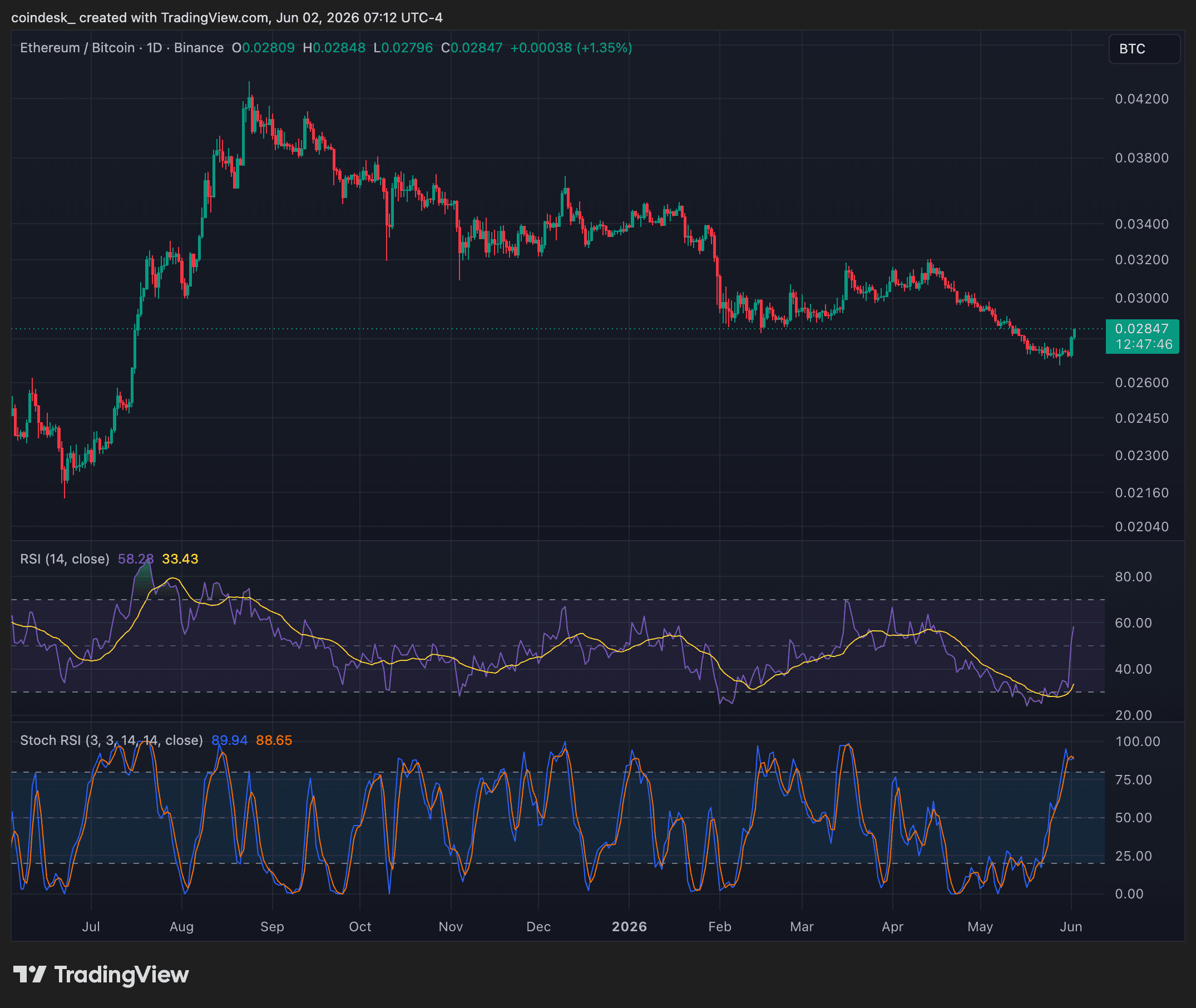
This isn't the first time Kendrick has forecasted $ETH outperforming bitcoin. Earlier this year, he had a similar call, citing the passage of U.S. Clarity Act, which he said would create a regulatory framework for the sector and boost digital assets such as $ETH, as it would unlock the next chapter for decentralized finance.
Bitcoin vs. Ethereum digital asset treasuries
While Strategy's bitcoin sale has rattled the market, Kendrick argued that the significance of the transaction isn't the $2.5 million in $BTC that changed hands, but what it reveals about the different economics of bitcoin and ether treasury firms.
Strategy (MSTR) and other bitcoin treasury companies rely largely on bitcoin price appreciation and capital markets activity to support their business models. Because bitcoin does not generate yield, treasury firms may occasionally need to sell holdings or raise capital to cover expenses and obligations.
Read more: Strategy sparked panic with bitcoin sale, but analysts say it was 'immaterial'
Meanwhile, $ETH can be staked to earn yield, currently around 3% annualized, providing a source of income without requiring firms to liquidate assets.
For example, Tom Lee's Bitmine (BMNR), the largest Ethereum treasury, amassed a $11 billion $ETH stash without issuing any debt. While that bet is deeply underwater, the firm estimates its staking operations generate roughly $258 million in annualized revenue, with projected rewards approaching $300 million annually through its MAVAN staking platform.
Kendrick argued that staking income makes ether treasury companies more self-sustaining than their bitcoin-focused peers. While Ethereum treasury firms such as Bitmine and SharpLink Gaming (SBET) currently trade at lower premiums than Strategy (MSTR), he expects investors to reward them for generating recurring income from their holdings, helping close that valuation gap over time.
Read more: Saylor's Strategy sold bitcoin for the first time since 2022. These firms are still buying

 thenewscrypto.com

 ambcrypto.com

 en.bitcoinsistemi.com
 1
1