


 2
2
Without raising the gas limit or shortening block times, $BNB Smart Chain is planning a significant block-building upgrade that could almost double network throughput. One particular inefficiency is addressed by BEP-675: builders and validators currently run the same block twice before it is sealed.
Block execution and validation
Specialized builders assemble and execute blocks under BSC's current SendBid system before sending bids to validators. Before signing the block, the validator re-executes each transaction to verify its validity. Due to BSC's 450-millisecond block interval, a large amount of the available production window is consumed by this redundant work. By enabling builders to submit fully executed blocks through SendBidBlock, BEP-675 modifies the procedure.
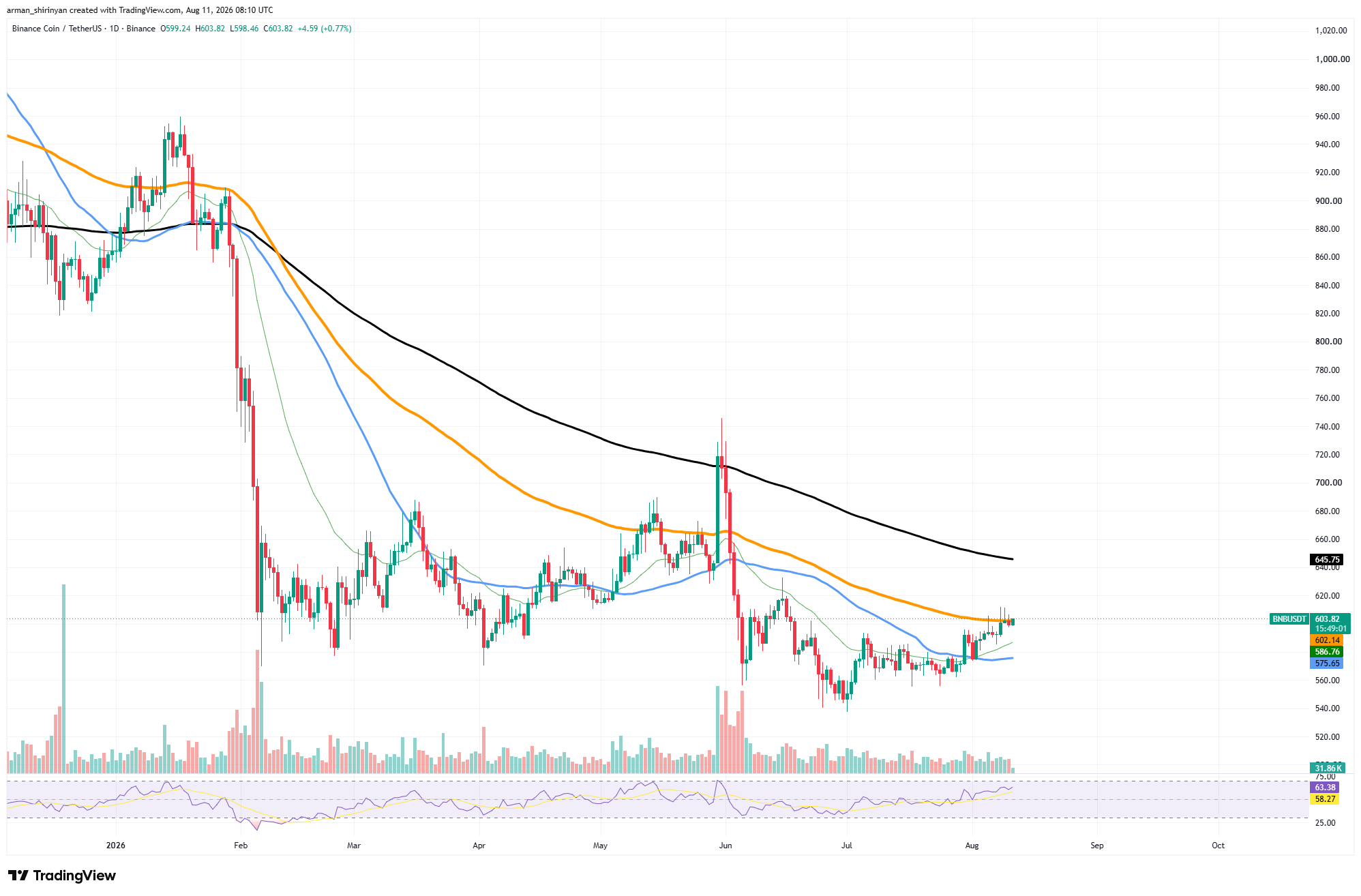
They are signed, broadcast, and compared to consensus rules by validators; full verification takes place later. This reduces the validator overhead on the critical path from 125 milliseconds to just 15 milliseconds, giving builders an additional 100 milliseconds to pack transactions, according to BSC's testing.
Significant outcomes were obtained on QANet, an internal testnet created to replicate BSC's cross-region validator topology. While both configurations kept the same 450 ms block interval and 100 million gas limit, throughput increased by 88% from 1,237 TPS to 2,324 TPS. While the median utilization rose from just 29.49 million to 98.99 million, the average block gas utilization increased from 46.35 million to 84.15 million.
Adopting BEP-675
Crucially, the measured finality lag was not increased by the additional throughput. In both setups, P99 finality stayed at one or two blocks. Therefore, rather than increasing the theoretical limits of BSC, the improvement primarily comes from making better use of the current block capacity.
Because builders ran out of time to pack, about 25% of the blocks could arrive almost empty under the previous system. The majority of tested blocks were able to approach the gas ceiling thanks to BEP-675. Adopting BEP-675 requires builders to run full nodes instead of fastnodes, and managing several competing bids becomes more challenging.
Even though they have less time to construct blocks, legacy bids will still be supported. There are no significant interface changes for regular BSC users. The possible advantage is that each 450 ms block can accommodate more transactions. Alongside FOCIL and Block-Level Access Lists, BEP-675 is a component of BSC's larger H2 2026 scaling roadmap.

 crypto.news
 en.cryptonomist.ch