


 3
3
Asset manager Bitwise has entered the tokenization market, taking over management of the Bitwise Crypto Carry Fund (USCC), a $259 million fund and the first on-chain product in the structure's history. Interestingly, $XRP was included in the basket of the fund's underlying assets on absolutely equal terms with BTC, ETH and SOL.
Commenting on the launch, Bitwise CEO Hunter Horsley confirmed the fund's on-chain launch and reported its first results: AUM exceeded $250 million, while the current 30-day yield remains at around 4% annualized.
Bitwise deploys $XRP into on-chain DeFi
Unlike traditional models, the fund does not bet on price appreciation. Instead, profit is extracted from market inefficiency through a basis trade strategy: USCC buys spot assets and simultaneously shorts futures on them. In this way, the product generates yield from the price difference, or basis, completely ignoring the direction of the trend.
Bitwise's first tokenized fund is now live: USCC, the Bitwise Crypto Carry Fund.
— Hunter Horsley (@HHorsley) June 1, 2026
~4% 30-day yield. >$250M AUM. Can be used on Aave Horizon and Kamino.
Launched by Superstate and tokenized on the FundOS platform.
Check it out — https://t.co/Ji4q6Iwc3Y
The main hook for institutions is the elimination of the "dead capital" problem, as the fund's shares are tokenized on Superstate's FundOS platform. This turns USCC shares into liquid overcollateral that is already accepted by DeFi heavyweights Aave Horizon, Kamino and Morpho.
Large players get a combo: capital generates yield inside the fund, while stablecoins can be instantly extracted against it as collateral for other deals.
While tokenized USCC is gaining traction on on-chain protocols, liquidity is being pumped on the NYSE by spot Bitwise ETFs, including the $XRP one. As of this writing, its net assets stand at $343.58 million with a share price of $14.25, while cumulative net inflows have reached $471.17 million.
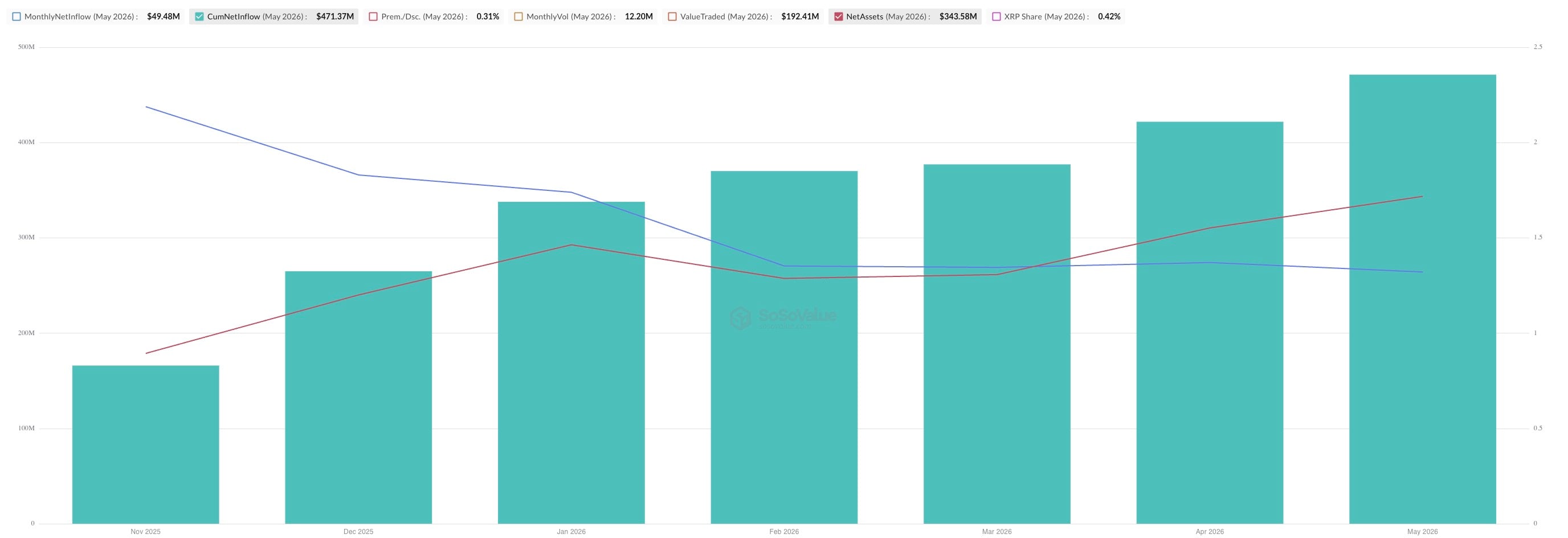
In the context of existing products, USCC effectively doubles the brand's presence by creating two independent gateways: the ETF collects classic Wall Street money, while the new fund packages institutional capital into DeFi.
Importantly, the product is closed to retail investors, and fund shares are distributed through a private placement. This means the fund is available only to qualified investors, is not registered with the SEC, and its managers openly warn that achieving the investment objectives is not guaranteed.

 cryptobriefing.com

 cryptopolitan.com
 cryptonews.net
 1
1