



 3
3
The crypto market links Bitcoin's current decline to Middle East tensions and the sale of part of the holdings by Michael Saylor and Strategy. However, Into The Cryptoverse founder Benjamin Cowen is convinced that external factors merely mask mathematical patterns.
While critics call the theory of 4-year cycles outdated, the reality of 2026 for Cowen is repeating historical patterns with week-level precision, characterizing June as a period of hidden price weakening.
Anatomy of a fakeout
The current macrostructure of the chart is developing strictly according to the historical scenario, as the cycle peak at $126,200 was recorded in October 2025, exactly on day 1,162 from the absolute bottom, which perfectly matches the timing of previous years. The subsequent decline at the beginning of the year, with January down 10.1% and February down 14.8%, was replaced by a deceptive spring rally in March and April of 12%.
However, Bitcoin still failed to consolidate above the key 200-day simple moving average. This countertrend move lasted only 16 weeks, fully fitting within the framework of the classic "dead cat bounce" of 15 to 25 weeks before another wave of decline toward the real bottom.
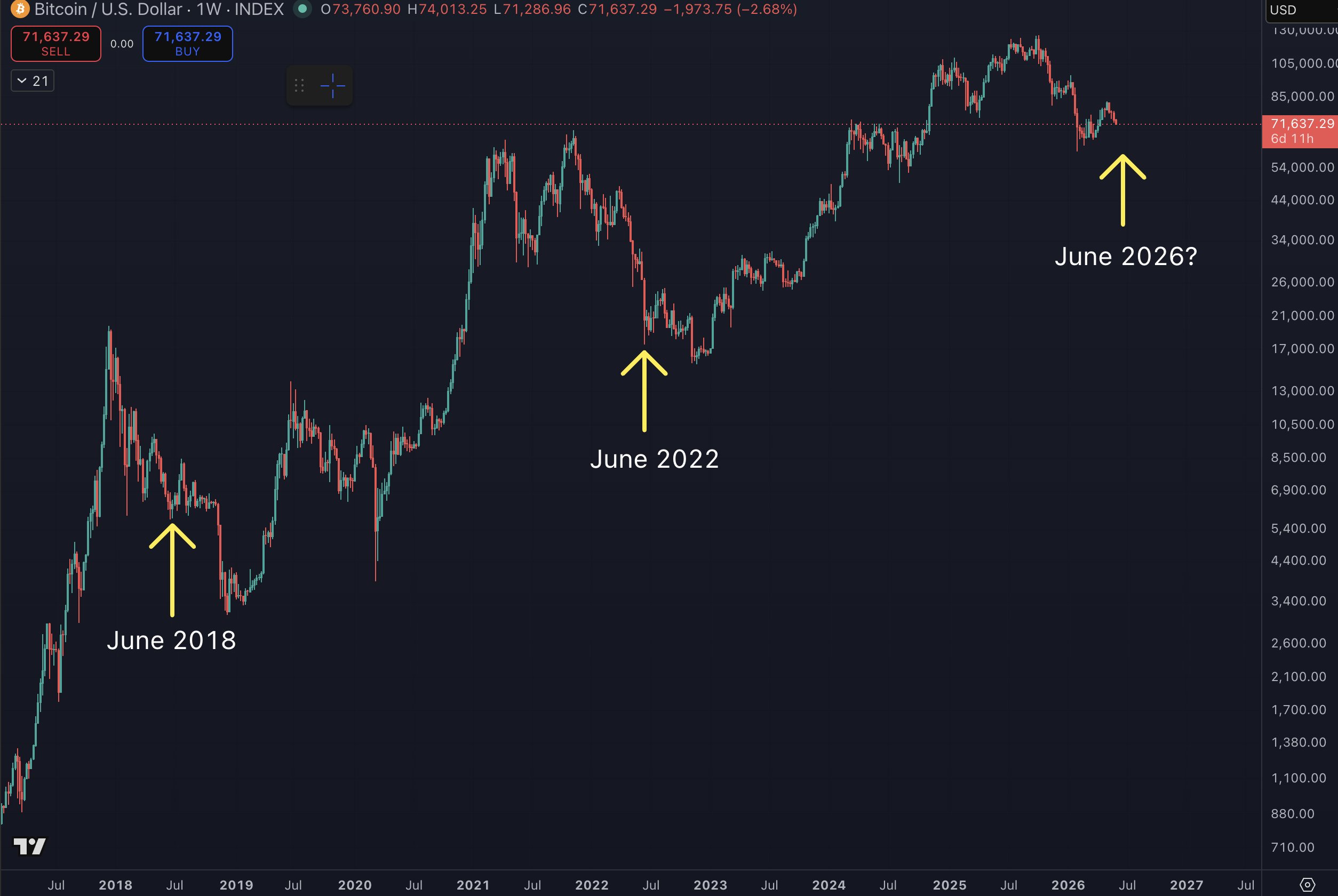
Optimists have an argument: the average June return of 6.91%. However, even this breaks against historical facts. CryptoRank heatmap data proves that this figure is artificially inflated by anomalies from bull years such as 2011, with 85.3%, or 2019, with 27.1%.
During periods of cyclical correction after reaching a global peak, June has invariably closed with a decline.
Where could the true bottom potentially form?
June in U.S. midterm election years is a traditional window of weakness for digital assets, Cowen emphasizes. From this, the current decline in trading volumes combined with negative fundamentals points to a high probability of breaking the February local low at $60,000.
According to the cyclical ROI model, the depressed summer will be followed by a traditionally difficult September. The historically protected, final bottom of the current 4-year cycle is expected only in October to November 2026.
By that point, according to statistics from previous years, Bitcoin will fully exhaust its downside potential and form a launchpad for the next global uptrend.

 news.bitcoin.com
 coindesk.com
 thecryptobasic.com
 coingape.com