



 7
7
Bitcoin’s rebound is running into a demand problem.
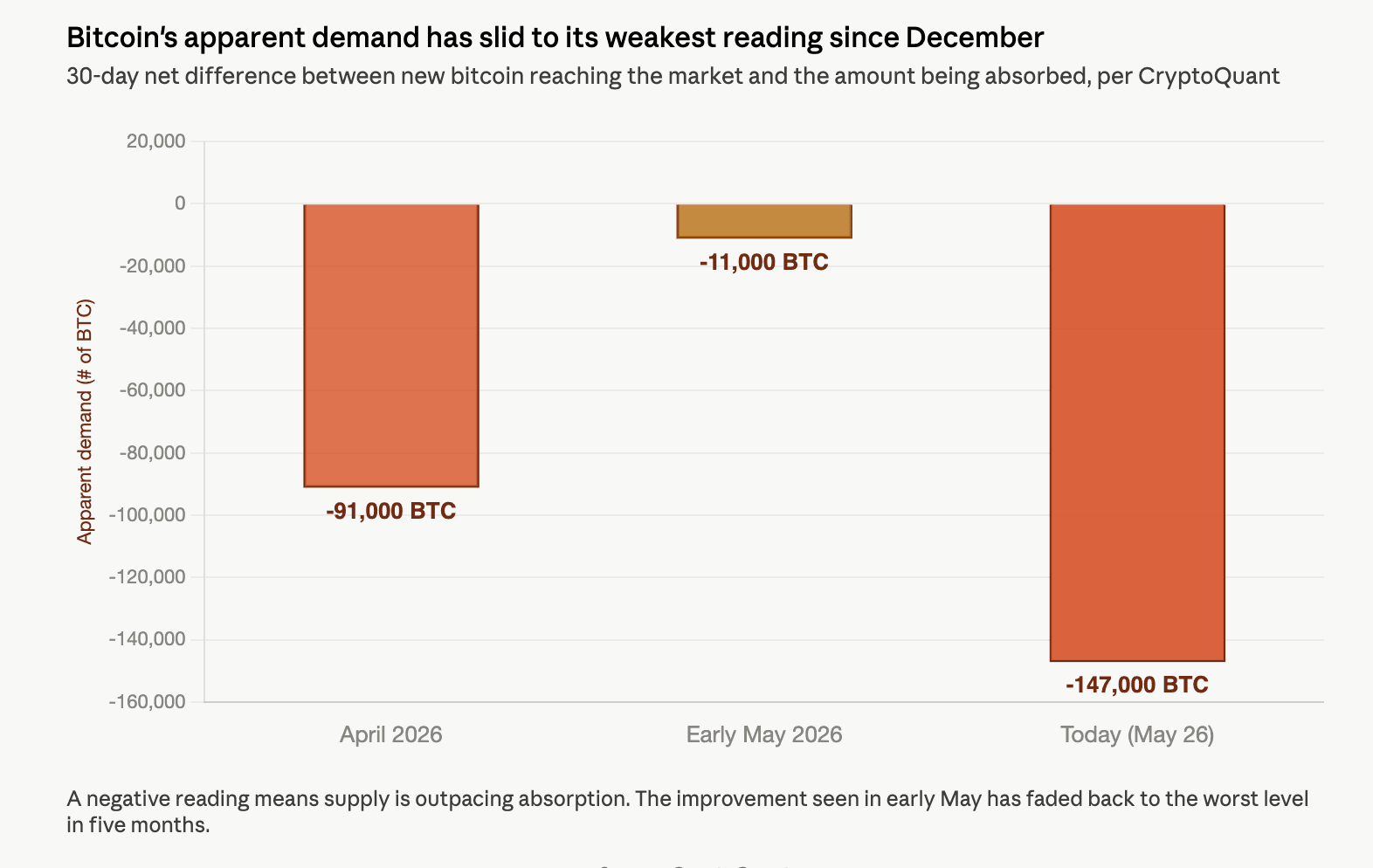
CryptoQuant’s 30-day apparent demand metric has fallen to minus 147,000 $BTC, its weakest reading since December 2025, even as bitcoin holds in the mid-$70,000s after bouncing from its April lows near $65,000.
The metric compares new miner supply and older coins returning to circulation with the amount of bitcoin the market is absorbing. A positive reading means buyers are taking down new and reactivated supply, while a negative reading means more coins are coming to market than buyers are absorbing on-chain.
The latter is the issue with the current rally.
Bitcoin has recovered sharply from April, but the move has not yet produced the kind of spot demand that usually supports a more durable uptrend. Earlier this month, data showed apparent demand had improved from -91,000 $BTC in April to roughly -11,000 $BTC, close to balance. The latest slide back toward -147,000 $BTC suggests that improvement has faded.
Other signals have been suggesting the same. The Coinbase Premium has stayed negative since late April, showing U.S. spot buyers have been less aggressive than offshore traders.
It means futures market buyers have largely led the price bounce from $65,000. It matters because futures-led rallies are easier to unwind. Perpetual positions can close quickly when funding shifts or liquidations start. Spot accumulation is usually stickier because buyers put up full capital and take actual $BTC, making that demand less likely to disappear on the first pullback.
None of this means bitcoin has to break lower immediately. Weak demand can sit under a range for days or weeks. But it does make the market more dependent on fresh spot buying if bulls want to push beyond the current zone.
If that bid does not show up, the $70,000 area remains the level to watch. CryptoQuant identifies it as the short-term trader realized price, where recent buyers’ paper gains largely disappear, and the incentive to take profit starts to fade.


 u.today
 ambcrypto.com