



 8
8
Is the global financial system heading toward a breaking point?
So far in 2026, markets have repeatedly raised the possibility of a 2008-style crash. Based on current macro data, this is no longer just a theory. The main driver behind this narrative is rising borrowing costs.
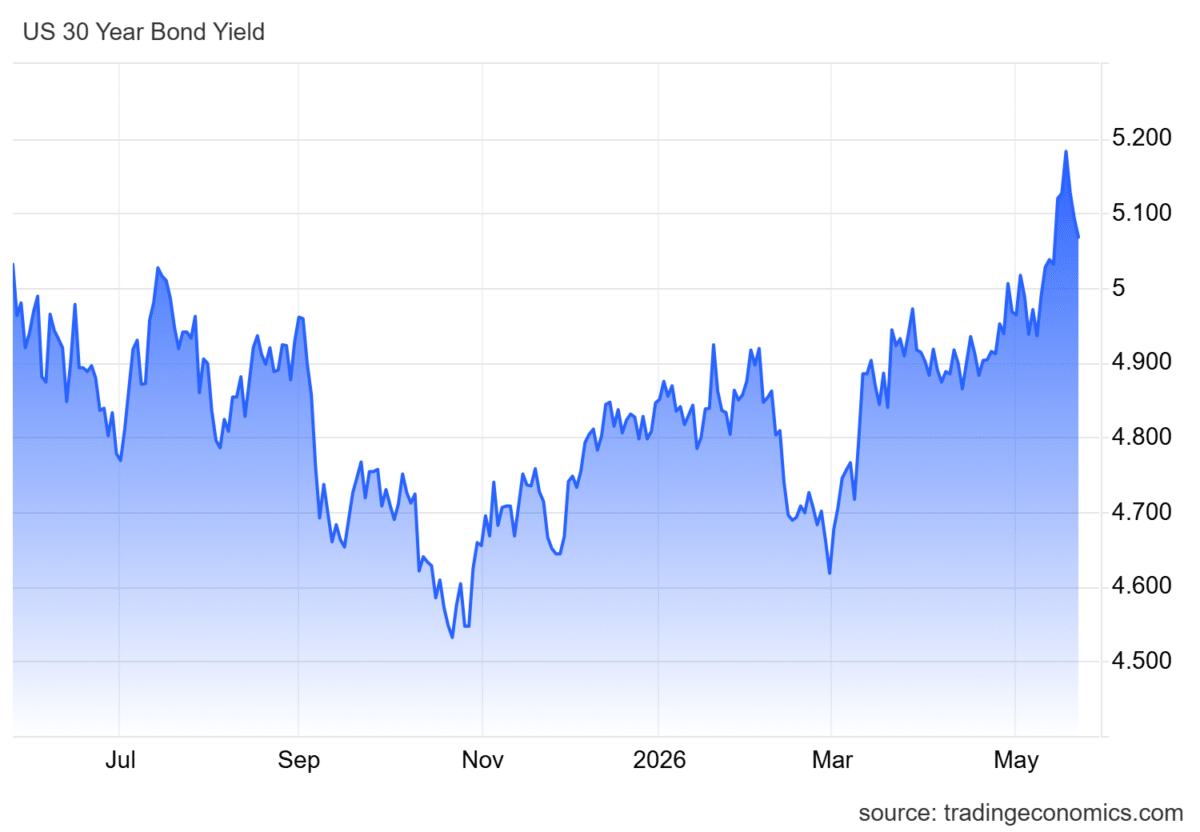
Sovereign debt markets are under clear pressure. The 30-year U.S. Treasury yield has moved above 5.14%, while Japan’s 10-year government yield has climbed to 2.80%. Together, these moves are tightening global liquidity. Yet, in this setup, some in the market are viewing it as a potential trigger for a Bitcoin [$BTC] supercycle.
The key question is, why would this be bullish for $BTC?
Notably, it comes down to rising debt and spending. The U.S. is now above $39 trillion in debt, while Treasury demand is weakening. At the same time, massive AI infrastructure spending is driving up demand for energy, chips, and materials, adding structural inflation pressure. In fact, recent reports suggest around $725 billion could be spent on AI infrastructure in 2026 alone, reinforcing that trend.
Against this backdrop, rising yields are putting government borrowing under pressure. With debt already at elevated levels, higher interest costs make it harder for the government to keep financing at the same pace. Naturally, this also puts pressure on the Federal Reserve, increasing uncertainty around further rate hikes.
Accordingly, some analysts view this as a potential trigger for Bitcoin’s supercycle.
$BTC’s short-term volatility vs. long-term liquidity
For the Bitcoin supercycle, separating short-term noise from long-term reality is key.
When bond yields spike, funds often lose money and are forced to sell assets, including Bitcoin. Since many investors still see Bitcoin as a risk asset, it usually drops with stocks during panic selling, leading to sharp short-term moves. But over the long term, this is often considered part of Bitcoin’s broader liquidity-driven cycle.
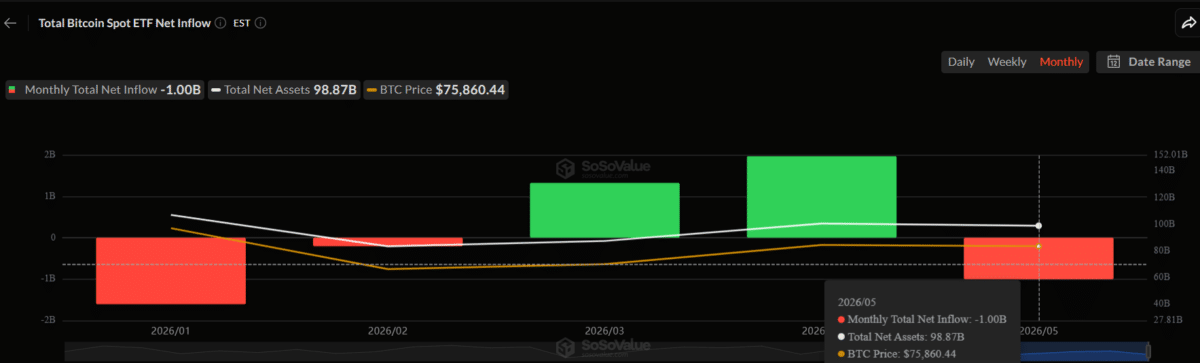
Reinforcing this trend, Bitcoin ETFs have seen over $1 billion in outflows this month alone. This marks the weakest ETF performance since Q1 2026. As a result, institutional funds are seeing their valuations come under pressure, which is also reflecting on their balance sheets. However, this is exactly where the market sees a potential setup for a Bitcoin supercycle.
More broadly, the macro picture is leaning in that direction.
As mentioned above, if financial stress keeps building, central banks may eventually be forced to step back in with liquidity to stabilize markets. In this context, $BTC’s ongoing pullbacks are not “$BTC-specific.” Instead, they are being driven by the broader macro setup, potentially creating an opportunity window.
For traders, the idea is straightforward: Don’t panic during volatility, stay patient through drawdowns, and focus on accumulating during weakness as conditions start to resemble a textbook Bitcoin supercycle.
Final Summary
- Rising debt, higher yields, and weak liquidity are causing short-term Bitcoin selling and ETF outflows.
- Some see this stress as long-term bullish, as future liquidity support could fuel a Bitcoin supercycle.

 en.bitcoinsistemi.com
 1
1
 coindesk.com

