

 1
1

 5
5
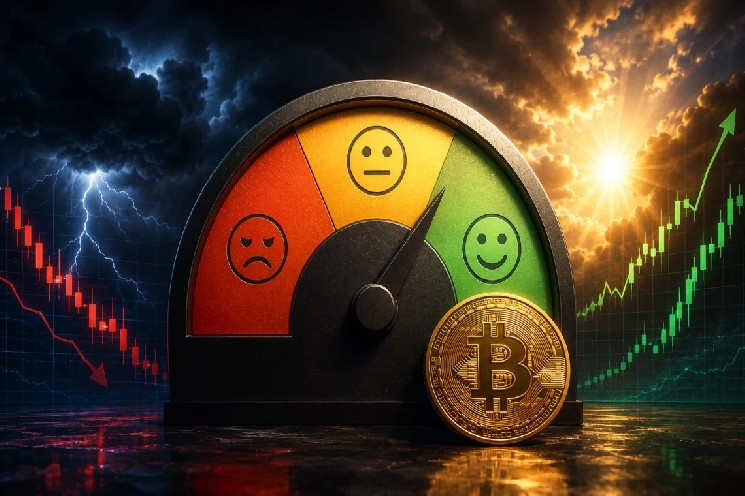
The so-called Fear & Greed Index is used to get an idea of the sentiment in the Bitcoin market.
It is often used to understand what the attitude of retail investors towards the crypto market is at any given time, but sometimes it provides conflicting data.
The current one seems to be one of those moments in which the data from the Fear & Greed Index appear to be at odds with reality.
The two Fear & Greed Indexes
First of all, it should be said that there are at least two Fear & Greed Indexes for Bitcoin.
In fact, there is also a much more “ancient” one, created in 2012 by what was then CNNMoney (now CNN Business), which was used to monitor stock market sentiment.
In this case, however, we will specifically analyze only the Fear & Greed Index of the Bitcoin market, which is also used as a sort of thermometer for the entire crypto market.
The original Fear & Greed Index on Bitcoin is the one by Alternative, created in 2018, in the middle of the crypto bear market.
This is a historical index that tends to be particularly volatile. It is true that retail sentiment in the Bitcoin market is volatile, but since retail investors are no longer the main players in this market, such volatility can sometimes be misleading.
In 2023 another similar one was created by CoinMarketCap. The latter turns out to be a bit less volatile, and therefore perhaps slightly more useful for analysis.
The conflicting data
The Fear & Greed Index is a daily figure that is calculated after the close of the day. Therefore, the figure published today actually refers to yesterday, while today’s figure will only be published tomorrow.
On Alternative, today’s figure is 47, while yesterday it was 46.
On CMC, however, today it is at 50, just like yesterday.
The main difference, however, is in Monday’s data (referring to Sunday), when on Alternative it was 40, while on CMC it was 47.
The fact is that these Alternative figures measure a slightly negative sentiment, almost at the beginning of the fear zone, while those from CMC measure an absolutely neutral sentiment.
Who is right?
By analyzing price trends, it would seem that CMC is right, because there has been no fear in the Bitcoin market for several days now.
In fact, according to CMC’s Fear & Greed Index, fear has disappeared from the Bitcoin market since shortly before mid-April, while according to Alternative’s index there was still fear on April 30.
This discrepancy is probably due to the fact that the index calculated by Alternative uses a less sophisticated, and therefore more volatile, algorithm, while the one by CMC uses a more complex algorithm that mitigates extremes.
The real market sentiment
In truth, by observing both the price trend of Bitcoin and, for example, that of Ethereum, what one perceives is a widespread positive sentiment, albeit only faintly so.
The problem is that one should distinguish retail sentiment from that of the whales, because retail investors are certainly the majority, and therefore inevitably end up weighing heavily in the calculation of this index, but these markets are now mainly driven by the capital moved by the whales.
Institutional whales also do not use sentiment at all to develop their investment or trading strategies, so the Bitcoin Fear & Greed Index is now a figure that should be taken with a grain of salt.
In moments like this, when there are very few retail investors operating in the crypto market with significant capital, analyzing their market sentiment is not particularly interesting.
On the other hand, institutional whales, which dominate this market at this time, do not have a real sentiment, and they do not think in this way.
The usefulness of the discrepancy
However, there can be some usefulness in analyzing such discrepancies.
In particular, when the market dominated by institutional whales seems to have a different sentiment from that of retail investors, perhaps something is brewing.
The point is that institutional whales mainly buy when there is fear, because this means that prices are low. Retail investors, on the other hand, tend to sell when they are afraid, and this is exactly what whales need in order to buy at low prices.
Conversely, when there is euphoria (or greed), retail investors start buying, with whales taking advantage of this to sell at high prices.
Therefore, if at a given moment retail sentiment is negative but whales are buying, it could mean that prices are low enough to be interesting for purchases, while conversely, when retail sentiment is positive, if whales are selling instead, it could mean that prices are high enough to be interesting for cashing in on previous purchases.
For example, the fact that the current sentiment of retail investors is neutral, or slightly negative, could prove useful if it were discovered that whales are buying.

 coinpedia.org


 coinedition.com
 cointelegraph.com
 newsbtc.com