



 2
2
Stellar is gaining attention from financial-infrastructure experiments as $XLM trades near $0.194. Nuvanté Technologies built a stablecoin clearing prototype on the Stellar network and integrated it with the Bank of England’s RTGS test environment. The prototype tested stablecoin clearing and settlement flows against the central bank infrastructure, while Stellar is preparing for its Protocol 28 upgrade vote on September 16. The two developments put Stellar’s settlement infrastructure and Soroban capabilities under focus as $XLM approaches $0.20.
Bank of England RTGS Test Puts Stellar’s Settlement Capabilities to Work
Nuvanté Technologies used Stellar to build a prototype for stablecoin clearing, testing the system within the Bank of England’s RTGS Synchronisation Lab. The setup examined digital-money flows involving stablecoin-to-stablecoin and stablecoin-to-fiat issuance, redemption and exchange.
The relevant development is the technical integration: Stellar was used as the blockchain infrastructure in a prototype designed to interact with a central-bank settlement environment. The use case also aligns with Stellar’s existing focus on stablecoins, tokenized assets and cross-border settlement, giving the network another institutional reference point beyond cryptocurrency trading.
Protocol 28 Vote Sets September 16 Deadline for Soroban Upgrade
Stellar validators are scheduled to vote on Protocol 28, known as “Adapter,” on September 16. The release contains three technical proposals focused on network performance and Soroban smart-contract operations.
⚙️ STELLAR $XLM IS UPGRADING FOR WHAT COMES NEXT
— Hailey LUNC XRP (@TheMoonHailey) September 14, 2026
Most people watch $XLM
Developers are watching something else.
⚙️ Protocol 28 – “Adapter” – is coming to mainnet, with the upgrade vote scheduled for September 16.
The goal?
Make Soroban contracts easier to upgrade, safer to… https://t.co/kWLz5BxCCo pic.twitter.com/yplLpUaJaB
$CAP-83 changes transaction-set propagation behavior to improve consensus performance when transaction data arrives slowly. $CAP-85 introduces externally managed contract executables, allowing multiple Soroban contracts to reference common executable code for coordinated upgrades. $CAP-86 adds functions designed to make contract-data migrations easier when application schemas change. The upgrade targets developer infrastructure rather than introducing a new token feature. Its focus is reducing the operational burden of maintaining and upgrading Soroban contracts as applications become more complex.
$XLM Price Analysis: Can Bulls Sustain Above $0.20?
$XLM is trading near $0.194 at press time, approaching a descending trendline that has capped the market since the June rally. The token has recovered from its August decline and is now testing the $0.195–$0.20 resistance area. A daily close above $0.20 would break the immediate trendline resistance and expose $0.22 as the next hurdle. A stronger continuation above that level would bring the $0.26–$0.28 resistance zone into focus.
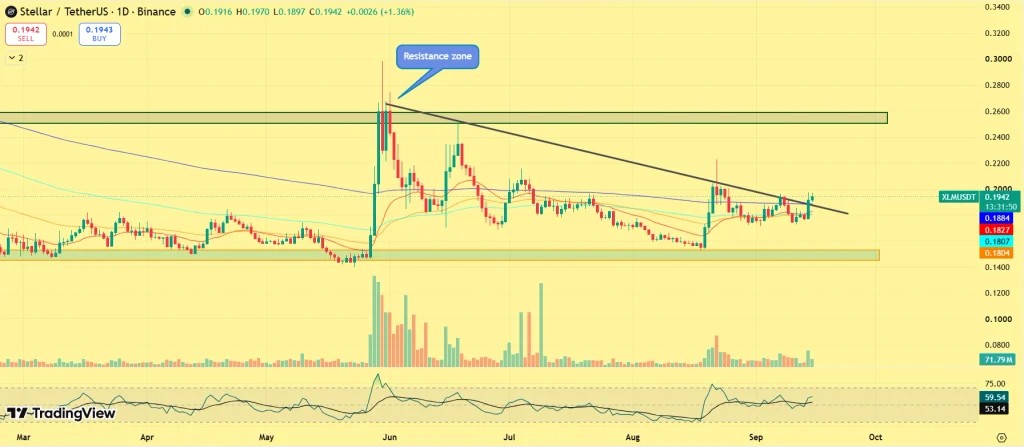
The RSI is around 59, indicating improving momentum without an overbought reading. On the downside, $0.182–$0.188 forms the nearest support cluster. A daily close below that region would weaken the recovery and shift attention back toward the lower trading range.
Final Words
The Bank of England test provides a concrete institutional use case for Stellar’s settlement infrastructure, while Protocol 28 targets the network’s ability to maintain and scale Soroban-based applications. Neither development guarantees additional demand for $XLM, so price confirmation remains essential.

 thecryptobasic.com


 finbold.com