


 4
4
Robinhood Markets’ [NASDAQ: HOOD] shares extended their decline after the company reported record second-quarter revenue and earnings that beat Wall Street expectations.
While the headline figures appeared strong, investors looked beyond the top-line results.
A one-off accounting gain boosted earnings, operating expenses climbed sharply, and crypto trading revenue continued to weaken, leaving the market questioning the quality of the quarter despite record revenue.
Investors looked past the headline earnings beat
Robinhood reported record quarterly revenue of $1.31 billion, up 32% year over year and ahead of analyst expectations.
Diluted earnings per share rose 48% to $0.62, while net income reached $573 million. The company also attracted $21.7 billion in net deposits and increased its Gold subscriber base to 4.8 million.
However, part of the earnings beat came from a $129 million gain, largely related to the deconsolidation of Robinhood Ventures Fund I.
The gain contributed approximately $0.14 to diluted earnings per share. Excluding that item, adjusted EPS would have been closer to $0.48.
That still exceeded the $0.44 consensus estimate cited by Reuters. Still, the margin of the beat was considerably smaller than the headline result suggested.
Investors also focused on rising costs.
Total operating expenses increased 33% year over year to $734 million, reflecting higher investment spending, restructuring charges, and costs associated with expanding the company’s product portfolio.
Crypto trading continues to slow
Robinhood’s crypto business also remained under pressure during the quarter.
Crypto transaction revenue fell 38% year over year to $100 million, while crypto trading volume on the Robinhood app declined 35% to $18 billion.
Following the Bitstamp acquisition, the company recorded an additional $22 billion in crypto trading volume, bringing combined quarterly volume to $40 billion.
Even so, crypto contributed less revenue than some of Robinhood’s newer businesses.
Revenue from event contracts surged more than tenfold to $156 million, overtaking both crypto revenue and equity transaction revenue for the quarter.
The results suggest Robinhood’s business is becoming more diversified. However, the continued slowdown in crypto trading remains an area investors are likely to monitor closely.
Can HOOD stock hold $86?
From a technical perspective, HOOD remains under pressure after falling from its July high near $119.
The stock traded around $87.58, below both its 50-period EMA [$96.98] and 100-period EMA [$93.89], indicating sellers continue to control the short-term trend.
Meanwhile, the Relative Strength Index [RSI] fell to 36.76, suggesting bearish momentum remains intact. However, the stock has yet to enter oversold territory.
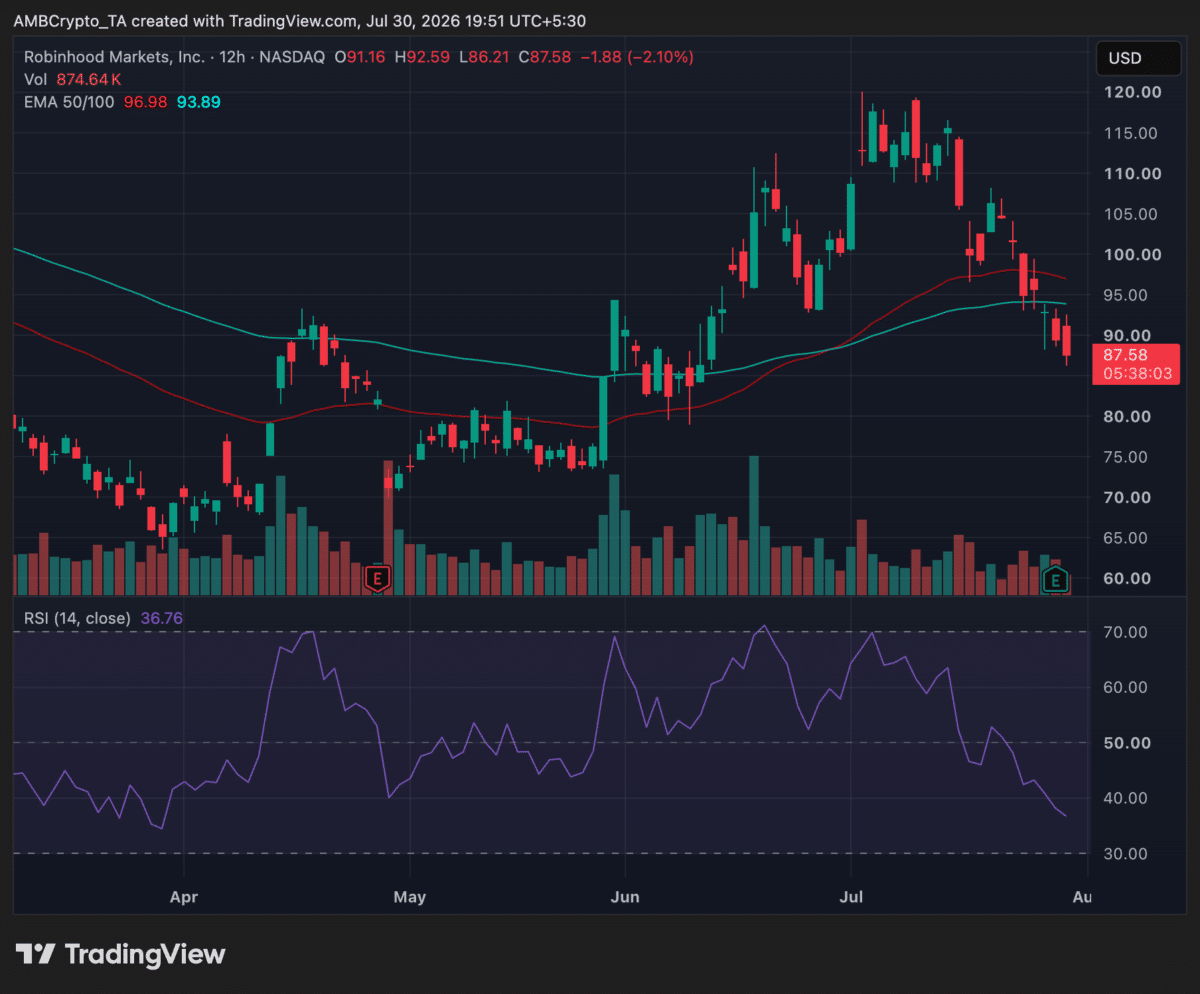
The first major support sits near $86.
If that level fails, sellers could target $84, followed by the psychological $80 level.
For sentiment to improve, HOOD would first need to reclaim $90 before challenging resistance around $94.
Final Summary
- Robinhood delivered record revenue and another earnings beat. Still, investors focused on the quality of earnings, rising costs and slowing crypto activity rather than the headline numbers.
- Holding $86 could stabilize the recent pullback. At the same time, a break below that level would increase the risk of a move towards $84 and potentially $80.

 coinpedia.org
 beincrypto.com