



 29
29
Cardano is sitting on one of the most interesting paradoxes in crypto right now — a credible ETF timeline building overhead, and a price chart that hasn’t noticed yet.
CME $ADA futures went live on February 9, 2026 — starting the mandatory six-month regulated futures clock required before a spot ETF can be approved under the SEC’s new generic listing standards framework.
The clock is ticking. The market, for the most part, is still asleep.
The ETF Timeline Is More Concrete Than Most Realise
August 9, 2026 is the date $ADA becomes eligible for the streamlined ETF approval process.
If Grayscale or NYSE Arca activates its filing on that date, the SEC has a maximum 75-day review window — putting a final decision deadline at October 23, 2026.
Firms like Bitwise and Canary Capital are also pushing for Cardano ETFs, meaning late 2026 could see multiple $ADA ETF launches simultaneously.
Grayscale has already increased $ADA’s allocation inside its Smart Contract Fund — from 17.96% to 18.33% — while reducing Ethereum exposure.
The Leios Public Testnet is scheduled for June 2026, targeting over 1,000 transactions per second.
The Midnight Mainnet — Cardano’s privacy-focused sidechain for confidential smart contracts — is also set for Q2 2026. The development pipeline is real.
The institutional positioning is happening. The price just hasn’t followed — yet.
The six-month mark doesn’t trigger automatic approvals. It opens a window where exchanges can list spot $ADA trusts under generic standards without filing separate rule changes.
Issuers still need effective S-1 registrations. The real tell between now and August 9 is whether spot $ADA ETF S-1 filings start appearing — signalling that issuers are lining up to launch the moment the threshold clears.
The Charts Tell a Story of Waiting
ADAUSD (Weekly): As of May 10, 2026 (05:45 UTC), $ADA trades at $0.2701, down -0.33% on the week. The MACD histogram has turned green and is expanding — an early bullish momentum shift from deeply negative territory.
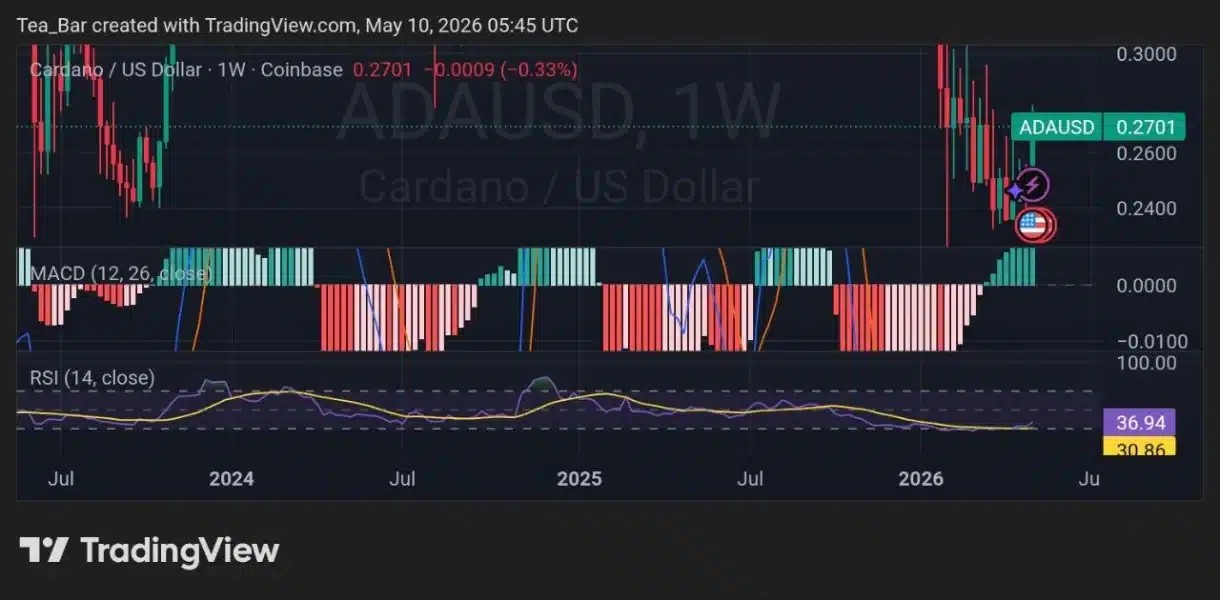
The MACD and signal lines are crossing upward. Every prior $ADA recovery has started with exactly this pattern.
The RSI at 36.94 is approaching oversold territory, while the RSI signal at 30.86 is at a level that has historically marked $ADA’s most significant accumulation zones.
The $0.26 horizontal support has held. The $0.28–$0.30 zone is the next resistance cluster — heavy liquidation data sits there, and a break above it could accelerate the move sharply.
ADABTC (Weekly): Against Bitcoin as of May 10, 2026 (05:45 UTC), $ADA sits at 0.00000335 — far from its cycle high of 0.00001587.
The RSI at 31.94 is nearing the 30 level that has preceded $ADA’s most explosive $BTC-relative recoveries.
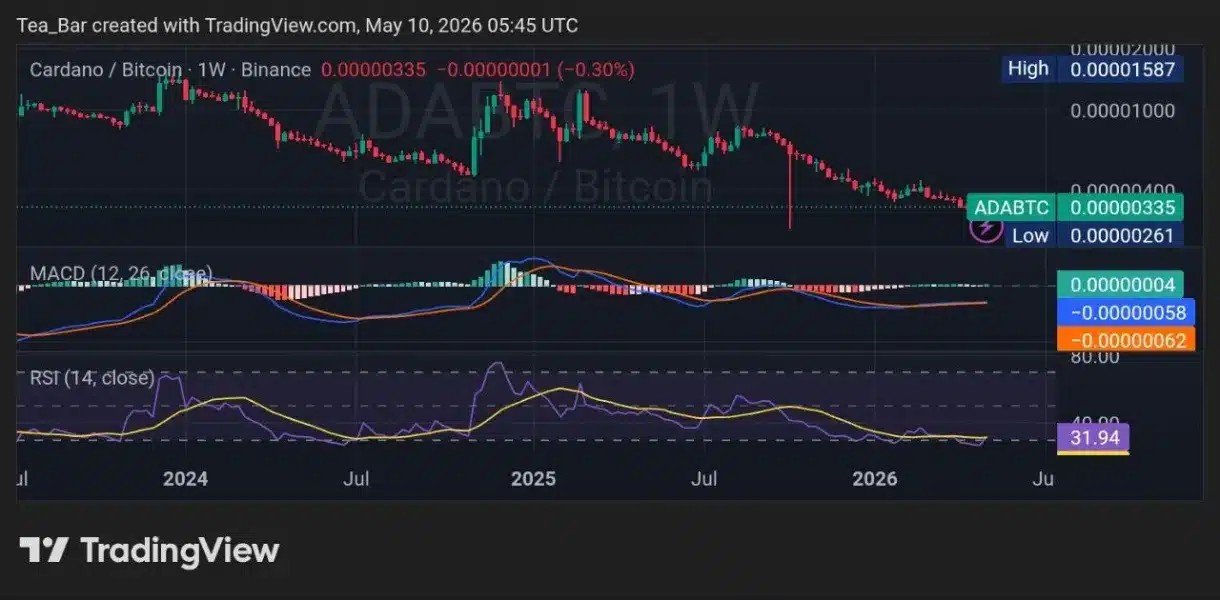
The MACD lines at +0.00000004 and -0.00000058 are compressing near zero. The histogram is tightening.
That kind of near-zero MACD compression, at an RSI this low on the $BTC pair, is the technical setup that has historically come just before $ADA outperforms Bitcoin significantly.
So Why Isn’t the Price Moving?
The Cardano community is split. A vocal segment points to slow adoption and questions whether the technology will ever reach mainstream use.
Another camp cites the ETF timeline, the governance hard fork, and the Leios scaling upgrade as the foundation of a strong recovery narrative.
Both sides are watching the same chart. The ETF window opens in 89 days. Whether the price starts pricing that in before or after August 9 may be the most important question $ADA holders have right now.
Disclaimer:
This article is for informational purposes only and does not constitute financial, investment, or trading advice. The views expressed are based on publicly available data, market observations, and the author’s interpretation at the time of writing. Cryptocurrency markets are highly volatile and unpredictable, and past performance or current technical setups do not guarantee future results. Readers should conduct their own research and consult with a qualified financial advisor before making any investment decisions. TechGaged does not accept liability for any losses incurred based on the information presented.

 en.bitcoinsistemi.com

 u.today


 finbold.com
 coinpedia.org