

 1
1


 22
22
Against the backdrop of unsatisfactory sentiment among retail investors, the $XRP Ledger (XRPL) ecosystem is showing atypical and rapid growth in institutional metrics. Fresh on-chain data from analytics platforms Artemis and RWA.xyz confirm that Ripple's network has effectively occupied the niche of private B2B clearing and real-world asset (RWA) tokenization.
This process has nothing to do with the usual cryptocurrency hype, as through on-chain statistics, three strong reasons emerge for why $XRP has become the token that large businesses are watching right now.
3 reasons why Wall Street is watching $XRP
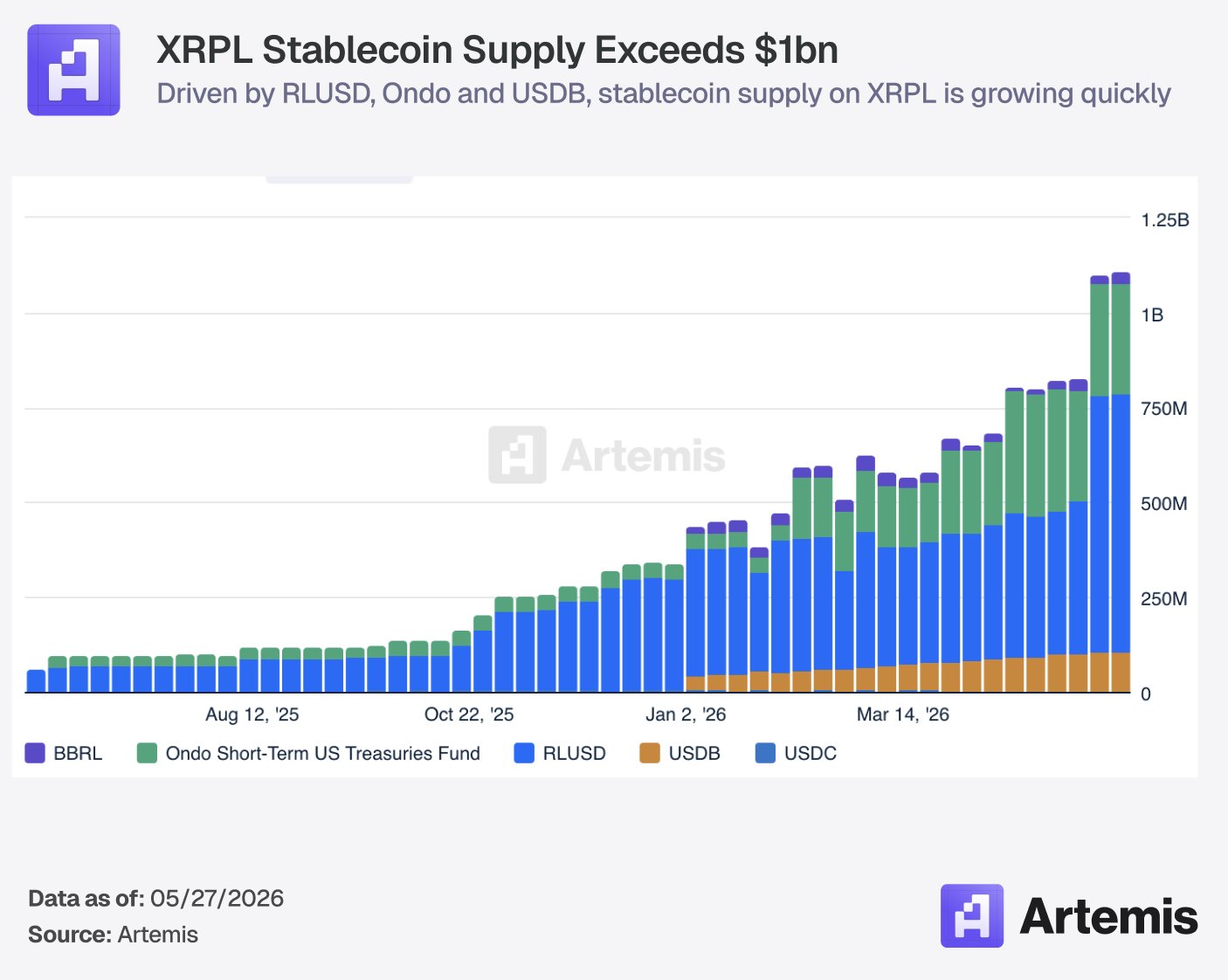
The first serious signal for the market was the crossing of a historic threshold, when the total volume of stablecoins on Ripple's network officially surpassed the $1 billion mark. In the past 30 days alone, stablecoin capitalization in the public XRPL environment jumped by 63.72%, reaching $823.24 million.
This powerful inflow of liquidity was driven by the launch of the company's own stablecoin, RLUSD, and the integration of Ondo Finance's short-term U.S. Treasury fund, which now holds more than $294 million on the network's balance sheet.
But the real depth of this process is revealed in the private corporate sector, where Ripple is winning the market share in interbank accounting. While most blockchains compete for the number of active users, XRPL's key volume is generated by major players using the network as isolated infrastructure for balance reconciliation. The indicator for these private corporate assets rose by 13.77% over the month, exceeding $4 billion in total.
Notably, this entire volume is distributed across only 85 large addresses, whose number jumped by 193% in a month. In addition to U.S. Treasuries from Guggenheim at $40.3 million and OpenEden at $39.6 million, these accounts are now also processing transactions involving tokenized Dubai real estate under the supervision of the emirate's Land Department.
Against this background, it is not surprising that Wall Street followed real business, and U.S. spot ETFs began actively buying available $XRP supply from the open market. After full stagnation in the first quarter, investment funds resumed purchases and accumulated between 1% and 1.25% of the asset's total market issuance.
In percentage terms, the depth of institutional $XRP accumulation through ETF wrappers now officially exceeds the comparable figures for the Solana (SOL) blockchain. Large investors are clearly giving preference to $XRP because of its understandable legal status and the direct integration of its technology into the banking sector, making this asset one of the most backed by real demand at the current stage.
However, the $XRP price is still reacting weakly to the success of its ecosystem, leaving open the main market question of when this massive corporate foundation will finally be reflected in it.

 crypto.news
 thecryptobasic.com
 coinpedia.org