


 13
13
In brief
- Air-gapped wallets never connect directly to the internet or wireless networks, helping protect private keys from online attacks.
- One such hardware wallet maker, Coldcard, recently fell victim to a massive exploit leading to over $114 million in user losses.
- While air-gapped wallets offer some of the strongest protection available for self-custody, they're not immune from threats. Here's why.
If you've spent any time around cryptocurrency, you've probably heard the saying, "Not your keys, not your coins." The phrase reflects the idea that whoever controls a wallet's private keys ultimately controls the crypto inside it.
An air-gapped wallet takes that philosophy a step further by keeping those private keys completely isolated from the internet. These wallets are designed to be essentially the highest level of security an individual crypto holder can get—which is what makes the Coldcard fiasco, an exploit that has resulted in losses totaling $114 million in Bitcoin and counting, especially harrowing for affected users.
What is a crypto wallet?
Despite their name, cryptocurrency wallets don't actually store Bitcoin, Ethereum, or other digital assets. Instead, wallets store the public and private keys that let you access and move funds recorded on a blockchain.
A public key is similar to an account number that others can use to send crypto. A private key, on the other hand, acts like a password or digital signature that authorizes transactions. Anyone who gains access to that private key can control the assets associated with it.
Crypto wallets can come in many forms, including actual paper wallets (meaning, a printed or handwritten copy of your private key or recovery phrase), software apps, mobile wallets, and hardware devices. They can also be divided into two broad categories: custodial and non-custodial wallets.
With custodial wallets, a third party holds your private keys on your behalf. That’s the case when, say, you store your Bitcoin, Ethereum, Solana or other digital assets with Coinbase or another centralized exchange. Non-custodial wallets, also known as self-custody wallets, put the user in complete control of those keys, along with the responsibility for protecting them.
What is an air-gapped wallet?
An air-gapped wallet is a type of non-custodial wallet designed to remain completely disconnected from the internet and all wireless communication, including Wi-Fi, Bluetooth, and NFC.
The "air gap" refers to the physical separation between the wallet and online networks. Because the device never connects to the internet, it presents a much smaller target for hackers, malware, and phishing attacks.
Who makes air-gapped wallets?
Several companies build hardware wallets specifically designed to operate without a direct internet or wireless connection.
Among the best known are ELLIPAL, whose Titan wallets use QR codes instead of USB or Bluetooth; Keystone, which also relies on QR codes; Foundation Devices, maker of the Bitcoin-focused Passport wallet; Blockstream, whose Jade wallet supports fully air-gapped Bitcoin transactions using QR codes; and, yes, even Coldcard.
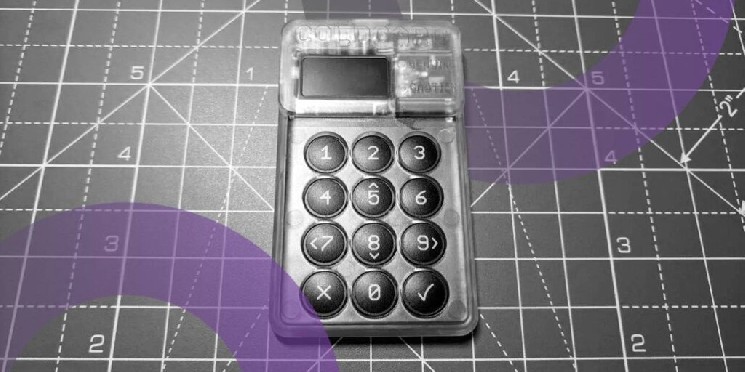
Coldcard is a Bitcoin-only wallet that supports offline signing using microSD cards and optional QR codes—and the target of a recent firmware exploit that has resulted in well over $100 million in stolen user funds so far.
While companies like Ledger and Trezor also make hardware wallets, their devices typically connect through USB or Bluetooth during normal use. Air-gapped wallets, by contrast, are designed from the outset to keep private keys isolated from the internet. But that doesn’t mean they are immune from potential exploits. As security experts have rushed to remind users recently, no option is ever 100% safe.
Are air-gapped wallets safer?
Keeping a wallet permanently offline dramatically reduces the risk of remote attacks. Malware can't directly access a wallet that never connects to the internet, and hackers can't exploit network connections that don't exist.
That doesn't mean air-gapped wallets are immune to every threat.
Users must still protect their recovery phrase, verify transaction details before signing, and keep the physical device secure. Losing the recovery phrase—or having it stolen—can permanently compromise access to a wallet. Likewise, someone with physical access to the device may still be able to attack it depending on its security features.
The tradeoff is convenience. Sending funds usually involves scanning QR codes or transferring files between devices, making the process slower than using a standard software wallet or exchange account.
A recent reminder that no wallet is perfect
Recent events have shown that even air-gapped wallets can contain critical flaws.
In late July 2026, Bitcoin hardware wallet maker Coinkite disclosed that a firmware build error introduced in March 2021 caused some Coldcard wallets to generate seed phrases from a much smaller pool of possible values than intended. That reduced the randomness protecting users' private keys, making them vulnerable to attackers who could guess them—or use AI to guess them much more quickly than they otherwise could manually.
That’s as bad as it sounds. Again, as a reminder, if someone else has your private key—either because it wasn’t secured properly, or you fell victim to a hack or scam, or because the attacker simply guessed correctly using AI or some other software—they now have control of all the funds associated with that address.
So, the difficult lesson here for security-conscious crypto holders is: while air-gapped wallets may never touch the internet, investors who use them are still relying on the maker of the hardware wallet for their individual security. And humans can still make mistakes.
Researchers at Galaxy Research said the Coldcard exploit unfolded in multiple waves, with observed losses growing from about $88 million to nearly $114 million in Bitcoin within days. The incident prompted many Coldcard users to move their Bitcoin after researchers warned that additional vulnerable addresses could still be targeted.
The breach was especially notable because Coldcard, introduced in 2017, has long been considered one of the most security-focused Bitcoin hardware wallets.
The incident highlights that keeping a wallet offline protects against many online threats, but it cannot eliminate every risk. A wallet's security also depends on the quality of its hardware, firmware, random number generation, and software development practices. An air gap is an important layer of defense—not a guarantee that a device is free from vulnerabilities.
One way to help mitigate potential risks, according to security experts, is to avoid single points of failure—meaning, don’t hold all your crypto in one place.

 protos.com

 news.bitcoin.com