



 15
15
Privacy-focused blockchain protocol Zama said it will accelerate compliance measures and proceed with its confidential $USDC launch after a US court lifted a temporary freeze on about $12.5 million in $USDC held in its cUSDC smart contract, according to a Tuesday X post by co-founder Rand Hindi.
The freeze, first reported by Cointelegraph on Saturday, stemmed from a temporary restraining order obtained in connection with an ongoing dispute involving stakeholders of an unrelated project, Overnight Finance. Circle froze the funds after receiving the court order, even though Zama was not a party to the case, according to Hindi's account.
“The same court has now lifted the freeze, determining that it was unwarranted,” Hindi wrote. He added that the protocol's cUSDC contract and all underlying $USDC had returned to normal operation.
The incident highlights tensions between privacy-focused blockchain infrastructure and centralized stablecoins whose issuers can freeze assets under court order.
Hindi argued that the episode “could have happened to any protocol holding freezable assets,” including decentralized exchanges, lending protocols and bridges.
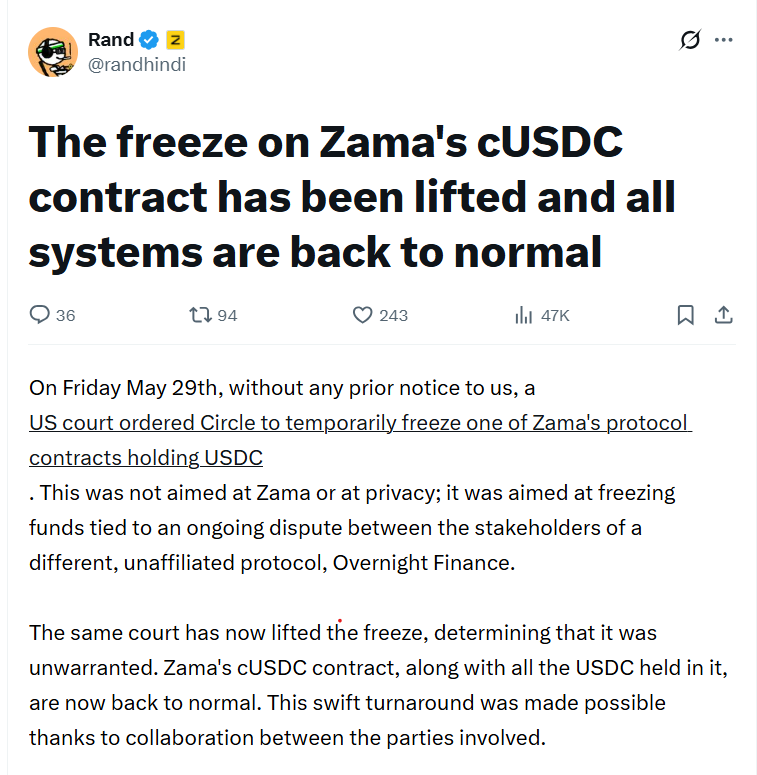
Zama $USDC freeze lifted. Source: Rand Hindi
According to Hindi, approximately $12.5 million in $USDC was deposited into Zama's confidential $USDC wrapper on May 11.
He said the deposit address later became the subject of litigation and a temporary restraining order connected to a dispute involving Overnight Finance. Because the deposit represented more than 99% of the contract's total value shielded, plaintiffs sought a blanket freeze order through Circle, he said.
Jeremy Bradley, Zama's chief operating officer, told Cointelegraph the court ultimately concluded that freezing an entire smart contract pool imposed disproportionate harm on uninvolved users. He said Zama demonstrated that, because its protocol preserves visible sender and recipient addresses while encrypting balances and amounts, the disputed account could be isolated and frozen directly without affecting other users.
Bradley said the case illustrates how protocols holding centralized stablecoins in pooled contracts may be exposed to similar risks. “Automated market makers, lending protocols, bridges, and anyone holding $USDC in a pooled contract is effectively one court order away from this exact situation,” he said.
Zama to accelerate compliance roadmap
In response, Zama said it will accelerate its compliance roadmap, including introducing automatic enforcement of compliance actions taken by underlying asset issuers.
Under the proposed framework, if Circle freezes a $USDC address, the corresponding confidential $USDC held by that address would also be frozen. The protocol also plans to establish a compliance council and integrate additional compliance and transaction-monitoring tools.
Bradley said the measures accelerate an existing roadmap rather than represent a change in strategy. “We always designed the protocol with programmable compliance in mind,” he said, adding that the incident made deploying those tools more urgent and would help provide institutions with greater confidence in the protocol's ability to respond to legal requests.
Despite the incident, Hindi said Zama remains committed to building on $USDC and plans to launch its cUSDC product later this month, including shielding $5 million of $USDC from its own treasury.
Bradley said the episode has reinforced interest from institutional users rather than dampened it, arguing that the court's decision to lift the freeze demonstrated that the protocol can operate within existing legal frameworks while preserving privacy features.
He added that Circle was acting pursuant to a court order and that the broader issue was the lack of tools for carrying out targeted freezes without affecting entire smart contract pools.
Asia Express: North Korea denies crypto hacks, Upbit’s bank tests Ripple

 coinfomania.com

 cryptopolitan.com
 cryptobriefing.com + 2 more