

 1
1
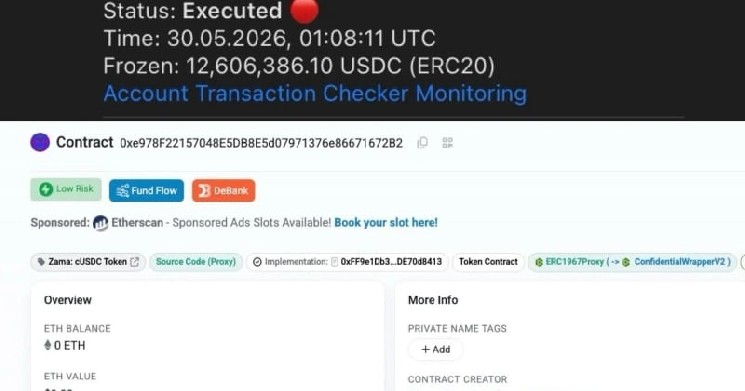
Circle just reminded the crypto world who actually controls $USDC. The stablecoin issuer froze Zama’s cUSDC contract on Ethereum on May 30, locking approximately 12.6 million $USDC, roughly $13M, after on-chain investigator ZachXBT linked the contract’s address to the Overnight Finance project amid rug pull allegations.
Zama, a cryptography firm known for its work in fully homomorphic encryption (FHE), acknowledged the freeze. CEO Rand Hindi stated the team is investigating and will provide updates as more information becomes available.
What is cUSDC and why does this matter
Zama’s cUSDC is built on the ERC-7984 standard, a framework designed to enable encrypted balances and transfers while maintaining composability on public blockchains like Ethereum. It was designed to let users hold and transfer stablecoins without broadcasting balances to the entire world — a useful concept for institutions that don’t want competitors tracking their treasury movements, or for everyday users who’d prefer not to have their financial life on a public ledger.
The freeze demolishes one assumption that some privacy-token advocates have been operating under. Encrypted balances don’t mean encrypted compliance powers. Circle still controls the underlying $USDC, and that means Circle can still blacklist addresses.
The compliance paradox at the heart of privacy tokens
Zama’s FHE technology allows computations on encrypted data without ever decrypting it. Zama has built confidential versions of both $USDC and USDT using this approach.
But the cryptographic elegance doesn’t change the legal architecture underneath. $USDC is issued by Circle, a company incorporated in the US, subject to US financial regulations. When Circle decides an address needs to be frozen, no amount of encryption changes that outcome.
Zama has positioned its technology as a bridge between the transparency demands of public blockchains and the privacy needs of real-world financial activity. The company’s ERC-7984 standard was designed to demonstrate that privacy and compliance could coexist.
What this means for investors
For anyone holding assets in privacy-wrapper protocols, the wrapper is only as sovereign as the asset inside it. If you’re wrapping a centrally issued stablecoin in a privacy layer, you inherit all the counterparty risk of that stablecoin, plus the additional smart contract risk of the wrapper itself.
A single freeze can lock millions in value with no recourse through the protocol’s own governance. If Circle can freeze a contract holding $13M based on an external investigator’s findings, the privacy guarantees that made these products attractive start to look more like privacy suggestions.
Projects building confidential applications will need to either build on decentralized stablecoins that lack issuer-level freeze capabilities, or accept that their privacy features operate within the compliance boundaries set by centralized issuers.

 coindesk.com


 en.coinotag.com
