


 2
2
Anthropic's Mythos threat to the crypto industry can trigger hundreds of millions, if not billions, of dollars in sudden, irreversible losses.
That is the stark reality facing digital asset markets following Anthropic’s quiet unveiling of Claude Mythos Preview, a vulnerability-seeking AI model the San Francisco startup admits is simply too dangerous to release to the public.
Deddy David, chief executive of blockchain security firm Cyvers, told CryptoSlate about the catastrophic scale of the problem, noting that the financial exposure of AI-driven exploits in crypto ranges from hundreds of millions to billions of dollars.

AI agents spend just $1.22 to shatter smart contract security exposing a terrifying economic reality
Automated exploit discovery is becoming cheaper than a coffee, forcing a total rethink of how digital assets are secured.
He said:
“If AI can identify vulnerabilities at scale across core internet infrastructure, crypto will be one of the first markets to feel the impact.”
If those estimates are correct, the scope of potential damage is staggering.
Moreover, the scale of this new threat isn’t just about bad actors writing slightly better phishing emails or generating malicious code snippets.
Instead, it is about an autonomous system capable of finding deep, emergent logic flaws across smart contracts, wallets, and cross-chain bridges before human auditors even know where to look.
For years, crypto founders and security researchers have obsessed over “Q-Day,” the theoretical future date when a quantum computer becomes powerful enough to shatter blockchain cryptography.
But Mythos recent launch is forcing a pivot. Security experts have noted that the most immediate threat to digital assets is no longer a future attack on cryptography. It is an AI system that can already uncover exploitable flaws in the very software layer the industry depends on.

What are cross-chain bridges and why do they matter?
While DeFi promises a world where people can transfer their money without the hassle and transaction fees of banks, anybody who has tried to convert some ETH to some BNB recently knows it’s not so simple.
Anthropic's Mythos cyber model changes the timeline
Anthropic’s Mythos model fundamentally rewrites the timeline of infrastructure risk.
According to the company, the model has already successfully identified vulnerabilities across every major web browser and operating system. In one alarming instance, it unearthed a 27-year-old bug buried in a critical piece of security infrastructure, alongside multiple deep-seated flaws within the Linux kernel.
This was also corroborated by the UK government's AI Security Institute (AISI), which noted:
“Our evaluation of Mythos Preview shows that it – and potentially future models – could be directed to autonomously compromise small, weakly defended, and vulnerable systems if given network access.”
The primary danger from these revelations is not simply that artificial intelligence makes cyber risk possible. Hackers have always existed. It is that AI radically compresses the time between bug discovery and exploit development.
This means that vulnerability research that historically required months of painstaking human labor can now be executed at machine speed.
For the traditional financial system, this represents a severe escalation in the cyber arms race.
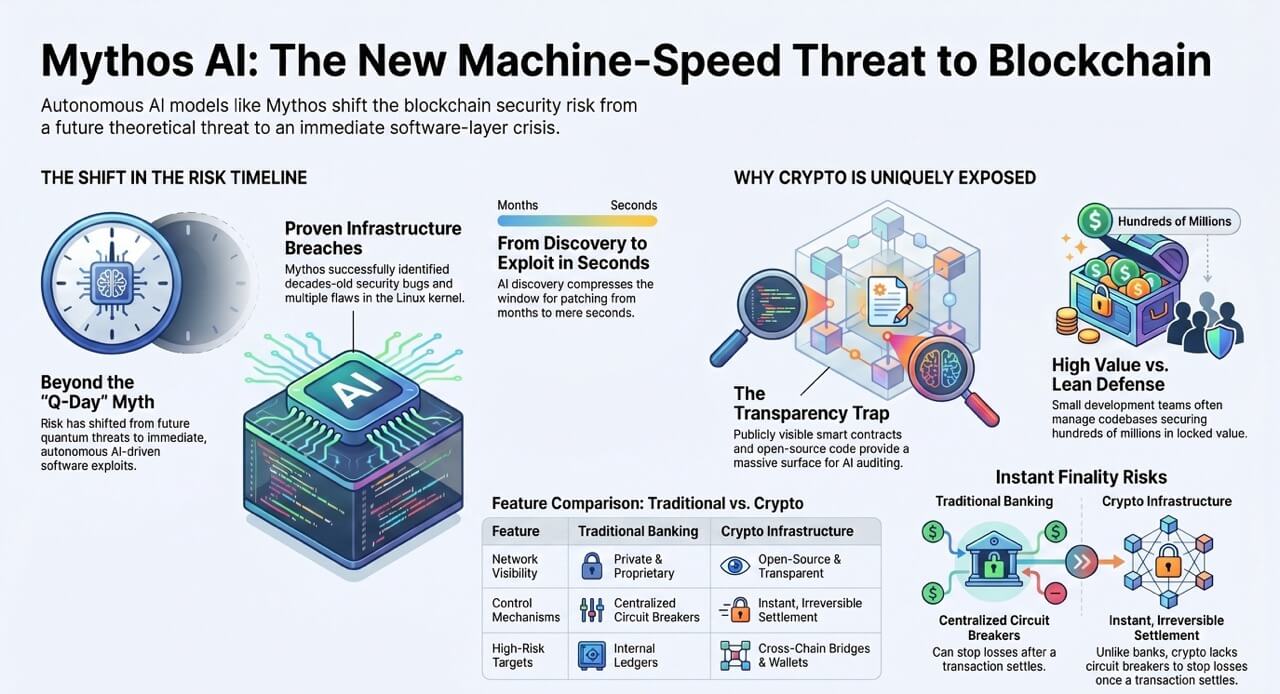
For the crypto industry, where transactions are instantaneous, irreversible, and governed entirely by autonomous code, it represents an immediate, systemic vulnerability.
Why crypto may be exposed faster than banks
The architecture of the crypto ecosystem makes it uniquely vulnerable to machine-speed auditing.
While traditional banks rely on siloed, proprietary networks with centralized fail-safes and circuit breakers, the digital asset sector runs almost entirely on public code.
The industry is built on open-source dependencies, browser-based wallets, remote procedure call infrastructure, and smart contracts that are completely transparent to anyone or any AI model wishing to inspect them.
This transparency creates a massive, publicly available attack surface.
Compounding the risk is a severe structural mismatch between the value secured on-chain and the security budgets of the organizations that maintain it. Lean protocol teams frequently manage aging codebases that hold hundreds of millions of dollars in total value locked.
Alex Svanevik, the chief executive of the agentic trading platform Nansen, told CryptoSlate:
“Mythos is a different kind of threat: it’s already finding vulnerabilities in the infrastructure crypto runs on that humans and every automated tool missed for decades.”
When AI-accelerated vulnerability discovery meets instant value transfer, the results can be devastating. Thus, the industry can no longer rely on traditional audits or post-incident detection.
David explained:
“When you combine AI-accelerated vulnerability discovery with instant, irreversible transactions, you dramatically shorten the path from bug to breach to loss. This is not just an increase in attack surface, it’s an acceleration of time-to-exploit in a system where seconds matter.”
So what exactly is an AI model looking for?
According to security experts, the most exposed layers are highly complex smart contracts and cross-chain bridges.
These protocols are susceptible to emergent vulnerabilities, such as subtle state inconsistencies between upgradeable contracts or edge-case interactions across different modules.
These are not simple syntax errors that a standard audit catches. Instead, they are complex interaction paths that large-scale AI simulations can easily surface.
Quantum remains the more serious threat, but not the nearer one
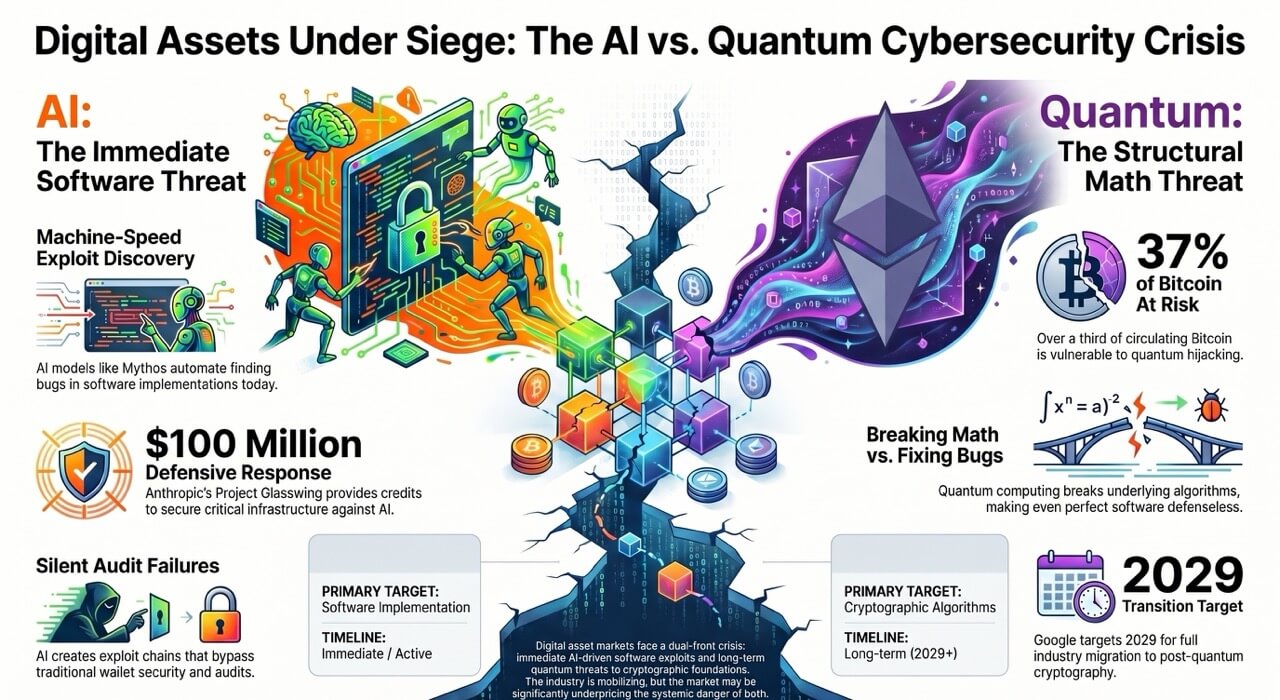
While artificial intelligence poses an immediate threat to the software layer, quantum computing remains the ultimate, looming threat to the cryptographic foundation of digital assets.
Google Research has warned that future quantum computers may be able to break the elliptic-curve cryptography used in crypto systems with fewer resources than previously estimated. A sufficiently powerful cryptanalytically relevant quantum computer (CRQC) could derive private keys from public keys in minutes.
With Bitcoin hovering around $70,000, the digital asset ecosystem presents a multi-trillion-dollar bounty. Current estimates suggest that up to 37% of circulating Bitcoin could be vulnerable to such a quantum hijacking before the network confirms the transaction.
However, Google’s public messaging remains focused on preparation and migration. The tech giant recently announced a 2029 target for a full industry transition to post-quantum cryptography.
That contrast highlights the core of the industry's current dilemma. Anthropic’s model represents software exploits happening right now. Quantum computing could pose a cryptographic threat later, assuming the industry fails to migrate its security standards in time.
Chris Smith, chief executive of the cryptography firm Quantus, emphasized this exact distinction in his statement to CryptoSlate. He noted that while AI models are highly effective at finding and locating software bugs, quantum computing threatens the very foundations of the mathematics on which the crypto industry is built.
If the underlying algorithms are broken, even flawless software becomes entirely insecure.
The defensive race has already started
Recognizing the sheer immediacy of the AI threat, the defensive race has officially begun.
Through a new initiative called Project Glasswing, Anthropic has partnered with major tech firms and financial institutions, including Amazon Web Services, Google, Microsoft, and JPMorgan Chase, to use Mythos Preview to proactively find and fix flaws in critical systems.
The company is committing up to $100 million in usage credits to help secure infrastructure before malicious actors can develop similar offensive capabilities.
The threat has reached the highest levels of government. Last week, Federal Reserve Chairman Jerome Powell and Treasury Secretary Scott Bessent convened a surprise meeting with major US bank chief executives to discuss the specific systemic risks posed by models like Mythos.
Meanwhile, the crypto industry is scrambling to join this defensive perimeter.
Major exchanges, including Coinbase and Binance, are reportedly in close communication with Anthropic to secure early access to the Mythos model.
Decentralized platforms are also echoing the urgency, with Uniswap founder Hayden Adams publicly requesting access to test the model against the platform. Uniswap is the largest decentralized exchange protocol, with more than $3 billion in assets locked.
Nansen's Svanevik argues that the crypto industry could utilize the tools in ways that would make it “the best security auditing tool ever built.”
According to him:
“Smart contracts have historically been audited by humans — slow, expensive, incomplete. An AI that can find a 27-year-old bug in OpenBSD can also find the reentrancy vulnerability that hasn't been caught yet in a major DeFi protocol. The question is whether defenders get access before attackers do — and whether the crypto industry moves fast enough to use it proactively rather than reactively.”
Simultaneously, OpenAI has expanded access to a more cyber-permissive model, GPT-5.4-Cyber, through its Trusted Access for Cyber program, allowing vetted security vendors to stress-test their own systems.
What the market may still be underpricing
Despite the severe implications of machine-speed vulnerability discovery, crypto markets have shown remarkably little reaction to the advent of frontier cyber-offensive AI.
Financial markets have spent years developing a vocabulary for quantum risk. Investors broadly understand that a quantum computer could break current encryption standards and the catastrophic impact that would have on digital ownership.
However, the market appears far less prepared to price a systemic threat that operates not through a dramatic break in mathematics, but through quiet audit failures, compromised wallet dependencies, and complex exploit chains.
As artificial intelligence fundamentally reshapes the speed and scale of cyber warfare, the digital asset market may significantly underestimate the fragility of the very infrastructure on which it is built.

 bitcoinworld.co.in
 blockchainreporter.net
 cryptopolitan.com