



 24
24
Chinese-language money laundering networks (CMLNs) have emerged as the dominant infrastructure for crypto-based illicit fund laundering.
The rapid rise of these Telegram-based networks marks a fundamental shift in how criminal proceeds move globally, with significant implications for national security and enforcement strategies worldwide.
$16.1 Billion Ecosystem: Scale and Speed
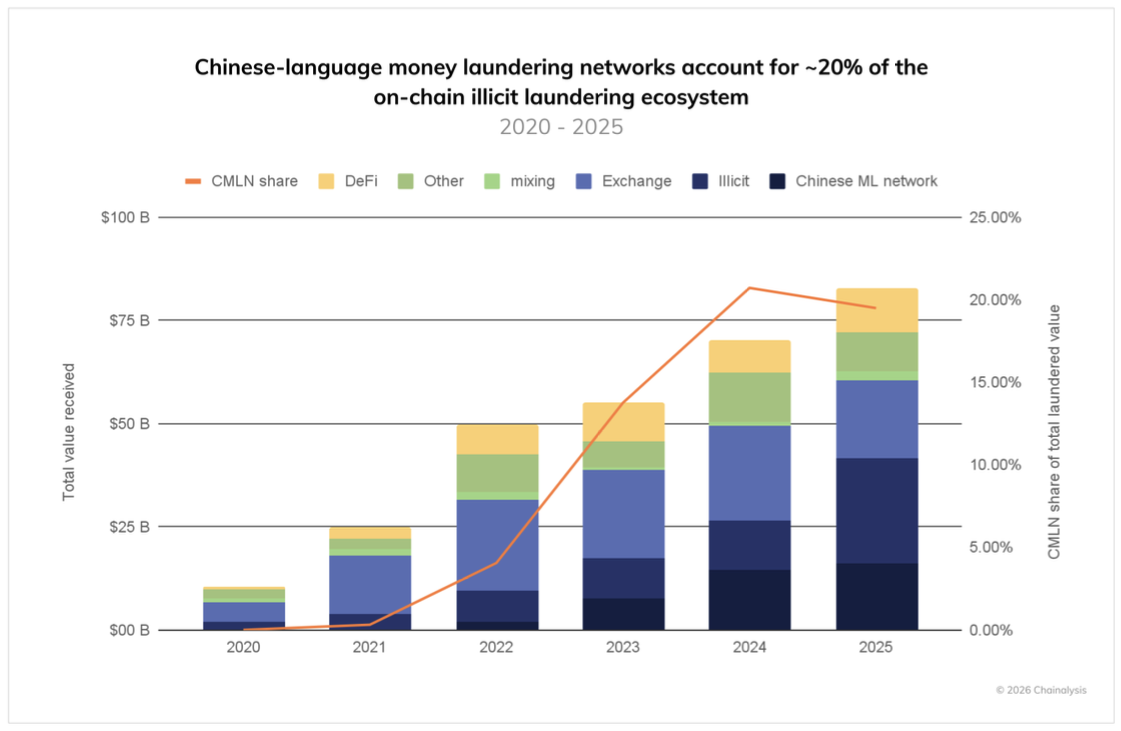
According to Chainalysis’s 2026 Crypto Crime Report, released on Jan. 27, CMLNs now account for approximately 20% of known cryptocurrency money laundering activity, making them the industry’s largest laundering channel.
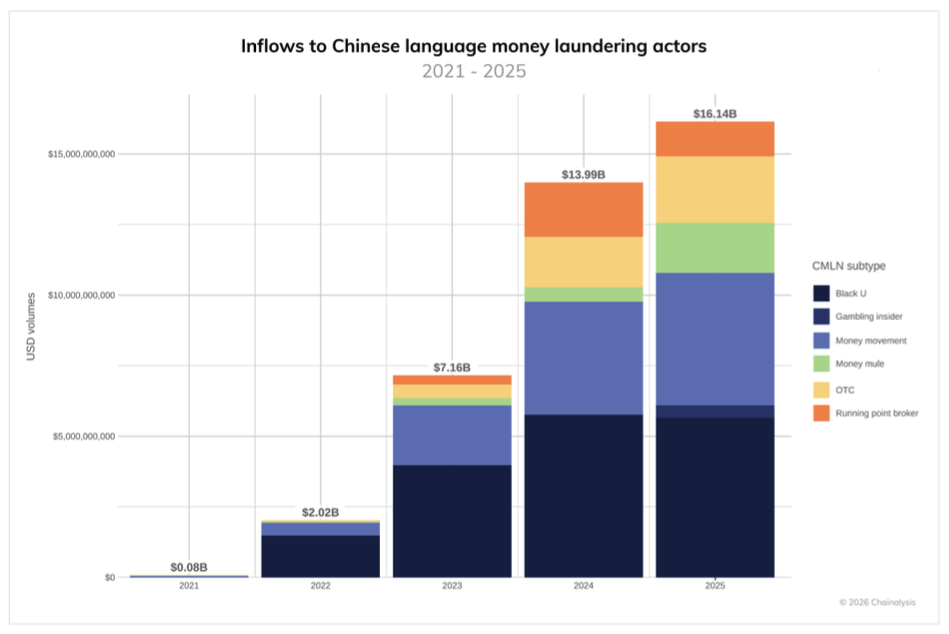
The report reveals that CMLNs processed $16.1 billion in 2025 alone, equivalent to roughly $44 million per day, operating through more than 1,799 active wallets. Since 2020, inflows to CMLNs have grown 7,325 times faster than those to centralized exchanges, 1,810 times faster than those to decentralized finance (DeFi), and 2,190 times faster than intra-illicit on-chain flows.
Chainalysis identified on-chain behavioral fingerprints of six discrete service types that comprise the CMLN ecosystem: running point brokers, money mule motorcades, informal OTC services, Black U services, gambling services, and money movement services.
Division of Roles Across Six Service Types
Running point brokers serve as the initial entry channel for illicit fund transfers. Individuals are recruited to rent out their bank accounts, digital wallets, or exchange deposit addresses to receive and forward fraudulent proceeds.
Money mule motorcades handle the “layering” phase of money laundering, forming networks of accounts and wallets to obscure the origins of funds. Some vendors have expanded their operational reach to five African countries.
Informal OTC services advertise “clean funds” or “White U” and process fund transfers without KYC verification. However, on-chain analysis revealed extensive connections between these services and illicit platforms such as Huione.
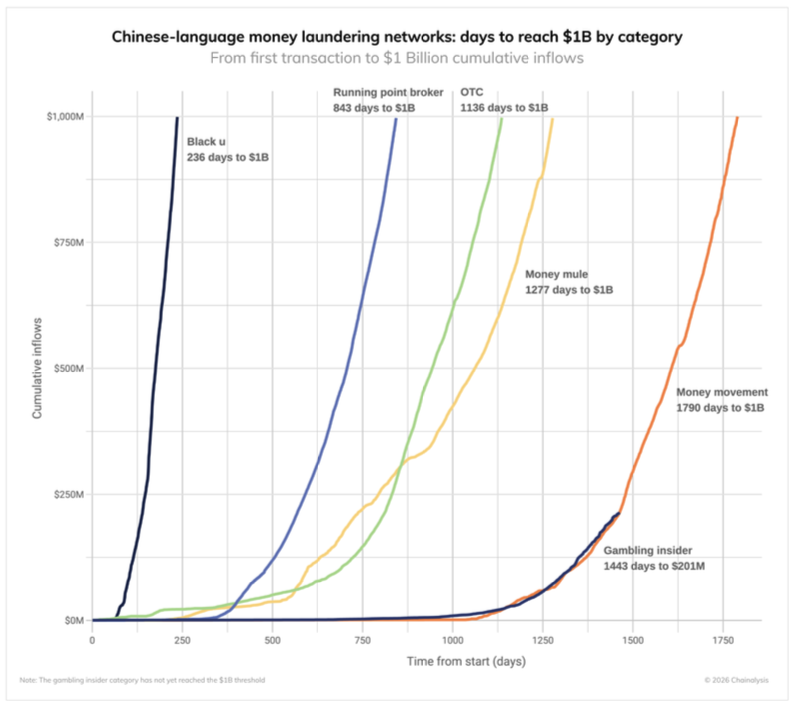
Black U services specialize in “tainted” cryptocurrency derived from hacking, exploits, and scams, selling them at 10-20% below market rates. These services demonstrated the fastest growth, reaching $1 billion in cumulative inflows within just 236 days. In Q4 2025, the average clearing time for very large transactions was just 1.6 minutes.
Gambling services leverage high cash volumes and frequent transactions to launder funds, and some Telegram vendors have been confirmed to offer rigged outcomes.
Money movement services provide mixing and swapping functionality, which illicit actors in Southeast Asia, China, and North Korea actively use.
Patterns Mirror Traditional Money Laundering
On-chain data revealed that CMLN financial flows mirror the traditional phases of money laundering: placement, layering, and integration. Black U services exemplify aggressive “structuring” (smurfing) behavior. Small transactions under $100 increased by 467% from inflow to outflow. Medium transactions ($100-$1,000) increased by 180%. Very large transfers (over $10,000) reached 51% more destination wallets than source wallets.
In contrast, gambling insiders, running point brokers, and OTC services operate as the ecosystem’s primary aggregators. These services pool funds from multiple points and consolidate them into wholesale amounts suitable for reintroduction into legitimate financial systems.
Guarantee Platforms as Central Hubs
At the center of the CMLN ecosystem are guarantee platforms such as Huione and Xinbi. These function as marketing venues and escrow infrastructure for money laundering vendors, but don’t control the underlying laundering activity.
Even after Telegram removed some of Huione’s accounts, vendors continued operations by migrating to alternative platforms. This demonstrates the need to target actual operators rather than just the platforms themselves.
Regulatory Response
Recent enforcement actions include the designation of Prince Group by the US Treasury’s OFAC and the UK’s OFSI. FinCEN issued a Final Rule designating Huione Group as a primary money laundering concern. The agency also released an advisory on Chinese money laundering networks.
However, while these actions have proven disruptive, core networks persist and migrate to alternative channels when challenged.
Expert Analysis
Tom Keatinge, Director of the Centre for Finance & Security at RUSI, said these networks have rapidly developed into multi-billion-dollar cross-border operations. He attributed the rapid growth to Chinese capital controls, explaining that wealthy individuals seeking to evade them provide the impetus and liquidity needed to service transnational organized crime groups across Europe and North America.
Chris Urben, Managing Director at Nardello & Co, noted that the biggest change in recent years has been a rapid transition from traditional informal value transfer systems to crypto. He explained that crypto offers an efficient way to move funds across borders, with less KYC compliance than traditional banks and the ability to carry billions of dollars in a cold wallet stored on a hard drive.
Need for Public-Private Collaboration
Chainalysis emphasized that addressing crypto-integrated laundering networks requires a shift from reactive enforcement against individual platforms to proactive disruption of underlying networks.
Urben advised that detecting these money laundering networks requires combining open-source and human-source intelligence with blockchain analysis. “Only when these tools work together, and develop leads that feed into each other, will you be able to match the players to the currency movements and map the networks,” he said.
The post Chinese-Language Networks Now Drive 20% of Crypto Money Laundering appeared first on BeInCrypto.

 bitcoinworld.co.in

 news.bitcoin.com
 1
1

 decrypt.co + 1 more
 protos.com