



 3
3
As an Arctic storm front batters multiple U.S. states, bitcoin mining activity across the country has pulled back sharply, with American-based operators scaling down operations to ease pressure on the power grid during a difficult stretch. As a result, Bitcoin’s network hashrate has declined notably, with current data placing total hashpower between 800 and 875 exahash per second (EH/s) over the past day.
Six-Day Slide: Bitcoin Hashrate Loses Nearly 250 EH/s During Arctic Blast
The Arctic storm front in late January 2026 is bearing down hardest on the South and the lower Ohio Valley, with the most severe conditions centered on Tennessee, Texas, Louisiana, Mississippi, Kentucky, Georgia, Alabama, and West Virginia. Several of these states host sizable clusters of bitcoin mining facilities, with Texas standing out in particular.
Three days ago, Bitcoin.com News reported that the world’s largest mining pool, Foundry USA, curtailed a significant portion of its hashrate in preparation for the storm after theminermag.com shared an update last week. Since then, the downward trend in hashrate has persisted. When measured using a three-day simple moving average (SMA) across a one-year window, Bitcoin has shed 385 EH/s since Oct. 15, 2025.
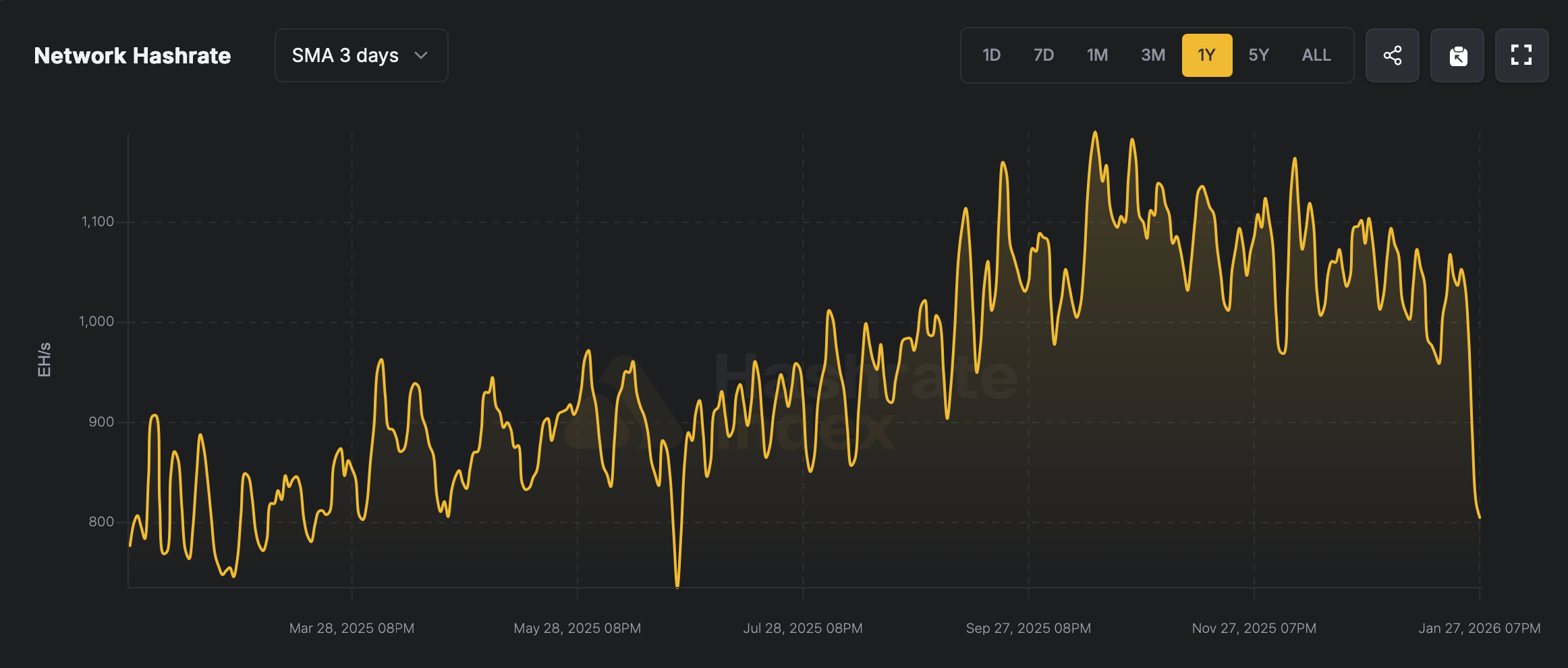
However, network data compiled by hashrateindex.com shows that the sharpest decline really unfolded after Jan. 22, 2026. On that date, total hashrate measured 1,053 EH/s, and today it sits at 805 EH/s using the three-day SMA. In practical terms, of the full 385 EH/s decline from the Oct. 15, 2025 all-time high of 1,190 EH/s, roughly 248 EH/s disappeared between Jan. 22 and Jan. 28.
As noted in our report, the slowdown in hashrate has pushed block intervals well beyond the usual 10-minute target. Average block times exceeded 12 minutes when that report was published and continue to hover at 12 minutes and 12 seconds. If this pace holds, the difficulty epoch arriving around Feb. 8, 2026, would rank among the largest adjustments seen in years.
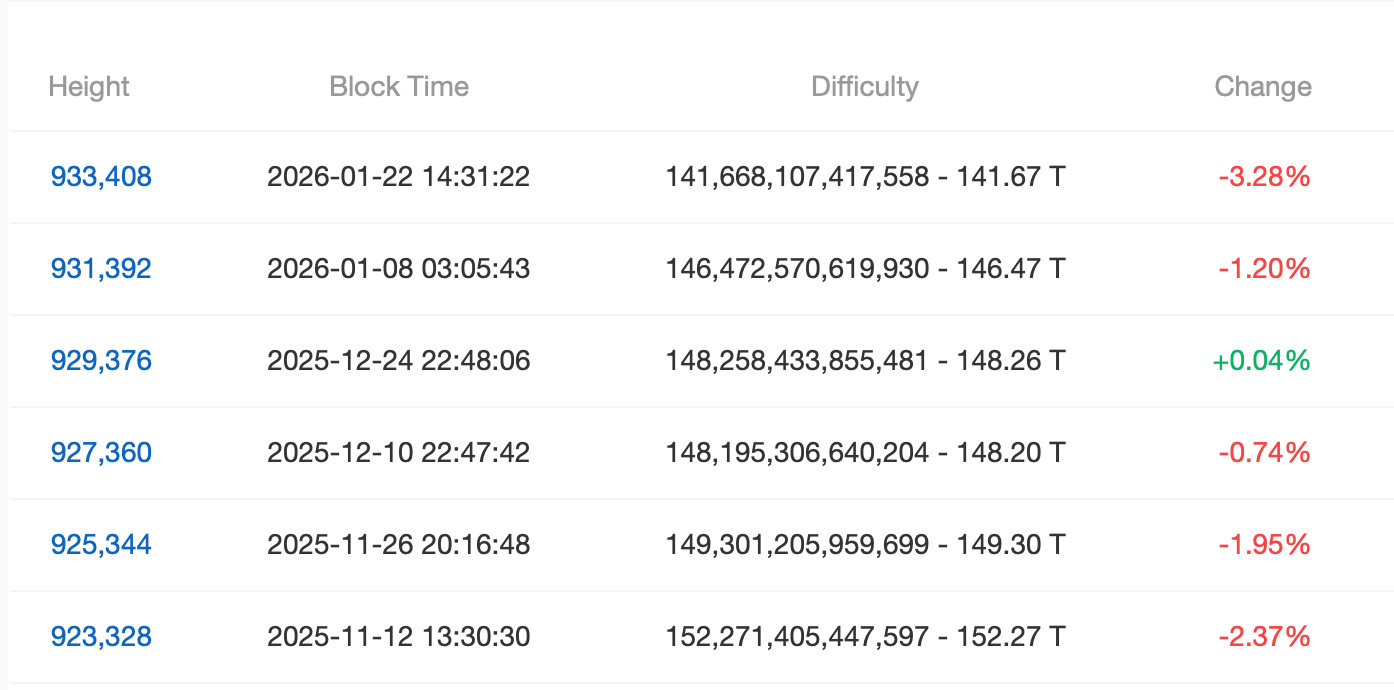
At present, hashrateindex.com and other tracking platforms are projecting a difficulty reduction of more than 18%. That outcome remains highly plausible, as the Arctic storm front moving across the U.S. is expected to persist into early next week, uncomfortably close to the upcoming difficulty epoch. Should the hashrate recover and block times normalize before the adjustment, the projected drop would shrink in size, but for now, the data points toward a record-setting difficulty drop.
Also read: Crypto ETFs Falter as Bitcoin, Ether See Combined Exit of $211 Million
For bitcoin miners grappling with softer BTC exchange rates and thin hashprice-based revenue, the timing could hardly be better. Such a sizable difficulty adjustment would offer immediate relief by easing competitive pressure and improving the odds of earning block rewards with the same infrastructure. In an environment where margins have been tight, even a temporary improvement in network conditions could translate into a meaningful boost to operating efficiency and near-term profitability.
FAQ ⛏️
-
Why is Bitcoin’s mining difficulty expected to drop in early Feb. 2026?
A sharp slowdown in hashrate and longer block times following U.S. storm-related mining curtailments has pushed the network toward a sizable downward adjustment. -
How large could the upcoming Bitcoin difficulty change be?
Current estimates from hashrateindex.com suggest the difficulty could fall by more than 18% if network conditions remain unchanged. -
What caused Bitcoin’s hashrate to decline so quickly in late January?
An Arctic storm front across major U.S. mining states forced operators, especially in Texas, to scale back activity to relieve stress on power grids. -
Why does a difficulty drop matter for Bitcoin miners?
Lower difficulty reduces competition per block, improving mining efficiency and revenue potential during periods of weaker hashprice.

 blockchainreporter.net


 cointelegraph.com
 cryptopolitan.com
