
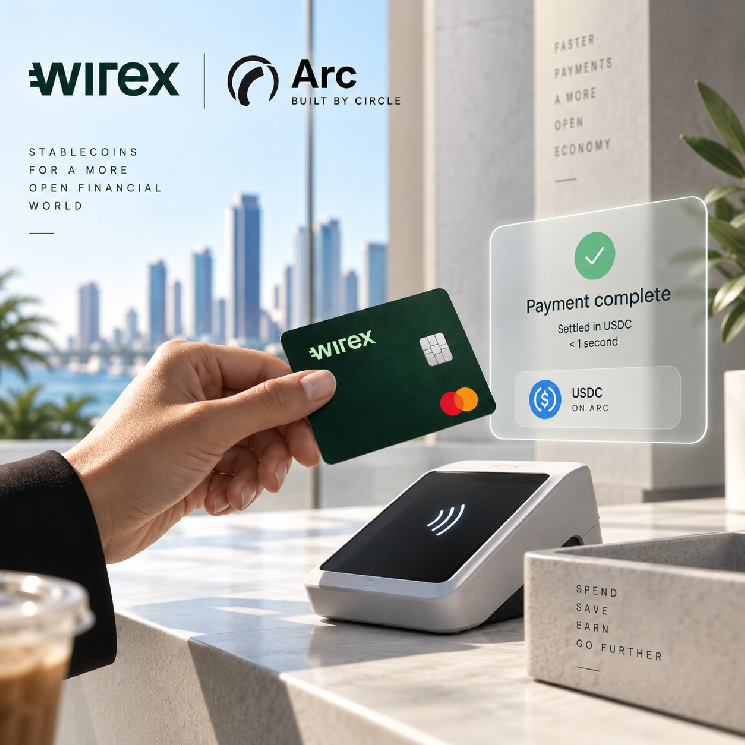

When Circle’s Arc mainnet went live last week, Jeremy Allaire called it “the single most significant launch in Circle’s history since $USDC itself.” The new blockchain was built specifically for financial markets, with $USDC used for gas and major TradFi companies including Visa and Mastercard participating as validators.
They spend through cards, bank transfers and payment networks.
That is where Wirex thinks the next stablecoin battle will be fought. The company launched on Arc’s mainnet on day one and has integrated the network into its stablecoin payments infrastructure, including Wirex One, its new onchain banking product.
Visa and Mastercard Validate Arc. That Doesn’t Automatically Put Stablecoins on Their Rails
Visa and Mastercard are both validators on Arc, helping secure the blockchain. Yet being an Arc validator and allowing consumers to actually spend stablecoins through Visa or Mastercard are two very different pieces of infrastructure.
Most stablecoin card programs do not have direct membership in the major card networks. Instead, they rely on a BIN sponsor or program manager, adding another intermediary along with additional costs and settlement windows.
Wirex is unusual because it holds principal membership with both Visa and Mastercard and says it can settle card transactions directly in $USDC and EURC without an intermediary bank. That means Arc’s sub-second settlement can potentially travel further through the payment stack rather than immediately running into another intermediary’s timetable.
The distinction sounds technical, but the consumer experience is easy to understand. A stablecoin can move almost instantly on a blockchain, but that speed matters much less if converting it into something spendable still depends on slower financial infrastructure.
Wirex One Is Putting Arc in Front of Consumers
Wirex has been testing on Arc since June and says more than 20,000 users participated in the closed beta for Wirex One before its public launch. The product combines stablecoin-funded spending, transfers, yield and other financial services while using Arc as part of the underlying settlement infrastructure.
At launch, Wirex One includes a stablecoin-funded card offering up to 8% cashback in USD, selected crypto and stablecoin yield products, multi-currency accounts, fee-free FX and ATM withdrawals, and transfers through systems including SEPA, ACH and Faster Payments. Wirex says tokenized equities and perpetuals are also scheduled to be added.
The target market is also different from the typical crypto card pitch. Wirex is positioning the product toward the “mass affluent”: customers who may have outgrown basic retail banking but do not meet the wealth thresholds associated with traditional private banking.
That is a sizable market to chase. The private banking sector is projected to grow by more than 10% annually to reach $1.24 trillion by 2035, according to research cited by Wirex.
Stablecoin Banking Is Becoming a Bigger Business
Wirex’s Arc launch also sits inside a much larger shift toward stablecoins becoming the infrastructure underneath everyday financial products.
Wirex says its broader stablecoin banking infrastructure recently reached $2 billion in annualized card spending volume. Through the same infrastructure, fintechs and wallets can launch accounts, cards, payments, payouts, yield and cashback products while settling activity in stablecoins.
The company has scale behind that pitch. Wirex says it has served more than 8 million users across 130 countries and processed more than $20 billion in transactions since launching in 2014.
That makes Arc interesting for a reason that goes beyond another blockchain launch. Blockster covered Arc’s mainnet launch as Circle positioned the network around financial markets, payments and stablecoin settlement. Wirex provides an early test of what happens when those rails reach an actual consumer financial product.
The Stablecoin Race May Be Won Above the Blockchain
Arc’s technical performance matters. So do its validators, privacy architecture and $USDC-based gas model. But none of those features automatically turn a stablecoin into something somebody can use at a restaurant, shop or ATM.
That requires another layer connecting blockchain settlement with existing payment networks.
Wirex’s argument is that this layer may ultimately determine which stablecoin networks gain real-world usage. A blockchain can settle a transaction in less than a second, but consumers will judge the experience by what happens when they tap a card, transfer money or try to access their funds.
Arc is building faster rails underneath digital dollars. Wirex is betting that the companies connecting those rails to the financial world people already use may be just as important as the blockchain itself.

 crypto.news
 coinfomania.com
