



 6
6
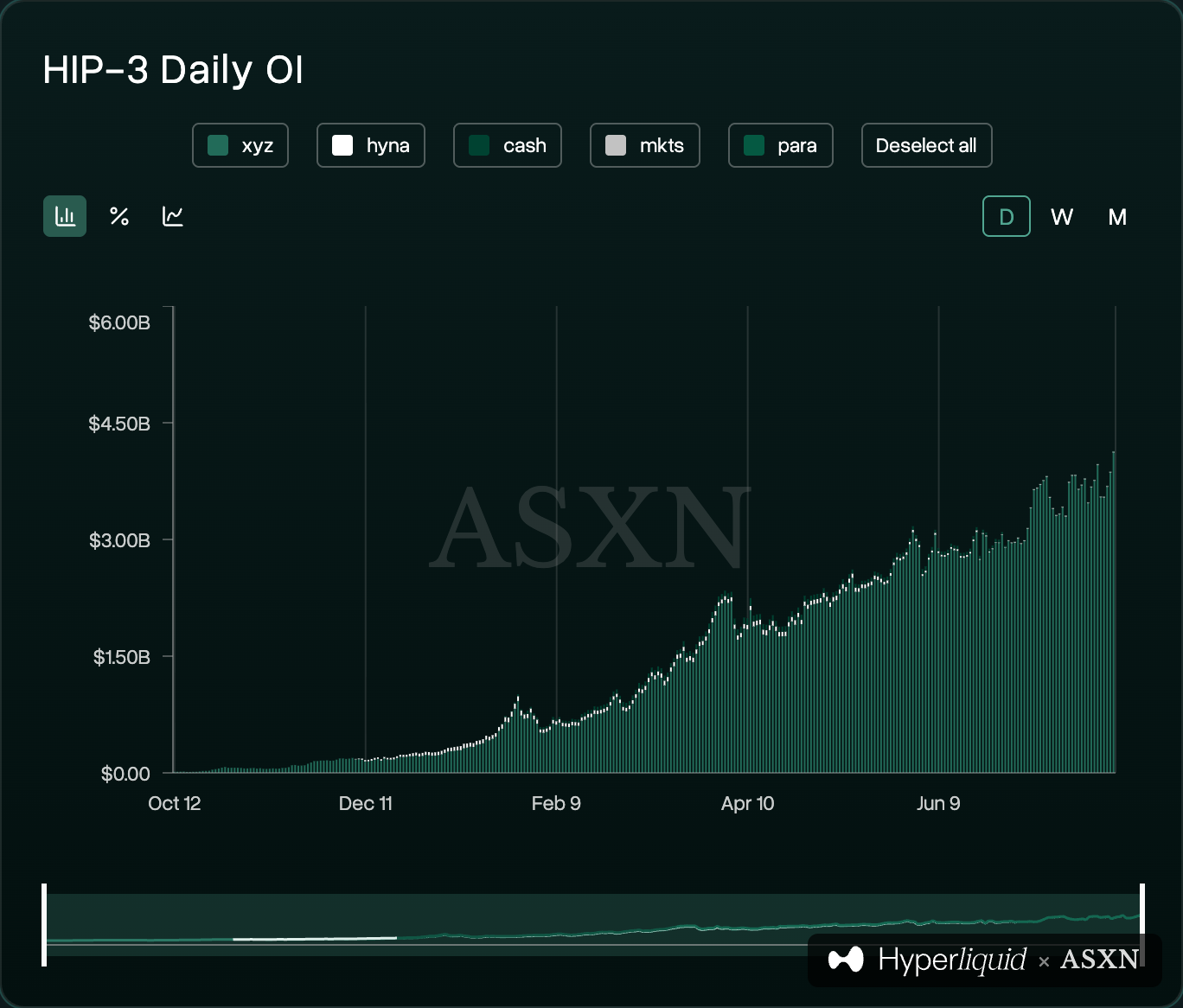
Hyperliquid has recorded a new milestone, with open interest in traditional asset markets (HIP-3) surpassing $4.13 billion for the first time, according to Hyperscreener ASXN. Meanwhile, daily trading volume saw an extraordinary jump, soaring 229% to $4.87 billion and fully exceeding the amount of capital held on the platform.
While traditional stock exchanges are closed, crypto traders are shifting en masse from memecoin speculation to 24/7 trading in tokenized stocks, commodities and indices on blockchain rails.
Contracts tied to shares of memory chip manufacturers SK Hynix and Micron Technology surged into the top-traded markets, allowing traders to react instantly to overnight news.
The main source of disruption in the equities section over the past 24 hours was Palantir (PLTR), whose explosive 25.86% gain topped the list of the day's best performers. This move triggered a major wipeout of leveraged positions, causing daily liquidations across markets deployed by xyz to jump 544% and exceed $19.25 million.
However, this new Hyperliquid all-time high also has a downside, as the free market quickly eliminated weaker players and led to a near-total monopoly.
Reality behind the $4.13 billion RWA boom
Infrastructure project xyz has captured almost complete control over liquidity on Hyperliquid, accumulating $4.12 billion of the total $4.13 billion. Amid this, smaller deployers are barely holding a modest $15 million to $20 million, while one of the ecosystem's pioneers, the Felix protocol, has already officially announced the closure of its markets.
Such harsh conditions are explained by the platform's tokenomics, as a major participant must lock 500 million $HYPE tokens as collateral to launch a trading interface, while half of the fees generated are directed toward $HYPE buybacks.
The explosive growth of the RWA sector has demonstrated that round-the-clock stock trading on blockchain rails is no longer a hypothetical experiment, but a mature market with billions of dollars in turnover.
However, as it continues to scale, the decentralized industry will have to address a classic challenge — how to develop an ecosystem in which virtually all real liquidity is concentrated in the hands of a single monopolist.

 coindesk.com
 coingape.com
 bitcoinworld.co.in

 crypto.news