


 11
11
The South Korean cryptocurrency market continues to strengthen its infrastructure for assets within the Ripple ecosystem. Today, Bithumb, the country's second-largest exchange, officially launched spot trading for Ripple's new regulated stablecoin, Ripple USD ($RLUSD), against the Korean won (KRW).
The listing took place just one day after a similar move by Upbit, the leader of the local market.
High rankings on paper, empty order books in reality
At first glance, the new won-denominated pairs had a successful start. According to current CoinMarketCap data, they immediately took high positions in the overall list of markets for the young stablecoin.
However, these high rankings are merely an illusion of success caused by the fact that $RLUSD's global network of trading pairs is still too small. Combined, South Korea's two largest exchanges currently account for only 0.74% of the coin's worldwide trading volume. Korean platforms have virtually no influence on the global market so far, while trading inside the country remains isolated.
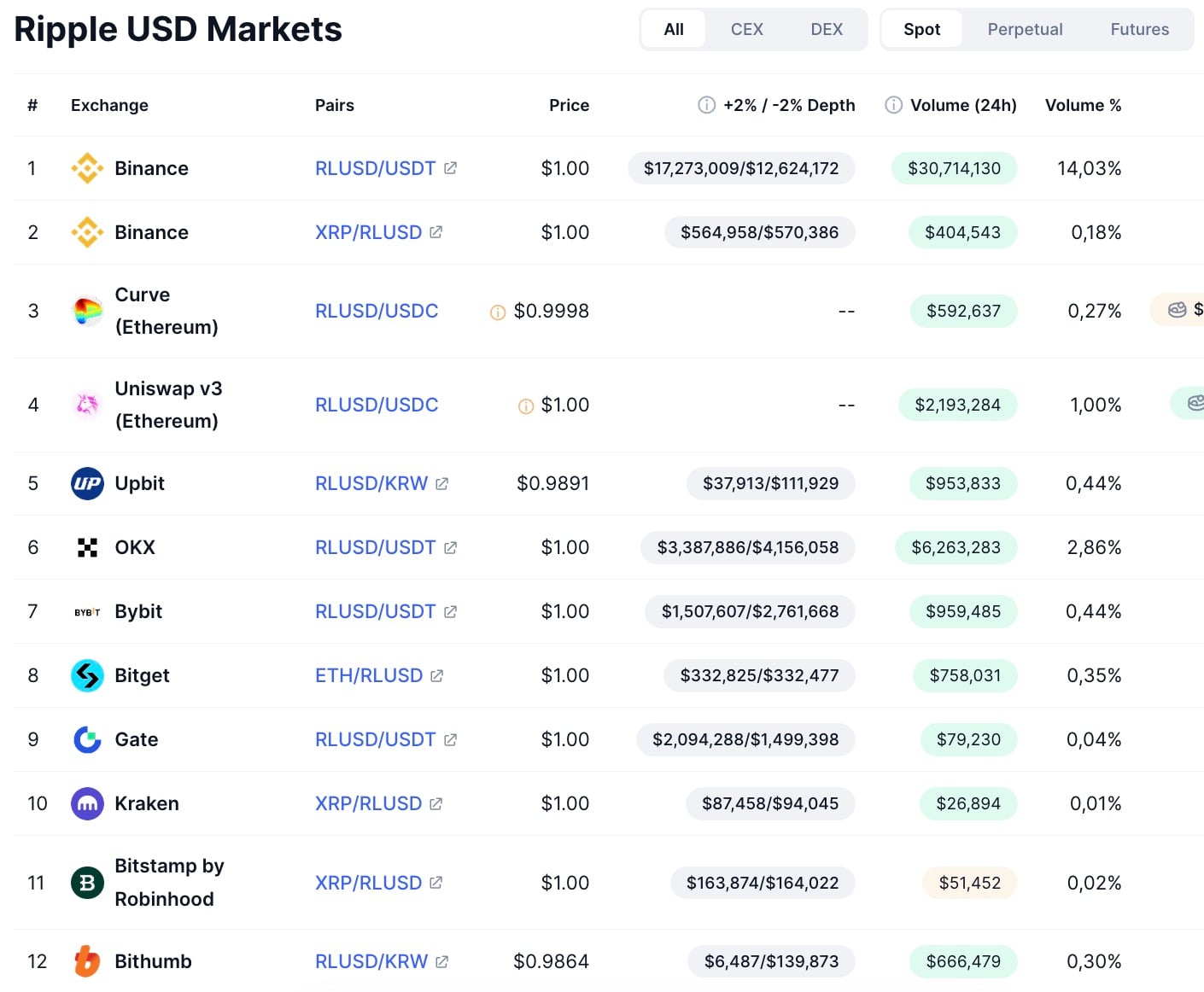
Upbit's order books currently show a severe imbalance in market depth within 2% of the price. Buy orders amount to only $37,913, while sell orders total $111,929.
The main purpose of any stablecoin is to maintain a price of exactly $1.00. The fact that $RLUSD is trading in South Korea at a discount of 1–1.5%, or a depeg, at around $0.986–$0.989 points to specific problems.
Local market makers have not yet established effective arbitrage mechanisms and are not aligning the exchange rate with the global market. As a result, traders on Upbit and Bithumb are currently losing money on conversions because the asset is undervalued inside the country relative to the U.S. dollar.
The listing has therefore taken place, but the market remains "empty" and unstable. Trading $RLUSD against the won is currently unprofitable and risky because of weak liquidity, despite the pairs' formally high positions in market rankings.
Ripple's USD stablecoin completes Korean market quest: What's next?
Despite the current spread-related problems, Ripple has steadily completed the formation of its South Korean hub. $RLUSD has now been listed by three of the country's key cryptocurrency exchanges: Coinone, which was the first to open trading, Upbit and Bithumb.
All the necessary infrastructure has been fully deployed at the local level. Custodian BDACS already provides regulated institutional custody services for XRP and $RLUSD.
The foundation for large-scale trading is fully in place. The stability of the Korean trading pairs now depends entirely on how soon major corporate capital and market makers begin injecting real liquidity into the exchanges' empty order books.

 en.bitcoinsistemi.com
 beincrypto.com
 cryptoslate.com