



 10
10
Coinbase and Robinhood will announce their earnings for the second quarter of 2026 this week, and, in this regard, the results will say as much about the future of cryptocurrencies as about the two companies.
Robinhood reports Wednesday after the closing bell, followed by Coinbase on Thursday. In combination, both firms signal one of the clearest indicators of whether digital assets continue to be driven by speculative trading or are now evolving into a more sophisticated type of finance infrastructure business involving stablecoins, subscription products, and ‘tokenized’ assets.
Two earnings reports the whole market will read
Coinbase and Robinhood became public companies in 2021 but they did so in different ways. Where Coinbase built its business around crypto trading and custody, Robinhood made its name in commission-free trading and later extended its operations to cryptocurrency and other digital assets. Today, both companies are becoming competitors in the same markets.
Wall Street anticipates Robinhood to report a profit of about $0.40 per share on its expected revenue of about $1.25 billion, and Coinbase to show a loss of about $0.36 per share while generating revenue of around $1.3 billion.
Although both firms are closely matching each other in terms of revenue generation, they are treated very differently by investors. Artemis data reveals that Robinhood has historically been rated higher than Coinbase in terms of its enterprise value-to-revenue metric, indicating that investors perceive it more as a diversified fintech firm than one that is primarily involved in the crypto trading business.
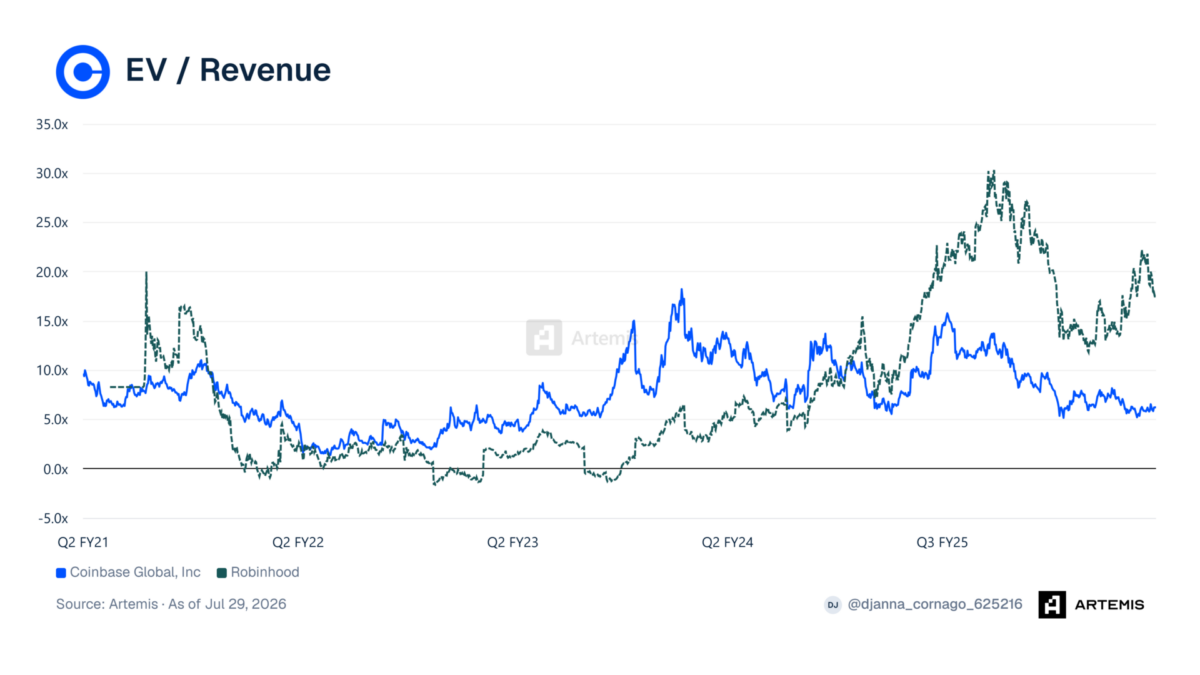
That distinction has been accentuated further amid downgrades for Coinbase from a number of analysts, while Mizuho analyst Dan Dolev suggests Robinhood can morph into the first “hyperscaler” for the brokerage sector.
Why retail’s retreat matters beyond two stocks
Crypto markets surged after Donald Trump’s win in the elections towards the end of 2024 and fell subsequently, as retail activity tapered off.
Robinhood seems to have adjusted to the change better. Artemis data indicated that Robinhood’s quarterly trading numbers increased from about $261 billion in early 2024 to more than $704 billion in the first quarter of 2026. Coinbase also showed improvement, with the total trading volume increasing from about $185 billion to some $517 billion in the same time period, though slower than in the case of Robinhood.
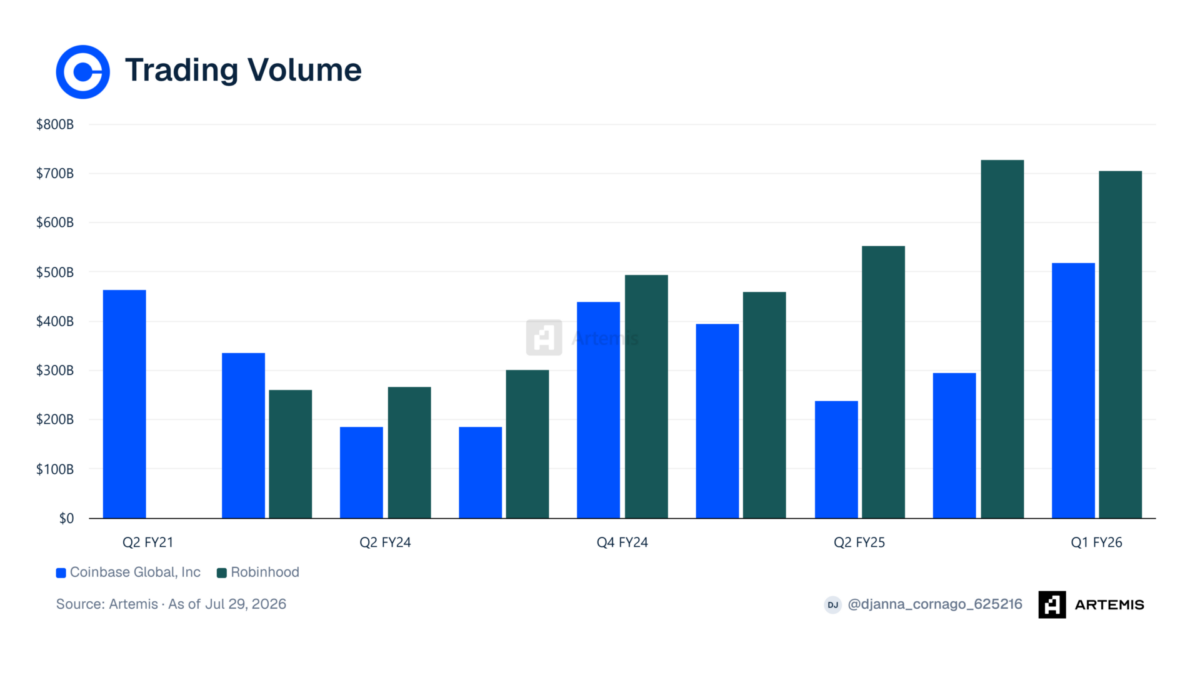
The difference indicates that Robinhood has acquired a greater percentage of retail trading business. However, investors will be looking past trading volumes to see whether those gains can be turned into permanent profits.
The two companies have both committed a lot of resources to the area of tokenized equities, and they believe that their bet on blockchain technology will pave the way for traditional financial instruments to integrate with cryptocurrencies. The strategy indicates a larger move towards establishing other longer-lasting revenue streams apart from just transaction fees.
Coinbase’s stablecoin engine faces new rivals
Coinbase has reduced its reliance on commissions earned from trading over the years with success, according to all indications.
According to Artemis data, its subscription and services revenue increased from roughly $103 million in mid-2021 to nearly $747 million by the third quarter of 2025. Its revenue from stablecoins grew significantly as well, moving from approximately $77 million in late 2022 to over $364 million, before slightly decreasing this year.
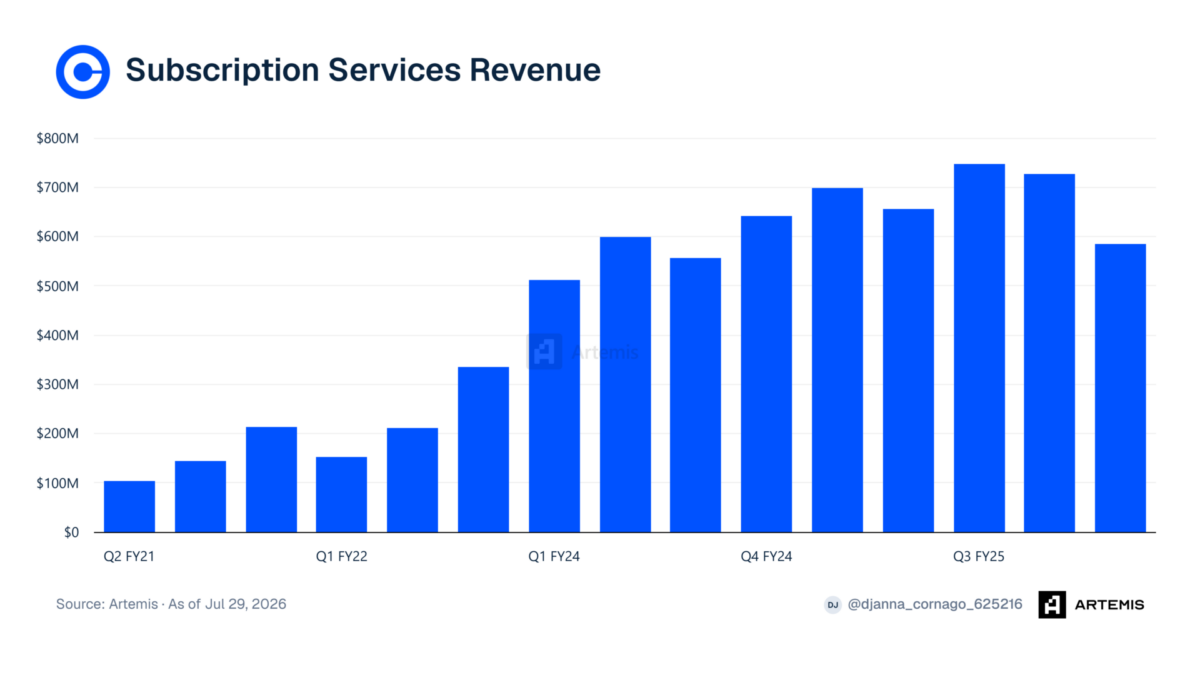
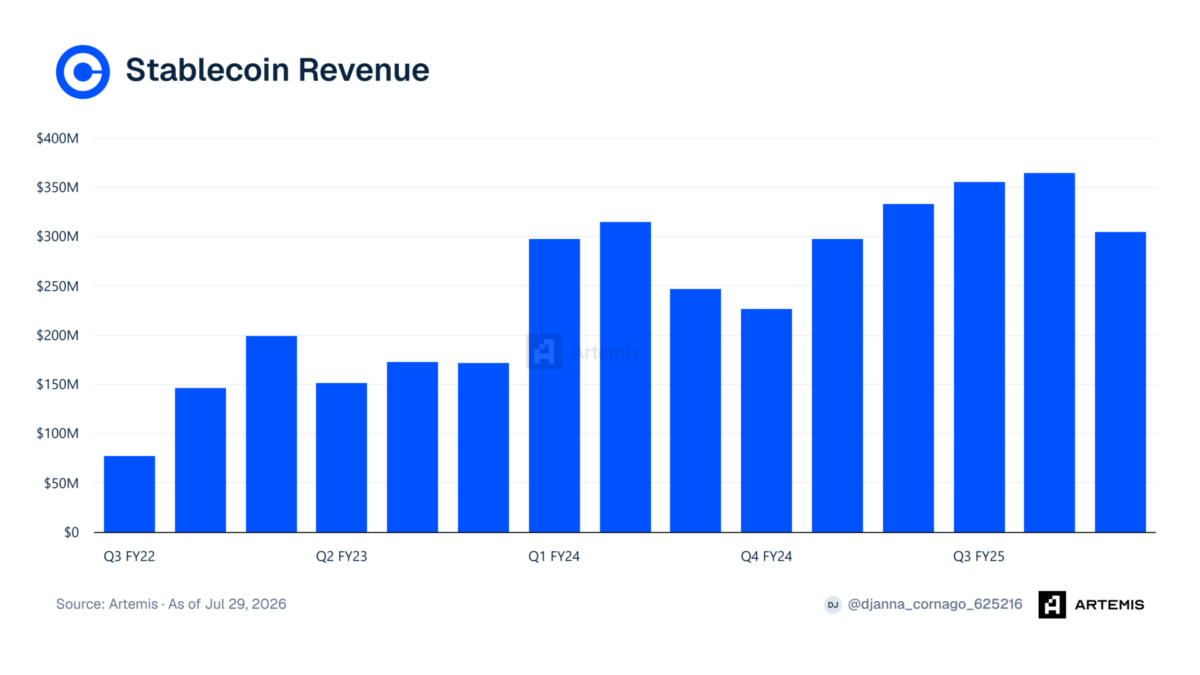
Those segments have mitigated the impact of lower trading activity, while customer assets on exchange continue to be above bear market bottoms irrespective of recent fluctuations.
However, concentration risk is an issue. In its first quarter letter to shareholders, Coinbase revealed that more than half of its revenue from subscription and services is USDC-related. That segment may be under pressure as both banks and major payment processing firms are launching new dollar-backed stablecoins.
CEO Brian Armstrong has also redirected Coinbase’s goals towards financial infrastructure after realizing that previous attempts by his company to create a social network using Base were unsuccessful.
Robinhood’s global build-out
Robinhood is engaging in a lot of the same initiatives but expanding them around a consumer platform.
Earlier this month, the company announced the launch of the Robinhood Chain, a Layer-2 blockchain based on Arbitrum, as well as tokenized stocks of U.S. companies for clients in more than 120 countries. Robinhood claims that it has nearly 28 million clients doing business in 38 countries.
CEO Vlad Tenev has called tokenization a potential “supercycle” for capital markets, reflecting increasing institutional interest in blockchain settlement and digital securities.
However, Robinhood is not as reliant on cryptocurrencies as Coinbase. Digital assets make up only approximately 12% of the company’s revenue compared to brokerage services, options trading, prediction markets and other products as other sources of revenue.
That diversification helps to explain why investors continue to provide Robinhood with a higher valuation than Coinbase even though revenues of both companies are relatively the same.

 en.bitcoinsistemi.com
 beincrypto.com
 cryptoslate.com