


 3
3
Crypto exchange OKX has launched a platform that will allow users to create their own spot, perpetuals and outcomes markets and choose which assets to list on them.
The platform, called Exchange OS, is built on OKX’s Ethereum layer 2, X Layer, and can tap liquidity across the company’s ecosystem as it uses the same infrastructure that powers OKX’s crypto exchange, Star Xu, OKX’s founder and CEO, said in a blog post on Tuesday.
Exchange OS is in the first stage of a three-phase rollout, and the first market built on the platform will be a predictions-style market for the FIFA World Cup.
The first stage of the rollout includes partners that will build on the platform before it opens to the wider public in the third quarter of 2026. Protocol improvements are expected to follow in the fourth quarter of the year and beyond.
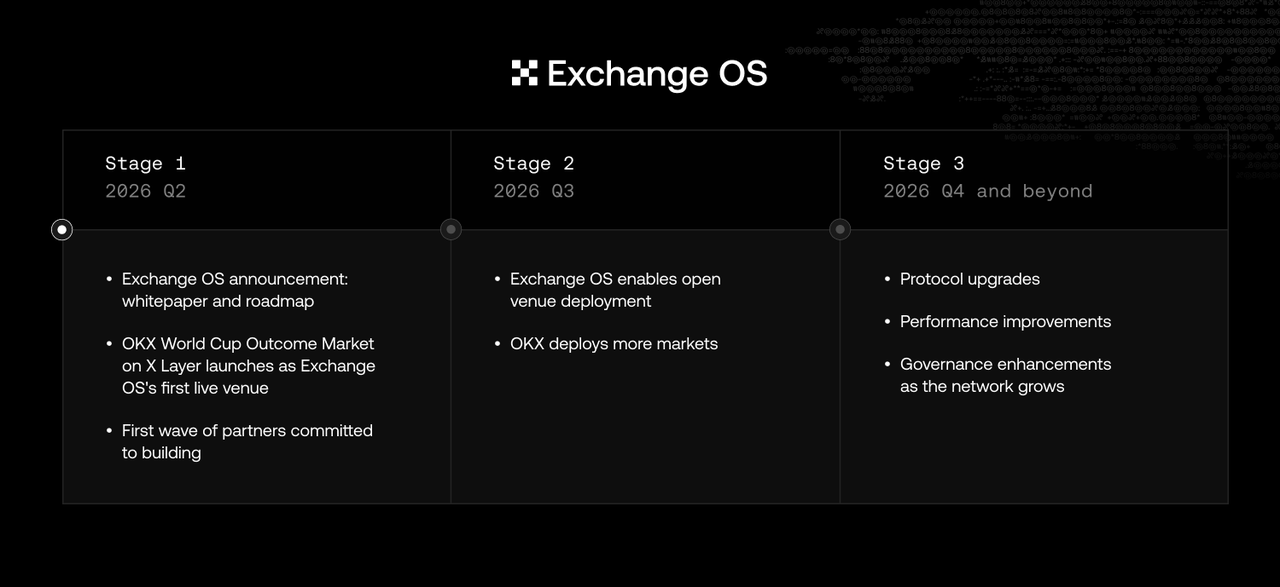
Three-stage roadmap for OKX’s Exchange OS through to Q4 2026 and beyond. Source: OKX
OKX is one of several crypto trading platforms that have expanded their product suites beyond spot and derivatives trading to capture a greater share of on-chain trading volume and liquidity.
In particular, OKX has pushed heavily into the tokenization space and rolled out infrastructure to support AI agent transactions, two areas that are receiving significant venture capital buzz and investment.
Xu said Exchange OS seeks to address what he claimed was the “fragmented infrastructure” of crypto-based finance services.
“While blockchain enabled open asset issuance, the infrastructure for trading, settlement, margining, and liquidity remains siloed across disconnected venues and applications,” Xu said.
Exchange OS aims to address this by integrating on-chain functions, such as matching, margining, liquidation, settlement and risk management, into X Layer by using the same infrastructure that powers the OKX crypto exchange.
“Instead of fragmented venues functioning as isolated systems, Exchange OS creates a shared execution environment where different market types can coexist on common rails.”
This could enable multiple markets to have access to the same pool of capital, Xu said.
Related: SEC seeks public comment as it weighs prediction market ETFs
Xu said users can also create their own assets, oracle systems, revenue models and compliance frameworks on Exchange OS in a permissioned or permissionless manner.
“A regulated institution can launch a fully KYC-compliant venue while a Web3-native team can operate a permissionless market on the same infrastructure stack,” he said.
OKX said Exchange OS can operate at millisecond-level latency, capable of processing up to 300,000 transactions per second.

 crypto.news
 coindesk.com
