


 12
12
Quantum computing is no longer a distant theory, as early signals now suggest crypto holders may soon face a silent race to secure their funds.
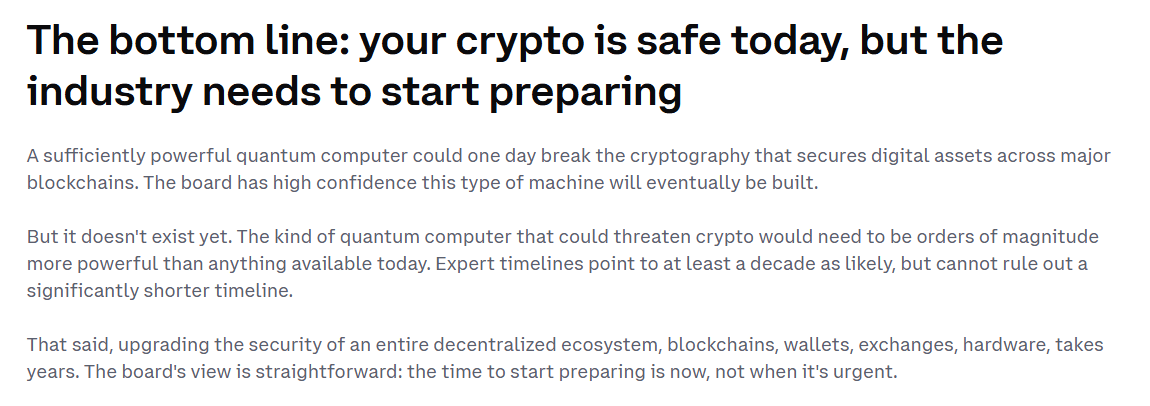
The Coinbase advisory board has now noted that a quantum computer capable of breaking encryption remains over a decade away.
As the picture became clearer, attention shifted toward the “harvest now, decrypt later” risk model. This means exposed keys today may become targets once quantum capability arrives.
Around 6.9 million Bitcoin [BTC], or 32% of the supply, already sits in exposed wallets.
This creates uneven risk, where older wallets face higher vulnerability. As a result, holders may need to migrate funds within a proposed three-year window, which may reshape behavior and network activity.
Blockchain responses to quantum risk begin to diverge
Quantum risk is pushing blockchains into early preparation, which is reshaping how networks approach long-term security. Bitcoin is exploring new address formats, though it has not committed to a full upgrade, which reflects cautious coordination.
As this unfolds, Ethereum [ETH] has outlined a detailed migration roadmap, which may improve scalability alongside stronger security.
Meanwhile, Solana [SOL], Algorand, and Aptos have begun rolling out quantum-resistant options, which signals faster adaptation among newer chains.
Layer 2 networks like Optimism [OP] have also introduced transition timelines, which adds clarity to execution.
This uneven progress creates divergence, where some networks move faster than others. Over time, this gap may influence capital flows, as users and developers shift toward ecosystems with clearer upgrade paths.
Execution risk drives quantum readiness
The focus has shifted from quantum capability to execution risk, which now drives market perception. Post-quantum cryptography already exists, yet adoption speed remains the key challenge.
As this becomes clearer, readiness starts to diverge, since Algorand and Aptos move faster than major networks.
Meanwhile, Ethereum and Solana still use validator signatures that aren’t secure against future threats, which increases risks by making networks vulnerable to delays in upgrades, problems with validators, and possible security issues.
As markets process this shift, price impact remains muted in the short term, since no immediate threat exists. However, medium-term volatility may rise, as news around breakthroughs or upgrades shapes sentiment.
Over time, assets may develop a safety premium, as investors favor networks with proven migration paths. This dynamic shifts valuation toward crypto-agility, where faster upgrades may attract capital and strengthen long-term positioning.
Final Summary
- Bitcoin faces rising quantum risk, as exposed wallets and migration pressure begin to reshape long-term security and user behavior.
- Ethereum and Solana show growing divergence, as quantum upgrade readiness starts to drive valuation and capital flows.

 coindesk.com

 u.today
 cointelegraph.com

 en.bitcoinsistemi.com

