

 1
1

 4
4
Wall Street’s biggest exchanges are embracing digital assets by aiming to put the $126 trillion equity market on blockchains — but they are not going at it alone; rather, they are relying on crypto exchanges to get there.
Over the past week, two of the world’s most powerful exchange operators — Nasdaq and Intercontinental Exchange (ICE), the parent company of the New York Stock Exchange — teamed up with digital asset exchanges to merge equities with blockchains through tokenization.
Nasdaq is developing a framework that would allow publicly listed companies to issue blockchain-based versions of their shares while preserving traditional ownership rights and governance. To distribute those tokenized stocks globally, the exchange is working with Payward, the parent company of crypto exchange Kraken. The offering could go live as soon as the first half of 2027.
Meanwhile, just days earlier, ICE revealed a strategic investment in crypto exchange OKX at a $25 billion valuation. That deal includes plans to launch new tokenized stocks and crypto futures, allowing the exchange operator to tap into OKX's 120 million user base.
The "everything" exchange
The flurry of deals points to a bigger transformation in how markets might function in the future.
For decades, stocks, bonds and funds traded on separate systems with limited trading hours. Blockchain technology promises a unified, always-on marketplace — one that in the industry believe could eventually host the settlement of all financial assets in the forms of tokens.
Antoine Scalia, founder and CEO of crypto accounting and compliance platform Cryptio, said the developments point to a broader shift toward what he calls the "everything exchange" – a marketplace where all asset classes trade on the same infrastructure.
"For a very long time, it was just crypto people pushing the narrative that traditional finance and crypto would merge," Scalia said. "Now we see the major exchanges moving."
"That’s a realization that eventually all assets will settle on blockchain rails,” he said.
This shift is being accelerated by a January SEC Staff Statement on Tokenized Securities, which finally clarified that tokenized equities carry the same legal weight as their "paper" counterparts. That gives Wall Street incumbents the legal cover to enter the market for tokenized equity trading.
'Frenemy'
However, the key question, Scalia added, is which platforms will dominate that future market: traditional exchanges like Nasdaq or crypto-native venues such as Coinbase (COIN) and Kraken.
But that doesn’t mean the two sides are purely rivals. In many cases, they need each other.
Traditional exchanges are looking for access to crypto-native traders, while crypto platforms want the distribution and credibility that established financial infrastructure provides, Scalia said.
"Distribution works both ways," he said. "Traditional exchanges want exposure to the crypto trading population, and there’s huge demand from crypto users to trade other types of assets. At the same time, crypto-native firms benefit from the reach of these traditional players to bring more people into crypto markets."
The result is an unusual, "frenemy"-like relationship between potential competitors. "It’s a very interesting dynamic with frictions and complementarity," Scalia said. "And it will be interesting to see how it plays out."
Why tokenized stocks matter
Tokenized equities – currently $1 billion – are only a fraction of the global equity market, but the potential is massive as all kinds of assets are increasingly move towards non-stop, around-the-clock trading.
A joint report by Boston Consulting Group and Ripple forecasted that tokenized assets could grow 53% a year, reaching $18.9 trillion across all asset classes by 2033 as their base case.
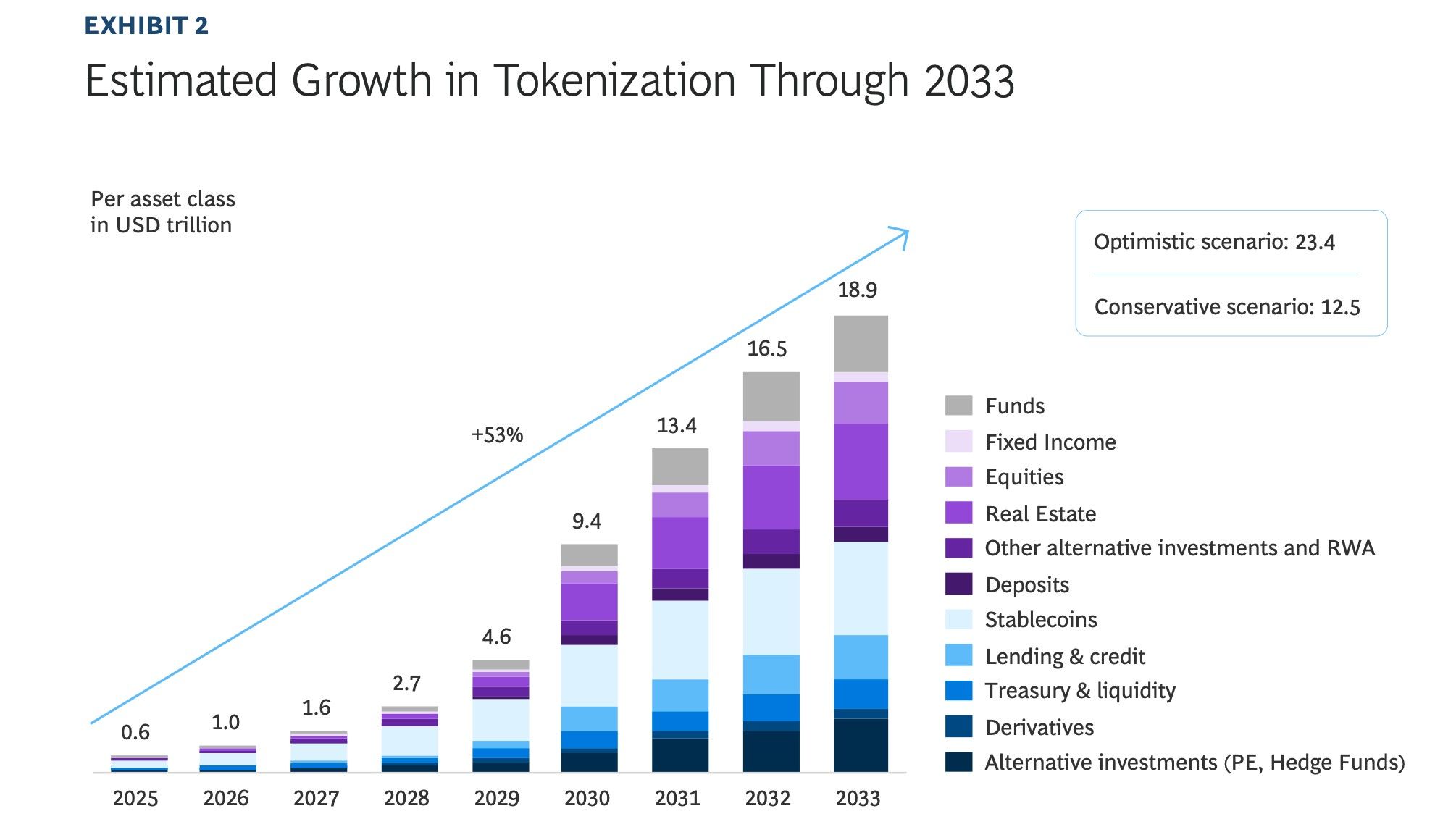
The market for tokenized stocks showcased even faster growth. The market value has tripled since mid-2025, RWA.xyz data shows, as Kraken, Ondo Finance, Robinhood and a slew of other exchanges and issuers rolled out token versions of equities.
The biggest advantage of putting traditional equities on blockchains is continuous price discovery, said Yuki Yuminaga, founder of tokenization startup Tenbin Labs. Unlike traditional stock markets today, which operate on fixed trading hours, blockchain-based assets never sleep and can trade around the clock. This will likely unlock more capital, improve liquidity and reduce market volatility.
Tokenizing stocks can also unlock more efficient lending and borrowing through decentralized finance (DeFi), Yuminaga added. Tokenized shares could be used as collateral in lending markets, increasing capital efficiency and enabling new financing opportunities, he said.
Giants like Nasdaq and NYSE entering the tokenized stocks game could also solve one of the biggest current pain points: liquidity.
"Tokenized equities have struggled with liquidity because traditional markets and onchain markets are separate," Yuminaga said. "If Nasdaq connects those two pools of liquidity, that could change the equation."


 en.bitcoinsistemi.com

 coinedition.com
 coinfomania.com