



 3
3
Table of Contents
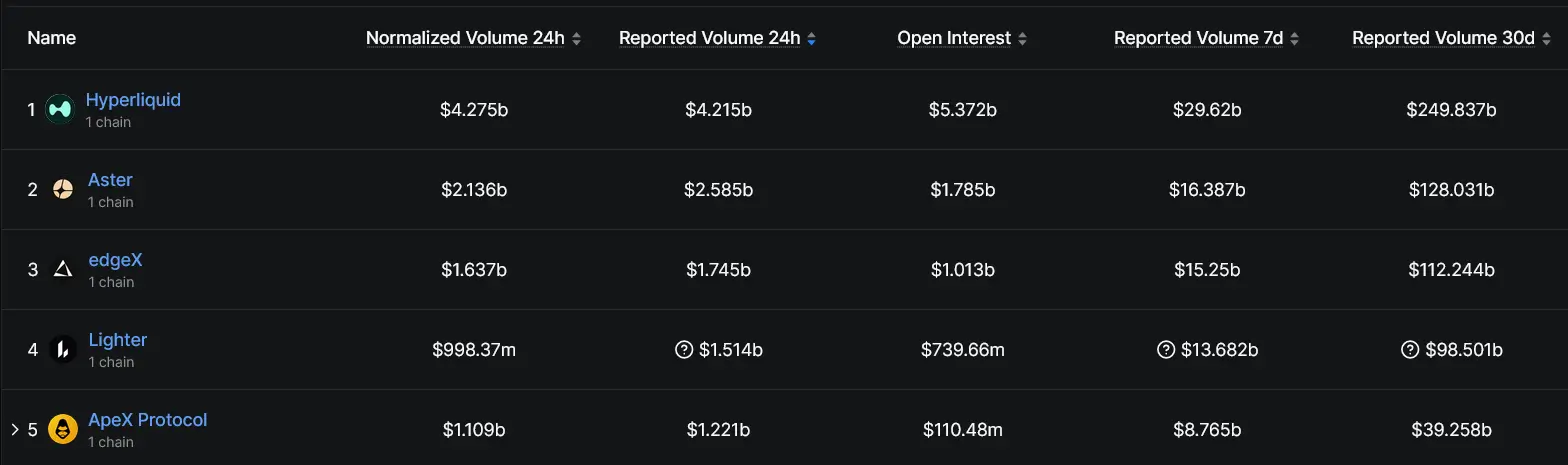
Aster is the second-largest perpetual futures DEX by daily volume, and it's not slowing down. With $2.136 billion in normalized 24-hour volume, CZ in its corner, and a multi-chain strategy that separates it from the pack, Aster has a real shot at the top spot. But Hyperliquid still holds a comfortable lead at $4.275 billion daily, and questions about volume sustainability linger. Here's a>How Does the Perp DEX Landscape Look Right Now?
The decentralized perpetual futures market is doing serious numbers. Total 24-hour volume across all protocols sits at $19.121 billion with $13.41 billion in open interest as of February 20, 2026.
Hyperliquid dominates at the top with $4.275 billion in daily volume and $5.249 billion in open interest. Aster follows at #2 with $2.136 billion daily and $1.771 billion in open interest. Behind them, edgeX ($1.637 billion), Lighter ($998 million), and ApeX Protocol ($1.109 billion) round out the top five.
Aster's 24-hour volume represents roughly 11% of the total perp DEX market. Its weekly volume hit $16.387 billion, still trailing Hyperliquid's $29.62 billion but showing consistent upward momentum. Cumulative volume has crossed $4 trillion overall, with daily fees ranging from $13 million to $100 million in recent months.
The platform has already flipped Hyperliquid for the top spot on multiple occasions. In October 2025, Aster posted $41.7 billion in 24-hour volume. It hit $12 billion in a single day again in November. These spikes haven't been sustained, but they prove the infrastructure can handle the load.
What Is Aster and How Does It Work?
Aster launched in late 2024 from the merger of Astherus, a yield protocol, and APX Finance, a perpetual trading platform. It operates across $BNB Chain, Ethereum, Solana, and Arbitrum, offering both spot and perpetual trading with leverage up to 1001x.
Three Trading Modes
The platform runs three trading modes. Perpetual Mode (Pro) provides an order-book interface with deep liquidity and low fees at 0.01% maker and 0.035% taker. The 1001x Mode offers on-chain, MEV-resistant perpetuals with one-click execution for high-leverage trades. Spot Mode handles cross-chain spot trading.
One standout feature is Aster's privacy-focused hidden orders, designed to prevent liquidation hunting and MEV extraction. The protocol also supports yield-generating collateral, letting users earn while they trade.
Deflationary Tokenomics
Tokenomics lean deflationary. $ASTER has a fixed max supply, with 80% of platform fees going toward buybacks and burns. So far, 177 million tokens (9% of post-burn supply) have been burned. Daily buybacks regularly hit $400,000 to $500,000, tying token scarcity directly to platform usage.
User numbers look strong on paper: 9.3 million cumulative users according to the project's Dune dashboard, $1.1 billion in TVL, and $1.8 billion in open interest.
What Does Aster Have Going for It?
Aster's path toward the top spot rests on a few key pillars: high-profile backing, a multi-chain strategy most rivals don't match, and a roadmap that keeps giving traders reasons to stick around.
The CZ Factor
The biggest name in Aster's corner is Changpeng Zhao. CZ provides advisory support on product and tech through YZi Labs, which holds a minority stake. He personally bought approximately 2.09 million $ASTER at an average price of around $0.91 and has publicly called Aster a "very strong project" that benefits $BNB Chain, even while it technically competes with Binance.
His involvement has moved markets. $ASTER launched at around $0.08 during its September 2025 TGE and hit an all-time high of $2.42. The community widely views the project as "Binance's DEX," and CZ's X posts and Spaces appearances have consistently triggered 20-35% rallies.
Multi-Chain Edge and What's Next
Beyond CZ, Aster's multi-chain approach is a genuine competitive edge. Hyperliquid runs on a single chain. Aster supports four, tapping users across $BNB Chain, Ethereum, Solana, and Arbitrum. That matters for traders who don't want to deal with bridging or who already hold assets on those networks.
The team continues to ship. Shield Mode recently dropped fees to 0.03% on open and close for privacy-focused high-leverage trading, and new stock perps like GOOGL and WDC went live with up to 50x leverage, expanding Aster's push into traditional equities alongside crypto.
The upcoming Aster Chain, a Layer 1 blockchain with a mainnet targeted for March 2026, is the next big catalyst. The testnet went live in early February with over 50,000 participants. It focuses on privacy and efficiency, aligning with CZ's recent comments about privacy being crypto's "missing piece." If the chain delivers, it could make 24/7 stock perps a core part of the platform's identity.
Whale accumulation, a Coinbase listing roadmap, and ongoing incentive programs like Aster Harvest are keeping momentum alive.
What Could Hold Aster Back?
Aster's numbers look impressive, but dig a little deeper, and there are real concerns that could slow its climb.
Volume Quality Questions
The biggest question mark is volume quality. Some of Aster's numbers may be inflated by airdrop incentives, point farming programs like Rh and Au, or wash trading. In October 2025, DefiLlama temporarily delisted Aster's perp volume data after finding a near-perfect 1:1 correlation between Aster's trading pairs and Binance's perpetual volumes. The data was later relisted, but with gaps in historical records and unresolved verification concerns. True adoption metrics like retention and organic open interest growth remain the numbers to watch.
Hyperliquid's Moat
Hyperliquid also has a deep moat. Its open interest ($5.249 billion vs. Aster's $1.771 billion) suggests more sticky capital and genuine trading activity. Hyperliquid's consistency, posting multi-billion-dollar daily volumes without the same spikes and drops, makes it a harder target than the raw numbers suggest.
$ASTER currently trades around $0.70, down roughly 71% from its all-time high, with a recent 78 million token unlock on February 16 (~$58 million in value) adding fresh supply pressure. Broader market conditions could weigh on volumes further.
There's also the positioning question. Aster targets a different user than Hyperliquid. It's essentially a CEX-like experience without KYC, while Hyperliquid leans into pure DeFi. They may end up coexisting rather than one replacing the other.
So, Can It Happen?
Aster has the backing, the tech, and the trajectory. If the Aster Chain mainnet delivers on its privacy promises and drives organic adoption, flipping Hyperliquid by mid-2026 isn't impossible. But "can" and "will" are different conversations. Sustained organic volume, not incentive-driven spikes, will be what separates a real #1 from a temporary one.
Sources:
- DefiLlama Perps Dashboard — Volume, open interest, and market share data for perp DEX protocols
- Aster Documentation — Protocol details, trading modes, and technical features
- Yahoo Finance — CZ's advisory role through YZi Labs, multi-chain strategy, and $ASTER purchase details
- CoinMarketCap — Aster platform overview, leverage specifications, and roadmap milestones
- CryptoBriefing — Aster Chain mainnet March 2026 timeline and testnet details
- Finance Magnates — CZ's personal $ASTER purchases and price impact
- Aster Dune Dashboard — Cumulative user metrics and on-chain activity data

 u.today

 cryptopolitan.com

 beincrypto.com
 protos.com