


 7
7
Despite launching in 2020, Polymarket really put itself on the map in November 2024 following the U.S. presidential election; however, 2025 brought unprecedented growth for a crypto-native app, as the decentralized prediction market has evolved into an international information resource often cited by the world’s top media outlets.
Just 18 months ago, Polymarket was well into its fourth year of operations, processing between $10 million and $30 million in volume per week. In November 2024, however, the platform shattered expectations, processing more volume in a 5-day period than it did throughout all of 2023.
For context, the prediction market’s volumes in 2023 were miniscule, with less than $1 million being traded on some days.
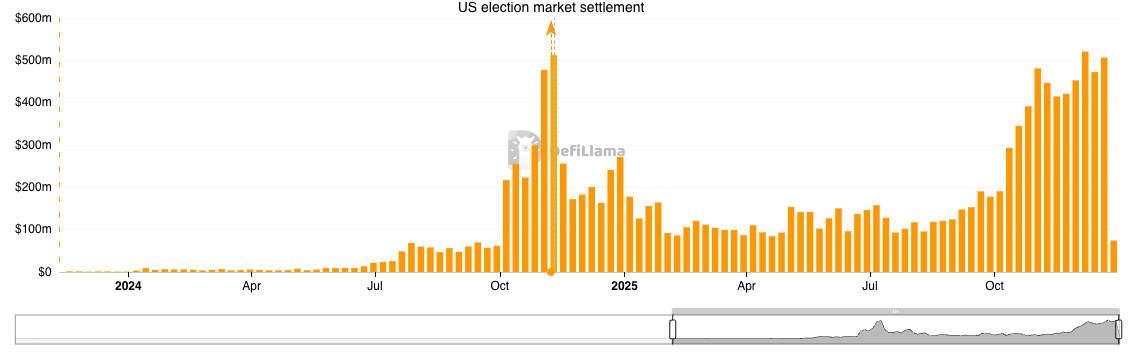
Fast forward to today, and Polymarket routinely processes $500 million a day, major news outlets regularly cite its odds, and its founder, Shayne Coplan, is dubbed the world’s youngest self-made billionaire.
Regulatory Advantages
The Trump administration in the United States has embraced prediction markets, with the President’s son, Donald Trump Jr., investing in Polymarket and serving as a strategic advisor to Kalshi, its regulated competitor.
Furthermore, President Trump himself has humorously referenced Polymarket odds, or the “polypoll,” as he calls it, in public speeches.
In addition to the presidential family’s vested interests in the success of the prediction market space, new regulatory changes slated for 2026 also bode well for prediction markets compared to traditional gambling venues, such as online sports betting.
Per the United States’ “One Big Beautiful Bill” passed in July, gamblers are limited to a 90% loss deduction, as opposed to prediction market traders, who are subject to the capital gains tax, in which 100% of losses can be deducted.
While it has not been explicitly discussed, this shift may be a factor in legacy betting services such as DraftKings entering the prediction market space as they look to retain power users for whom that extra 10% is significant.
In October, DraftKings announced its acquisition of the Railbird prediction market, making Polymarket Clearing the official clearing house for the upcoming DraftKings prediction market arm.
Outlook for 2026
The past year’s prediction market race has mostly been characterized by the ongoing, and often unsavory, rivalry between Kalshi and Polymarket.
The competition intensified after the Federal Bureau of Investigation (FBI) raided the home of Polymarket founder Shayne Coplan in 2024. Just days after the events, it was revealed that Kalshi team members paid influencers, including former NFL Pro Bowler Antonio Brown, to slander Coplan on social media.
Throughout 2025, Kalshi and Polymarket would take turns revealing either new VC raises or new partnerships, and their counterpart would announce a strikingly similar development within 48-72 hours.
However, 2026 may be the year in which Kalshi and Polymarket lean more into their own unique user-acquisition processes and away from their immature rivalry.
Polymarket is set to officially launch in the United States in 2026 after receiving approval to operate from the Commodity Futures Trading Commission (CFTC) in November, and the Polymarket US app is slowly rolling out limited access to U.S. users as of today.
There is also increased speculation around Polymarket’s future crypto activations, namely a native $POLY token, and potentially its own Ethereum Layer 2 network.
Kalshi, on the other hand, is facing legal troubles in the United States after the state of Nevada, home of the gambling mecca Las Vegas, filed a cease-and-desist order against it.
The decision came after a U.S. District Judge dissolved a previous 7-month injunction that allowed Kalshi to operate in the state. It is worth noting, however, that there is no publicly available information on whether the state plans to impose the same restrictions on Polymarket.
Kalshi’s crypto integration plans remain unclear. The company has sponsored a series of crypto-native influencers on X and leans into stablecoin integration for onramping and offramping. However, the prediction market’s data, orderbook, and user base remain entirely offchain and gated by know your customer (KYC) restrictions.
The information presented by the company and its affiliates suggests that Kalshi may continue to lean further into the crypto space beyond just user acquisition, but there are no official statements to confirm that at this time.
 en.bitcoinsistemi.com


 coindesk.com

 cointelegraph.com

 cryptopolitan.com
 en.cryptonomist.ch