

 0
0
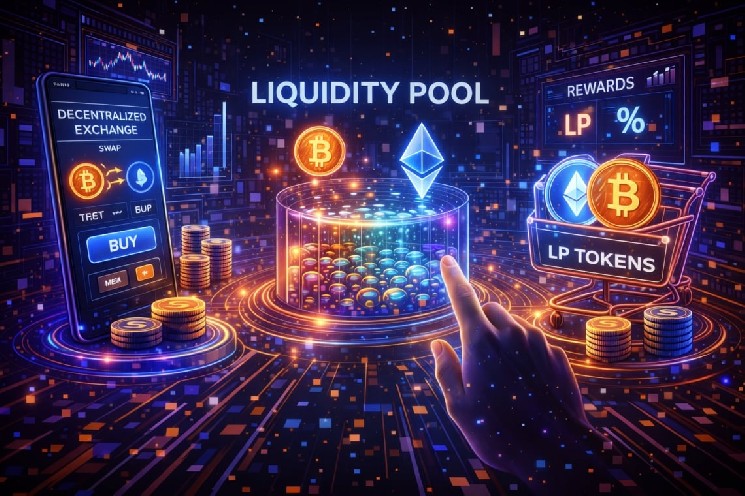
Decentralized crypto exchanges (DEX) are based on liquidity pools.
In these pools, crypto-to-crypto trading pairs operate, allowing on-chain swapping of one token for another in a peer-to-peer manner, thanks to smart contracts on blockchains like Ethereum, BNB Chain, Solana, or others.
In other words, anyone holding a token on a specific blockchain can use a DEX on the same blockchain to exchange it with other users’ tokens.
However, while from a theoretical standpoint it seems relatively simple, from a technical perspective it is not at all.
Summary
Liquidity Pools
On traditional centralized exchanges, there are the so-called order books. Each buy or sell order is entered into the order book, waiting for an opposite order with which it can be matched. Once two opposite orders that perfectly match (one sell and one buy) are found in the order book, the exchange automatically executes the trade.
On DEXs, however, order books are not present, so a different and somewhat more complex technique must be used.
The majority of modern DEXs indeed use the so-called AMM (Automated Market Maker) model, which is based precisely on liquidity pools. These are nothing more than smart contracts that contain pairs of tokens deposited by users.
So instead of order books where orders are placed, there are liquidity pools for individual trading pairs to which tokens are sent directly.
These tokens, once sent to the liquidity pool, are effectively locked in the smart contract, and it is the AMM algorithms that determine the exchange price and execute the swaps.
Technically, when a user requests to exchange one token for another, they effectively deposit their token into the liquidity pool, and after the swap, they can withdraw the other token from the same liquidity pool.
Liquidity Providers
The issue is that, for the exchange to occur, the other token must already be present in the liquidity pool, meaning the one the user wants to receive in exchange for theirs.
Indeed, those who deposit tokens into a liquidity pool are referred to as Liquidity Providers (LPs), and they earn by receiving a share of the fees generated from swaps within the pool. They often also receive additional rewards that are distributed to incentivize the liquidity providers.
Therefore, becoming an LP is a way to generate passive income, although it involves specific risks.
First and foremost, liquidity providers earn a form of passive income derived from the percentage of fees on each trade within their liquidity pool. In high-volume pools, it is possible to earn high APYs.
Moreover, on many DEXs, they receive native tokens of the DEX as an incentive.
The interesting thing is that anyone can become an LP with their own wallet, without KYC.
How to Become a Liquidity Provider
First, ensure you have a non-custodial wallet that can connect with the DEX.
It should be noted that each DEX is based on a blockchain, so it is necessary to ensure that the wallet is compatible with the DEX.
Additionally, one must also ensure that the wallet has sufficient fees to cover the cost of transactions (commonly known as gas).
Fees are paid in the native crypto of the blockchain you wish to use.
At that point, you can proceed to connect the wallet with the DEX by following the specific procedure on the DEX (which is generally quite similar across various decentralized exchanges).
The most “challenging” part comes now.
To operate as a liquidity provider within a liquidity pool, you must have both tokens of the trading pair you wish to engage with in your wallet, in equal value.
Therefore, it is not enough to connect the wallet to the DEX; one must also ensure they have sufficient funds to operate as an LP on a specific trading pair.
Only at that point is it possible to proceed further with the actual addition of liquidity to the pool.
On the DEX, you need to look for the “Pool” or “Liquidity” option, or something similar, select the trading pair you want to operate on as an LP, and enter the amount of tokens you wish to use.
At this point, simply send the tokens, approve the transaction, and confirm the addition of your tokens to the liquidity pool.
The Earnings
Once your tokens are locked in the liquidity pool, you receive LP-tokens in return, which represent your share of liquidity in the pool.
Earnings are automatically accumulated every time someone executes transactions on that specific trading pair within the chosen DEX.
There are tools like DeBank and Zapper that can be used specifically to track earnings.
Obviously, the tokens locked within the liquidity pool can be withdrawn at any time. To withdraw them, you need to redeem them by exchanging a portion of your LP-tokens: this operation will burn the returned LP-tokens and remove your liquidity from the liquidity pool, transferring it to your wallet.
The Advantages
The first obvious advantage is the ability to earn yield on your tokens.
It is true that tokens from both crypto of the chosen trading pair are required, but the APYs can be quite attractive if pairs with very high trading volumes are selected.
Additionally, it is possible to withdraw your funds from the liquidity pool at any time, so theoretically there should not be particularly high risks, as long as everything functions correctly.
Finally, in this way, one contributes to the DEX ecosystem, helping to make it more efficient by reducing slippage for traders.
The Risks
The greatest risk is the so-called impermanent loss.
When the relative price of the tokens in the pool changes compared to the price they had at the time of deposit in the pool, the AMM algorithm automatically rebalances the pool by selling the appreciating token and buying the depreciating one.
This means that, in the event of a withdrawal, you end up with more tokens of the one that has depreciated, but fewer of the one that has appreciated. In fact, it constitutes a loss compared to simply holding the tokens.
However, this is an “impermanent” loss, because if prices return to the initial level, the loss would be extinguished. However, if one withdraws during a divergence, the loss effectively becomes permanent.
Moreover, impermanent loss increases with volatility, therefore it is crucial to pay close attention, especially to trading pairs with higher volatility.
Moreover, there are also other risks, the classic ones associated with decentralized smart contracts.
First of all, if smart contracts are not properly executed, they can be attacked and breached by hackers, who may succeed in stealing all the funds.
Additionally, sometimes funds may be frozen if there are issues, making it difficult to withdraw them.
Finally, in the event that on-chain fees are high at certain times, these would effectively constitute an additional cost not necessarily anticipated.
It should also be noted that new token liquidity pools are often subject to an additional risk, namely that the team behind the launch might at some point drain the liquidity, significantly decreasing the token’s value.
Therefore, becoming a liquidity provider on a DEX can certainly be an opportunity, but it requires education and risk management. Additionally, it is always important to assess whether the risks are worth the effort.
 cryptobriefing.com
 financemagnates.com
 bitcoinworld.co.in
 protos.com
 coinfomania.com
 cointelegraph.com