
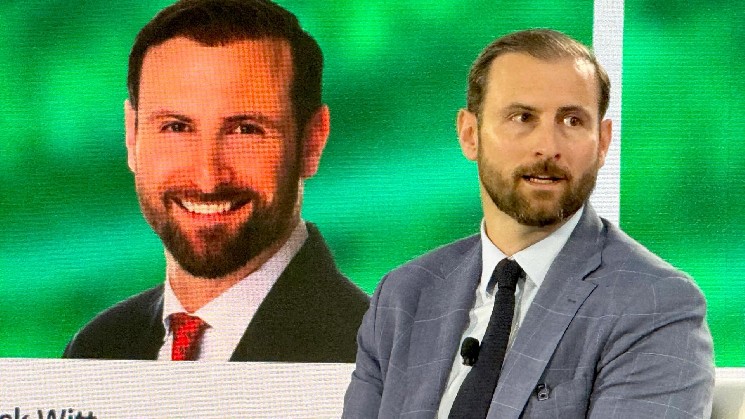

The White House's crypto adviser, Patrick Witt, said Republicans have granted as much as 95% of requests from Democratic negotiators in the Digital Asset Market Clarity Act and he said any Senate opposition to it must be political at this stage.
In a Monday appearance in Washington, Witt said President Donald Trump deserved a "big thank you" for his new willingness to further compromise on a Clarity Act government ethics provisions.
"These are historic and unprecedented provisions," Witt said at a Solana Policy Institute summit. "I wouldn't want to be a Democrat that votes against these."
He said he feels "very good" about the coming Senate vote on what he said was the product of a massive, bipartisan effort, but he said that whether it gets enough yes votes could be "a political calculation and not a policy calculation."
On Sunday night, Senate Republicans circulated another draft of the Clarity Act, this time making some further concessions to Democrats on the key government-ethics section and other points, such as criminal prosecution of decentralized finance (DeFi) projects. However, the compromise wasn't one crafted alongside Democrats, and initial signals show some resistance there. The bill will need a large number of Democrats to vote yes if it's going to beat the Senate's 60-vote threshold.
Democratic staff on the Senate Banking Committee noted Monday that the new version leaves Trump's own appointees — especially the attorney general — too much authority to shut down enforcement of the ethics section, and they said the power given to states to target the attorney general with legal action instead of individual violators is insufficient.
The industry and its supporters spent Monday cheering on the Clarity Act process, which faces a major test on Tuesday with a plan for casting the first of several votes to begin advancing the bill on the Senate floor. The first vote is widely seen as the bellwether that will signal the chance that the long-awaited legislation — currently more than 600 pages — heads toward passage.
But there are plenty of headwinds to this process. So far, a large number of state attorneys general have also said they don't support the legislation's treatment of their legal powers to pursue bad actors. And on the flip side, the crypto industry is uneasy about the new language's treatment of DeFi.

 cointelegraph.com


