
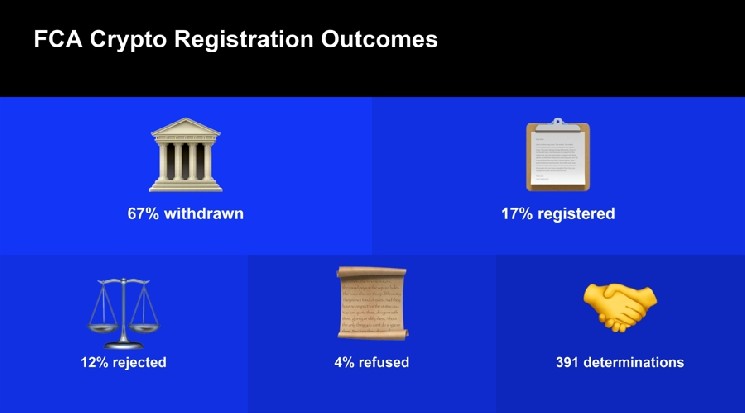

FM Intelligence found that 263 of 391 crypto registration cases completed by the Financial Conduct Authority (FCA Financial Conduct Authority (FCA) The Financial Conduct Authority (FCA) is the largest financial regulator for all financial markets in the United Kingdom (UK).The UK regulator is responsible for the conduct of firms authorized under the Financial Services and Markets Act 2000. Moreover, the FCA is also responsible for the regulation of behavior in retail and wholesale financial markets, supervision of the trading infrastructure that supports those markets, and the prudential regulation of firms not regulated by the PRA. Its rol The Financial Conduct Authority (FCA) is the largest financial regulator for all financial markets in the United Kingdom (UK).The UK regulator is responsible for the conduct of firms authorized under the Financial Services and Markets Act 2000. Moreover, the FCA is also responsible for the regulation of behavior in retail and wholesale financial markets, supervision of the trading infrastructure that supports those markets, and the prudential regulation of firms not regulated by the PRA. Its rol Read this Term) ended in withdrawal through August 1, 2026. That is 67% of all determinations, compared with 17% that ended in registration and 4% in formal refusal.
The headline looks severe, but it does not mean the regulator formally rejected two-thirds of applicants. Withdrawal is a separate outcome.
FCA guidance says firms may withdraw when they need more time to address gaps, cannot show that they meet the required standard, or conclude that refusal is likely.
The formal refusal count captures only the last stage of the process. A case can leave the gateway before a final decision, including after the FCA has raised substantive concerns.
The full FM Intelligence report separates withdrawals, rejections and refusals rather than combining them into a single failure rate.
Recent Decisions Look Different
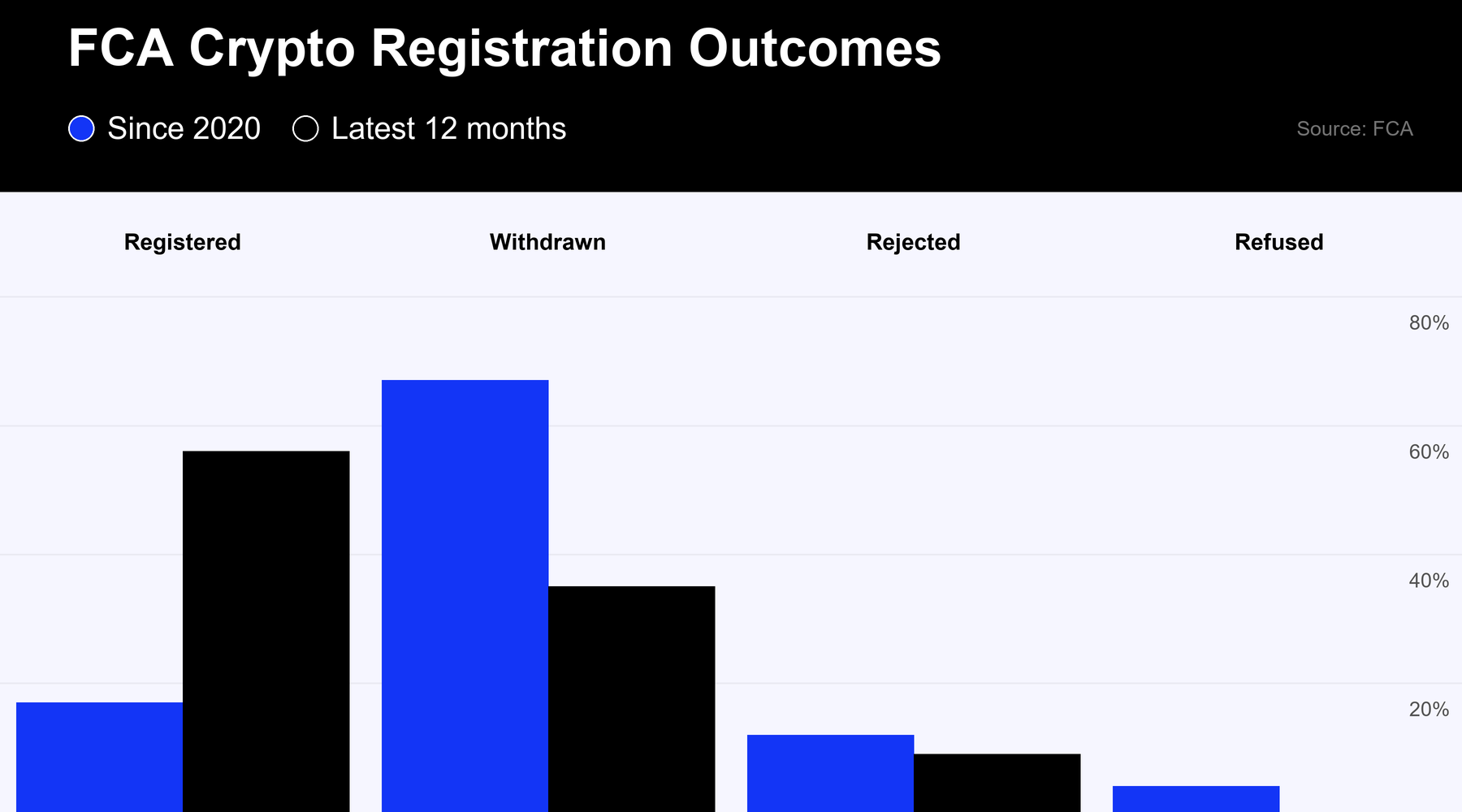
The latest 12-month figures point in another direction. Registrations represented 13 of 23 determinations, or 56%, while withdrawals fell to 35% of decisions. Across the full period since January 2020, registrations accounted for only 68 of 391 decisions, or 17%.
That comparison does not establish that the FCA lowered its standards. The recent figure covers decisions made during one period, not a matched group of applications submitted during the same period.
Cases can cross reporting windows, and firms may return with another application after withdrawing or being rejected.
The small denominator also matters. Twenty-three recent decisions are not enough to identify whether the change came from stronger applications, a different mix of firms, earlier regulatory engagement or case timing.
The public tables show outcomes, but they do not connect each decision to its filing date or identify repeat applicants.
A New Gateway Replaces the Old Comparison
The historical record arrives just before the UK changes the regulatory test. Crypto firms will be able to apply for authorization under the Financial Services and Markets Act from September 30, 2026, with the application window expected to close on February 28, 2027.
Existing registrations under the Money Laundering Money Laundering Money laundering is a blanket term to describe the process by which criminals disguise the original ownership and proceeds of criminal conduct by making such proceeds appear to be derived from a legitimate source.Money laundering is an issue that traverses countless industries and sectors, which includes the financial services space. Though criminal money may be successfully laundered without the assistance of the financial sector, billions of dollars’ worth of criminally derived money are laund Money laundering is a blanket term to describe the process by which criminals disguise the original ownership and proceeds of criminal conduct by making such proceeds appear to be derived from a legitimate source.Money laundering is an issue that traverses countless industries and sectors, which includes the financial services space. Though criminal money may be successfully laundered without the assistance of the financial sector, billions of dollars’ worth of criminally derived money are laund Read this Term Regulations will not convert automatically. The new assessment extends beyond anti-money laundering controls to governance, operational resilience, prudential requirements and Consumer Duty.
FinanceMagnates.com previously reported that firms applying late may face restrictions on taking new UK business while their cases remain pending.
That makes the historical 17% registration share a poor forecast for the 2027 regime. The applicant population, legal standard and available transitional protections will be different. Even firms that cleared the existing gateway must apply again.
The older data still show where applications have left the process and why formal refusals alone understate attrition.
The complete FM Intelligence report examines the outcome definitions, the shift in recent decisions and the parts of the UK crypto market that the registration statistics do not capture.

 cointelegraph.com + 2 more

 crypto.news
 coingape.com
