


 10
10
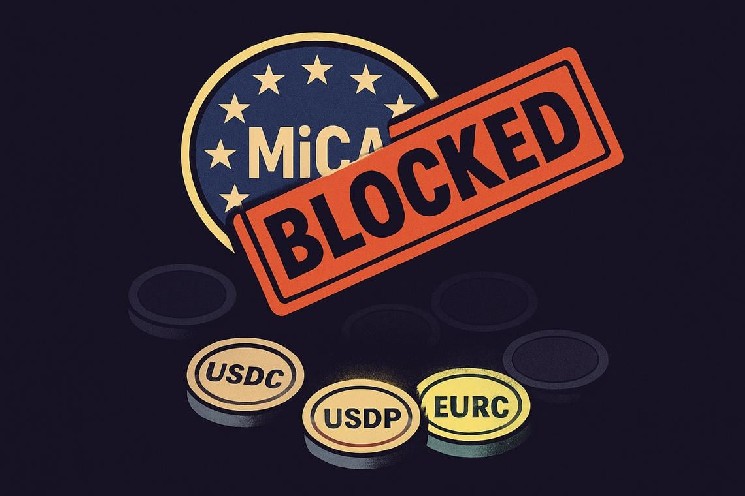
Only three stablecoins from the world’s top 50 currently meet the EU’s MiCA standards — and that gap between market reality and regulatory compliance is bigger than most people realize. According to Patrick Hansen, Circle’s Senior Director of EU Strategy and Policy, the EU stablecoin market has made measurable progress under MiCA, but the numbers reveal just how much of the global stablecoin ecosystem still operates outside Europe’s regulatory perimeter.
Key takeaways
- The EU currently has about 35 regulated e-money tokens issued by 21 entities under MiCA.
- Among the world’s top 50 stablecoins, only $USDC, $USDG, and $EURC are MiCA-compliant.
- Patrick Hansen, Circle’s Senior Director of EU Strategy and Policy, flagged the compliance gap and outlined what the MiCA framework review should address.
- The upcoming MiCA review is expected to target improved competitiveness, stronger global regulatory coordination, and a recognition regime for foreign-regulated stablecoins.
Current MiCA Compliance of Top Stablecoins in the EU
The EU’s MiCA regulation has produced a structured, functioning market for regulated stablecoins — but the compliance picture at the top of the market is strikingly thin. Out of the 50 largest stablecoins in the world by market capitalization, just three — $USDC, $USDG, and $EURC — satisfy MiCA’s requirements as regulated e-money tokens. That is not a rounding error. It reflects a structural divide between the EU regulatory perimeter and where the bulk of global stablecoin activity actually occurs.
All three compliant tokens are connected to Circle, the US-based stablecoin issuer that has been among the most aggressive in pursuing European regulatory authorization.
Overview of Regulated E-Money Tokens and Entities
Across the EU as a whole, the regulated stablecoin market encompasses approximately 35 e-money tokens issued by 21 entities. That represents a meaningful base of compliant issuers, suggesting MiCA has successfully created a licensing pathway. But the fact that only a handful of those tokens appear anywhere near the top of global stablecoin rankings points to a deeper problem: MiCA compliance, as currently structured, may be a barrier that global-scale issuers are choosing to navigate around rather than through.
The largest stablecoins by market cap — most of them dollar-denominated and issued outside the EU — remain outside MiCA’s framework entirely.
Top MiCA-Compliant Stablecoins
Among the 50 biggest stablecoins globally, $USDC, $USDG, and $EURC stand as the only MiCA-compliant options. $USDC and $EURC are both Circle products; $USDG is issued under the Global Dollar Network. For EU-based traders, institutions, and DeFi participants who want to remain within compliant rails, that list is short — and the dominance of Circle-affiliated tokens within it is notable.
This concentration matters strategically. Any EU regulatory tightening or enforcement push against non-compliant stablecoins would immediately benefit the handful of issuers that have already gone through the MiCA authorization process.
Insights from Circle on EU Stablecoin Regulation
Circle’s Hansen is one of the most active voices shaping how the industry engages with European policymakers, and his assessment of the current MiCA framework is both candid and forward-looking.
Role and Perspective of Patrick Hansen
As Circle’s Senior Director of EU Strategy and Policy, Hansen sits at the intersection of regulatory affairs and market development. His observation that only three of the top 50 stablecoins comply with MiCA is not a criticism of the regulation per se — it is a diagnosis of how far implementation still needs to go before MiCA achieves the market transformation it was designed to deliver.
The EU has built a working regulatory architecture. What it has not yet done is bring the largest, most liquid stablecoin products into that architecture.
Expected Outcomes of the MiCA Framework Review
Hansen pointed to three priorities the MiCA framework review should deliver. First, improvements to market competitiveness — addressing concerns that the current rules place EU-compliant issuers at a disadvantage relative to unregulated competitors operating in less restrictive environments. Second, stronger global regulatory coordination, acknowledging that stablecoins are fundamentally borderless instruments that cannot be fully governed by any single jurisdiction acting alone. Third, and perhaps most structurally significant, the establishment of a recognition regime for foreign-regulated stablecoins — a mechanism that would allow stablecoins authorized under other jurisdictions’ frameworks to operate within the EU under defined conditions, rather than forcing every issuer to seek full MiCA authorization from scratch.
That third point carries broad implications. A recognition regime could dramatically expand the pool of compliant stablecoins available to EU users without requiring every global issuer to establish a European entity and navigate the full licensing process. It would also signal a shift in European regulatory philosophy — from an inward-facing compliance wall toward a more interoperable, internationally coordinated approach.
Whether those reforms materialize in the near term remains open. The timeline for the MiCA review has not been specified, and the precise criteria for any recognition regime are still undefined. But the direction Hansen outlined suggests the EU is aware that a framework with only three compliant tokens among the global top 50 is not yet delivering the competitive, integrated digital asset market that MiCA was envisioned to create.
FAQ
How many e-money tokens are regulated under MiCA in the EU?
About 35 regulated e-money tokens are currently issued by 21 entities in the EU under the MiCA framework.
Which of the world’s top 50 stablecoins comply with the EU’s MiCA regulation?
Only $USDC, $USDG, and $EURC among the top 50 stablecoins by market capitalization comply with MiCA.
Who from Circle has provided insights on MiCA compliance and regulation?
Patrick Hansen, Circle’s Senior Director of EU Strategy and Policy, provided the key data and analysis on MiCA compliance status and the expected outcomes of the framework review.
What are the expected benefits of the ongoing MiCA framework review?
According to Hansen, the review aims to improve competitiveness for EU-regulated issuers, strengthen global regulatory coordination, and establish a recognition regime for stablecoins regulated under foreign frameworks — potentially expanding the range of compliant tokens available to EU users.
Article produced with the assistance of artificial intelligence and reviewed by the editorial team.

 crypto.news
 cryptopotato.com
 coinpedia.org
 cointelegraph.com + 1 more