


 3
3
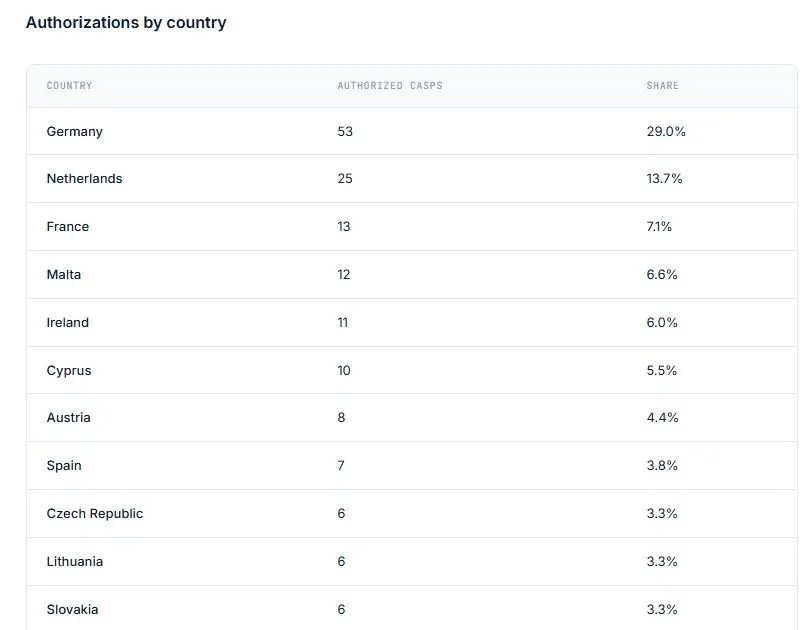
Europe’s crypto sector is entering its sharpest contraction in years. About 210 firms hold a Markets in Crypto-Assets (MiCA) licence ahead of the July 1 MiCA deadline.
That number compares with nearly 2,747 Virtual Asset Service Provider (VASP) registrations counted across the European Union in 2024. The new licensed group represents roughly 7% to 8% of the previous registered universe, according to industry trackers and supervisory data.
MiCA Deadline: The Scale of the Cut
Industry tracker Coincub estimated 2,747 VASP registrations across Europe in 2024. Poland alone accounted for more than 1,400. ChainScreen placed authorised CASPs at around 183 in April 2026. ITISPay updated that figure to roughly 210 by May.
Estonia shows the squeeze most clearly. Its Financial Intelligence Unit reported 641 licensed VASPs in June 2021. The number fell to 45 by October 2024 and to 40 by February 2025. The country was once one of Europe’s largest crypto hubs.
France highlights a different angle. Reuters reported in January that only 30% of roughly 90 unlicensed French firms had applied for MiCA authorisation. A further 40% did not intend to apply, and 30% had not responded to the regulator.
Patrick Hansen, Director of EU Strategy and Policy at Circle, has tracked MiCA authorisations since December 2024. His early-2026 count showed 39 CASP licences and 14 stablecoin issuer approvals among the first 54 granted.
The pace has picked up since then, but it remains far short of the legacy market. The list of licensed crypto exchanges captures only a slice of that group.
Why Most Providers Will Not Make It
The CASP standard demands governance frameworks, prudential capital, cybersecurity controls, client protections, and continuous supervisory dialogue. Smaller firms struggle to absorb those fixed costs.
Faustine Fleuret is Head of Public Affairs at Morpho and a former president of the French industry association ADAN. She has argued that MiCA’s design places a heavy burden on smaller players.
“A small startup and an international giant are treated the same way: there is no scaling of MiCA rules according to the size of the actor or the risks they pose.”
The VASP licensing process under earlier national regimes was already demanding. MiCA raises the bar substantially while applying identical rules to every applicant, regardless of size.
What Happens After July 1
Ignacio Santos is CEO of Madrid-based Fazil Crypto. He told BeInCrypto exclusively about heavy inbound interest since his firm obtained its Spanish CASP licence.
“Since it was published that we had obtained authorisation, we have seen a huge amount of movement. We have been contacted by exchanges, payment companies, law firms, M&A advisers, entrepreneurs with crypto projects and also companies from outside Europe.”
Unlicensed entities now have five options after July 1. They can obtain a licence or stop operating. Other options include an orderly wind-down, client transfer to an authorised CASP, or a merger with a licence-holder. The French AMF warned in May that operating without authorisation will expose firms to criminal prosecution.
Law firms tracking the transition expect a wave of consolidation through the second half of 2026. International operators seeking European access face the same choice as smaller domestic firms. Recent EU crypto licensing rules suggest the framework will continue to favour larger, well-capitalised players.
The market that emerges in late 2026 will be smaller and more concentrated. Whether it also becomes safer for retail users depends on enforcement after the deadline.

 coingape.com
 protos.com