


 5
5
India’s Parliamentary Standing Committee on Finance is set to meet representatives from Binance, WazirX, and ZebPay on May 20 as lawmakers examine the future of digital assets. The meeting comes as India’s crypto sector remains active, heavily taxed, and still without a complete regulatory framework.
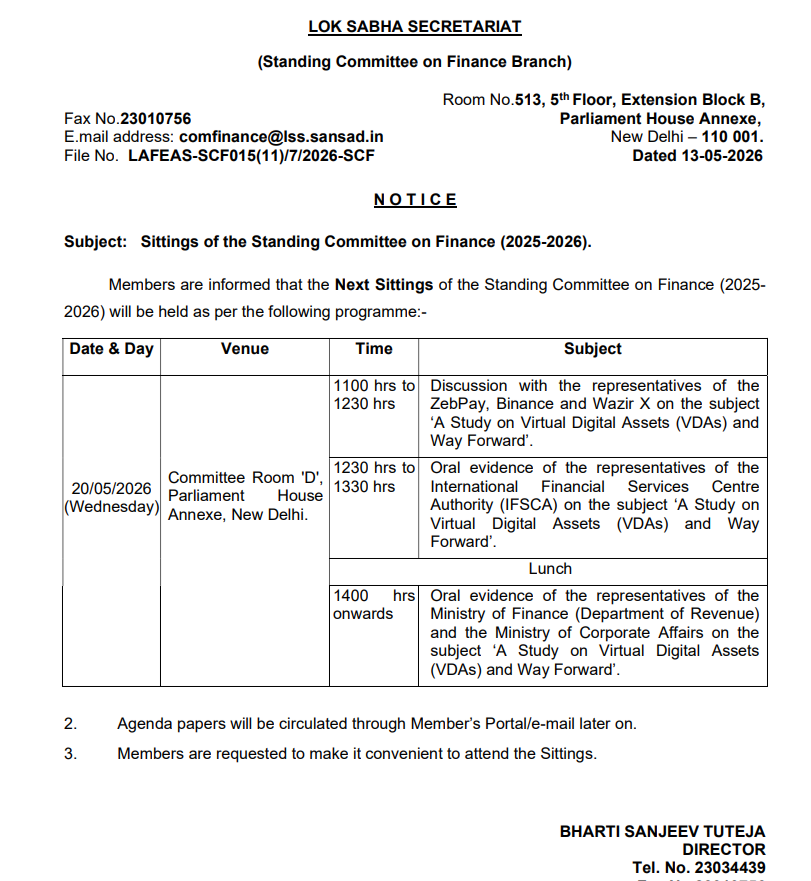
According to the Lok Sabha Secretariat notice, the sittings will take place at the Parliament House Annexe in New Delhi. The subject listed for the day is “A Study on Virtual Digital Assets (VDAs) and Way Forward,” placing crypto policy back in focus for exchanges, regulators, and investors.
Crypto Exchanges Face Parliament Panel
The first session is scheduled from 11:00 a.m. to 12:30 p.m. and will include representatives from ZebPay, Binance, and WazirX. The panel is expected to hear from the exchanges on market operations, user protection, compliance standards, and the impact of India’s current tax rules.
Source: X
This marks a direct engagement between lawmakers and three well-known crypto platforms operating in or around the Indian market. Their appearance matters since India has continued to treat crypto as a taxable asset class while stopping short of introducing a full sector-wide law.
The second session will run from 12:30 p.m. to 1:30 p.m. and will include oral evidence from representatives of the International Financial Services Centre Authority. The final session, from 2:00 p.m. onward, will involve officials from the Ministry of Finance’s Department of Revenue and the Ministry of Corporate Affairs.
Regulation Beyond Taxation
India’s crypto industry has long argued that taxation alone cannot serve as a regulatory framework. The country currently applies a 30% tax on gains from virtual digital assets, while a 1% TDS has also weighed on domestic trading activity.
However, lawmakers have moved slowly on broader rules. Minister of State for Finance Pankaj Chaudhary previously told Parliament that the government had no fixed timeline to finalize VDA regulations, noting that crypto assets are borderless and require international coordination.
That uncertainty has left exchanges navigating a mix of tax rules, anti-money laundering obligations, and financial intelligence reporting requirements.
Compliance and Investor Protection in Focus
The May 20 meeting may also revisit concerns around financial crime, platform accountability, and investor protection. Earlier reports noted that Binance, ZebPay, and WazirX had links to investigations involving crypto assets seized in money-laundering probes tied to online gaming and betting applications.
Meanwhile, India’s courts have also started shaping the legal treatment of digital assets. A recent report noted that the Madras High Court recognized cryptocurrency as property under Indian law in a case involving XRP tokens on WazirX, giving users and businesses a clearer legal footing for ownership and disputes.
The committee’s discussions may not deliver immediate regulation. Nevertheless, they could help define what India’s next VDA framework should include, from exchange registration and consumer safeguards to tax reform and compliance duties. For India’s crypto market, the hearing signals that lawmakers are again moving beyond a tax-only approach and toward a wider policy debate.
Related: Wego Launches Stablecoin Payments With Triple-A for Travel Bookings

 cryptobriefing.com
 coingape.com
 bitcoinworld.co.in