


 4
4
A recent legal document from the U.S. Congress has now reaffirmed the classification of $XRP as a commodity by the SEC and CFTC.
The document released by the U.S. Congressional Research Service (CRS) called attention to the latest framework developed by the U.S. SEC, which classified $XRP alongside Bitcoin and Ethereum as digital commodities.
Key Points
- The U.S. CFTC and SEC classified $XRP as a digital commodity in a joint statement in March 2026.
- A Congressional Research Service report has now reaffirmed this by placing $XRP in the digital commodities category under the SEC’s new framework.
- The SEC’s updated system divides crypto assets into five groups.
- The SEC v. Ripple Labs introduced a major difference between initial token sales and secondary market trading.
Congress Document Reaffirms $XRP Classification
Notably, the recent moves show U.S. regulators have taken a more direct position on $XRP. For context, in March 2026, the U.S. CFTC and SEC released joint guidance that placed $XRP alongside Bitcoin and Ethereum as a digital commodity.
This move showed a change from earlier views under the previous SEC leadership, which often treated most crypto assets as securities.
The update has now gained more support through a new Congressional Research Service (CRS) legal document, which highlights the same classification, giving it more credibility. $XRP’s inclusion in this category indicates that both regulators and lawmakers now show stronger alignment on how to treat major crypto assets.
Content of the Congressional Document
The CRS document, published on April 3, 2026, explains how U.S. securities laws apply to crypto assets. For context, the SEC has adopted a five-part system that groups assets into digital commodities, digital tools, digital securities, stablecoins, and collectibles. Within this system, the report places $XRP under digital commodities.
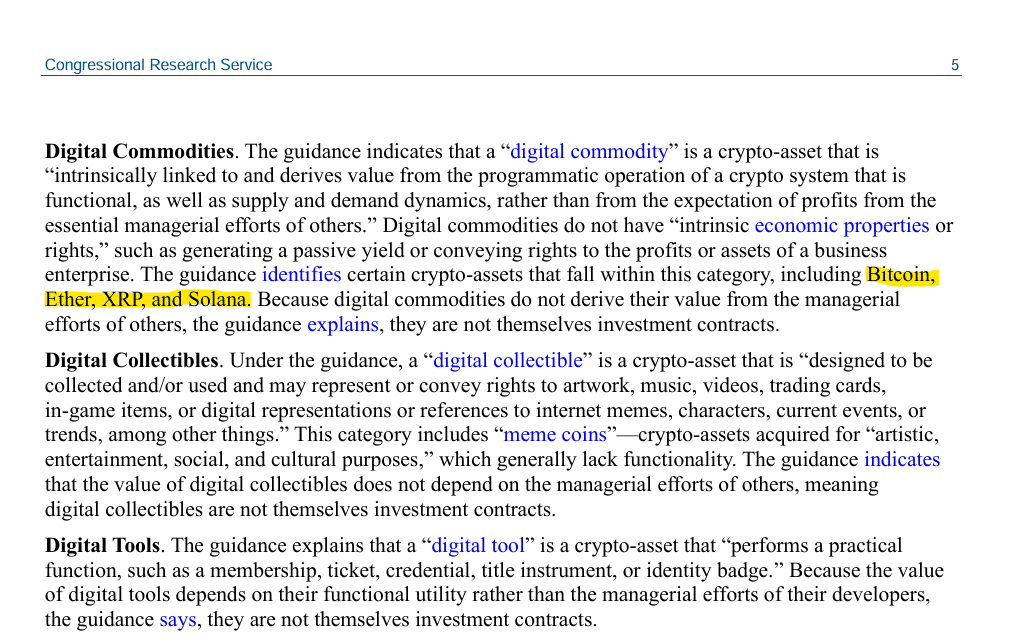
The document notes that digital commodities get their value from how their networks function and from market demand, not from the efforts of a central group. As a result, the SEC does not treat them as securities by default. Instead, regulators assess how people sell or promote these assets to decide if a transaction qualifies as an investment contract.
The report also explains that a crypto asset can fall under securities rules if issuers promote it with promises of profit based on their work. Once those promises no longer drive expectations, the asset can move out of that category. The new approach focuses on real use and investor expectations instead of relying only on decentralization.
Ripple Case Influencing Legal
The CRS report also discussed the case involving Ripple, highlighting its impact on crypto regulation. It mentioned the ruling in SEC v. Ripple as a major example of how courts apply securities laws to digital assets.
Notably, the case introduced a difference between early token sales and later trading. Courts may treat initial sales as securities offerings in some situations, while secondary market trading does not always meet that standard.
However, the document clarified that courts still disagree on some details. Notably, different judges have taken different positions, which shows that the legal framework continues to develop. Despite this, the Ripple case remains an important reference point in current discussions.
The CRS document placed these developments within a broader policy shift in the United States. The SEC has started to focus more on clarity and less on aggressive enforcement. As a result, it has dropped some cases and launched efforts to guide the crypto market more clearly. Meanwhile, Congress continues to work on laws that will define how the SEC and CFTC share oversight.

 news.bitcoin.com

 coindesk.com
 2
2
 cryptopolitan.com