


 6
6
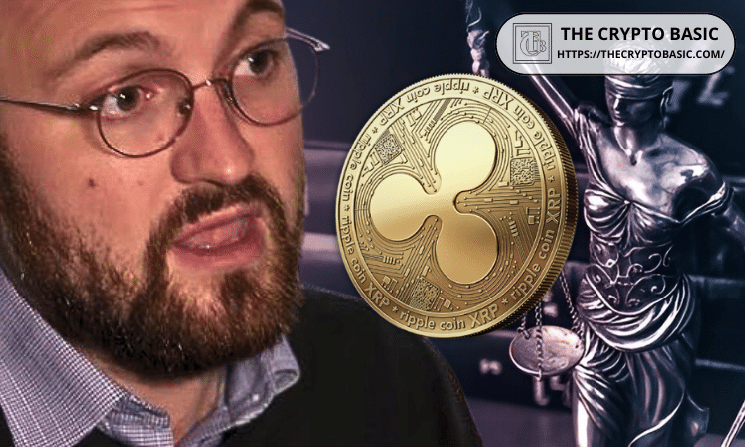
Cardano founder Charles Hoskinson addresses fresh criticism from the $XRP community over his lack of support for Ripple during its legal battle with the SEC.
Amid his continued criticism of the Clarity Act and Ripple’s backing of the bill, Hoskinson pushed back against claims that he ignored Ripple’s legal struggles.
Key Points
- Charles Hoskinson stressed that he publicly opposed the U.S. SEC lawsuit against Ripple.
- He added that Ripple did not need financial backing, as its large pre-mined $XRP holdings, valued at billions of dollars, already provided the resources to fund its legal defense.
- Hoskinson argued that Ripple is not acting in the industry’s interest, criticizing its support for the Clarity Act, which he described as deeply flawed.
- $XRP community members question why he rarely addresses Ethereum’s ICO token distribution, despite his early involvement in the project.
Ripple Didn’t Need Financial Support to Fight SEC: Hoskinson
Addressing the controversy in his latest livestream, Hoskinson argued that critics have misrepresented his stance during the lawsuit. He explained that he publicly opposed the SEC’s decision to sue Ripple and expressed this position in several interviews and recorded discussions at the time.
However, some members of the $XRP community maintained that public comments were insufficient. Instead, they argued that influential crypto leaders should have offered direct financial support to help Ripple defend itself.
In response, Hoskinson rejected the view and pointed to Ripple’s substantial financial resources. He emphasized that the company has a massive $XRP pre-mine that gives it sufficient financial strength. To further reinforce the point, he noted that the company funded the $1.2 billion Hidden Road acquisition using these resources.
As a result, Hoskinson argued that Ripple already had more than enough capital to manage its legal battle without relying on financial backing from leaders in other blockchain ecosystems.
Ripple Not Fighting for the Industry
Meanwhile, Hoskinson broadened the discussion to address industry politics and regulatory advocacy. He argued that Ripple is not promoting policies that benefit the entire digital asset sector, citing its support for the Clarity Act.
According to Hoskinson, the current version of the Clarity Act could shield Ripple and $XRP while leaving smaller projects exposed. In particular, he warned that the bill may classify newer projects as securities while protecting established networks.
Furthermore, he cautioned that passing the legislation in its current form could reduce competition in the crypto sector. He also suggested that some provisions could expose open-source developers to unlimited legal liability.
Given these concerns, Hoskinson argued that Ripple’s continued support for the Clarity Act stems primarily from its own interests rather than from efforts to defend the broader industry.
$XRP Community Pushback
Hoskinson’s remarks triggered another round of debate among $XRP supporters. Some critics challenged his claim that Ripple allocated over 70% of the $XRP supply to itself.
They questioned why he rarely discussed token distribution during the Ethereum ICO, an early project he co-founded. For context, critics have often raised concerns about the actual size of founders’ allocations in early blockchain projects, suggesting the amounts may be larger than publicly reported.
Moreover, $XRP supporters accused Hoskinson of criticizing Ripple out of competitive rivalry, suggesting that $XRP could benefit more from the Clarity Act than ADA.
Hoskinson Warns of Declining Industry Discourse
Amid this backlash, Hoskinson expressed concern that the crypto industry is losing the ability to engage in meaningful debate. He argued that years of social media propaganda, sensationalized coverage, and polarized narratives have weakened the public’s capacity to critically analyze complex issues.
Meanwhile, Ripple and its CEO, Brad Garlinghouse, have continued to support the Clarity Act, even as recent moves have prohibited stablecoin yields. To them, “clarity is better than chaos.”
Garlinghouse has previously indicated that he expects the legislation to pass as early as the second quarter of the year.
However, it remains unclear whether this projection will materialize amid growing pushback from industry stakeholders such as Hoskinson and Coinbase CEO Brian Armstrong.

 u.today
 1
1


 cointelegraph.com

 news.bitcoin.com
 coinfomania.com