

 2
2

 14
14
Justin Sun and his numerous cryptocurrency projects feature as both a plaintiff and a defendant in a variety of different lawsuits.
In fact, there are so many that keeping track can almost feel like a full time job. So, for those interested in that sort of thing, Protos has attempted to cut through the clutter and pulled together the suits involving Sun and his firms that we believe are most important.
Justin Sun’s fight with Huobi’s founder
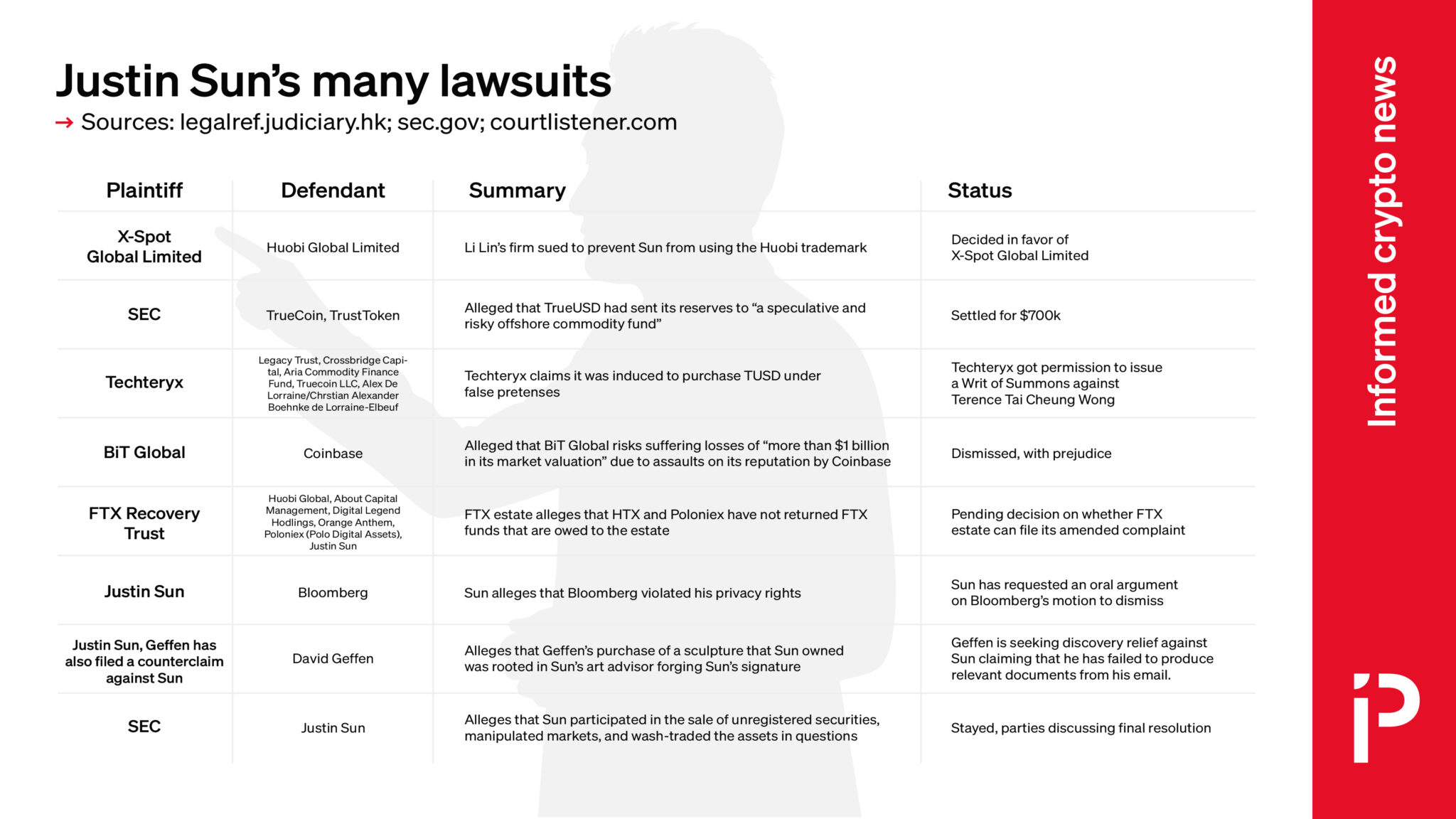
Sun has been engaged in a series of disputes with Huobi founder Li Lin.
Initially, Sun accused Li’s brother, Li Wei, of taking advantage of the Huobi Token, specifically claiming that Li Wei had “received millions of HT tokens for free.”
This tweet was subsequently deleted.
Read more: Justin Sun fights a lot of lawsuits on behalf of companies he doesn’t own
The focus of this dispute then shifted to Sun’s use of the “Huobi” name.
Eventually, the High Court of Hong Kong determined that the requested injunction from Li’s firm would be granted, limiting Sun’s ability to use the Huobi name in Hong Kong.
More recently, Sun accused Li of concealing a $30 million hole in Huobi’s books when it was sold to About Capital Management.
Sun has since deleted the tweet where he made this accusation.
TrueUSD and the missing reserves
Techteryx, the Sun-affiliated firm that operates TrueUSD, has been engaged in a dispute with First Digital over the reserves of TrueUSD and how they were managed and invested.
TrueUSD had allowed First Digital to manage substantial portions of the reserves, and these investments were directed into a series of speculative and illiquid investments.
The portion of TrueUSD’s reserves invested into these assets became inaccessible when the fund they were invested in refused redemption.
Read more: What’s up with TrueUSD and the rest of TrustToken’s stablecoins?
Many of these claims about the reserves were echoed in the SEC lawsuit against TrueUSD (already settled).
Additionally, an attestation for TrueUSD from Moore Hong Kong, including notes from Techteryx executive Jennifer Jiang retrieved on February 19, reads, “The Hong Kong depository institution has invested all or substantially all of the collateral in other instruments to generate yield, which cannot be readily convertible to cash, and are subject to ongoing legal proceedings.”
Several of the defendants in this case maintain that this issue should be handled according to an arbitration agreement and not in court.
Read more: FTX knew Justin Sun tried to acquire TrueUSD
Reporting and legal filings related to this case have also revealed that Sun had to extend a large line of credit to TrueUSD because of the insolvency resulting from this reserve mismanagement.
Sun has also publicly claimed that First Digital’s role in the management of these reserves suggest “obvious loopholes in the trust industry in Hong Kong.”
First Digital Trust also publicly responded to Sun’s accusations, claiming that a substantial portion of the redemption issue for TUSD’s reserves was rooted in “AML/KYC concerns regarding the buy-out deal between TrueCoin and Techteryx and the identification of the ultimate beneficial owner of Techteryx.”
This would seem to be an allusion to Sun, though Techteryx and TrueUSD have, for some reason, continued to maintain that Sun isn’t the ultimate beneficial owner.
Older TrueUSD-related firms, specifically Archblock, TrueCoin, and TrustToken, have also recently been targeted in a lawsuit by the Celsius estate.
BiT Global’s lawsuit against Coinbase
Coinbase and Sun have been involved in lawsuits over tokenized bitcoin (BTC).
Sun is an advisor to Wrapped Bitcoin (WBTC) and has ties to BiT Global.
After Sun became involved with WBTC, Coinbase chose to delist the token.
Read more: Coinbase takes aim at Justin Sun in WBTC lawsuit response
BiT Global hoped that Coinbase would pay damages and would also be forced to relist WBTC.
Coinbase responded by pointing out it believed there was an “unacceptable risk that control of WBTC would fall into the hands of Justin Sun.”
It additionally noted that BiT Global wasn’t willing to answer questions “about who ultimately owned and controlled BiT.”
BiT Global’s lawsuit was dismissed with prejudice.
FTX’s lawsuit against Justin Sun
The FTX estate is seeking an opportunity to file an amended complaint against HTX, Poloniex, Sun, and other Sun-affiliated entities like About Capital Management.
The proposed amended complaint alleges that both Poloniex and HTX still retain millions in FTX estate assets that they’ve been unwilling to hand over.
Specifically, it alleges that Alameda Research had assets “then-valued at approximately $27.5 million” between the two Sun-owned exchanges, and “both Huobi and Poloniex had locked the Alameda accounts, rendering the debtors unable to recover their assets.”
The suit additionally verified some of the opaque structures that Alameda Research preferred, noting that the Poloniex account wasn’t associated with Alameda Research in general but was opened in Sam Bankman-Fried’s name.
Similarly, the Huobi account was also opened up under the name of an Alameda Research employee.
The amended complaint also complains that Sun’s “liquidity arrangement” with FTX as it collapsed “affirmatively facilitated a breakdown of creditor equality by providing preferential treatment unavailable to others who didn’t have tokens associated with Sun.”
This arrangement ended up “effectively reallocating estate value away from the general creditor body and towards Sun and his enterprises” as it “was designed to — and did — artificially inflate the prices of Sun-affiliated tokens by inducing a surge in demand on FTX.”
Several of the entities defending against this have filed responses opposing the ability for the estate to file this amended complaint, often claiming that the suit had done an inadequate job of proving these Sun-affiliated entities were Sun’s alter egos.
Justin Sun’s lawsuit against Bloomberg
Sun has filed a suit against Bloomberg following his participation in and inclusion on the Bloomberg Billionaire Index.
Sun had shared a variety of documents with Bloomberg, including a list of crypto addresses and evidence that he owned HTX, so that he could be included on the index.
Sun subsequently tried to insist in a group chat with Bloomberg reporters that “all information shared within the group is strictly confidential and for verification purposes only.
He also demanded that, “Once the verification is complete, the data must be deleted,” and also stipulated that the data shared should be used “solely for verification and may not be used for any other purpose (including reporting).”
Read more: ‘Someone’ is taking advantage of HTX’s reserves
Bloomberg, notably, did not agree to these terms.
Subsequently, the outlet was able to publish reporting on Sun that revealed that he owned the majority of $TRX tokens and the HTX exchange.
Most recently Sun’s representatives have requested an oral argument over Bloomberg’s motion to dismiss.
This suit against Bloomberg is only one example of Sun pursuing journalistic outlets; he also reportedly complained to Bullish, CoinDesk’s owner, to get an article about his purchase of a multi-million dollar banana removed.
Justin Sun’s lawsuit against David Geffen
Sun has also filed a suit against music mogul David Geffen.
It alleges that Geffen’s purchase of a sculpture that Sun owned hinged upon Sun’s former art advisor forging Sun’s signature.
Geffen’s representatives have described the suit as “seller’s remorse.”
Geffen has also filed a counterclaim against Sun that alleges that Sun filed this lawsuit because his team had “failed to find a buyer” for paintings that were part of the deal with Geffen.
Geffen’s counterclaims allege that following this failure, “Sun and Xiong contrived this fraudulent lawsuit, hoping to pressure Geffen into rescinding the deal or paying Sun.”
The SEC lawsuit against Justin Sun
The SEC has also sued Sun, alleging that he sold unregistered securities, wash-traded, and participated in market manipulation.
Allegedly, Sun and Sun-affiliated entities engaged in a scheme to wash-trade $TRX tokens on a US-based platform, specifically Bittrex.
Additionally, the amended complaint details how Sun was frequently spending time in the United States while he was directing these activities, helping the SEC establish jurisdiction.
Read more: SEC sues Justin Sun over $TRX, BTT, market manipulation
Recently, Sun has become one of the largest financial supporters of United States President, Donald Trump.
Sun was the largest individual purchaser of the $TRUMP memecoin and also the largest individual purchaser of the WLFI token issued by Trump-founded World Liberty Financial.
World Liberty also named Sun as an advisor to the project.
Subsequently, the SEC requested a stay in the case, leading to frequent accusations of Sun-Trump corruption centered around their extensive financial relationship.

 decrypt.co
 coingape.com

 en.bitcoinsistemi.com


 cryptobriefing.com