



 4
4
Ripple CEO Brad Garlinghouse now sees a 90% chance the Clarity Act passes by April, outpacing prediction markets as White House pressure and industry backing intensify, signaling accelerating momentum for long-sought U.S. crypto regulatory clarity.
Ripple CEO Turns 90% Bullish on Clarity Act as Prediction Markets Lag Behind
Momentum is building rapidly in Washington to advance the Clarity Act, with Ripple CEO Brad Garlinghouse projecting a 90% chance the bill passes by the end of April as lawmakers work against a White House-backed March 1 deadline to move the legislation forward before the midterms. His outlook is notably more bullish than Polymarket odds, which currently price the probability of passage lower than his estimate.
Commenting on his earlier estimation of an 80% chance, Garlinghouse stated:
“I think it’s now 90% it will pass by the end of April.”
“The White House is pushing hard on this, and I think that is a big reason why it will get done. It needs to get done for U.S. leadership,” the Ripple CEO opined.
Garlinghouse emphasized Ripple’s pragmatic approach to the legislation, noting: “Our position is very much: don’t let perfection be the enemy of progress.” He continued: “No bill is perfect, and I think that it got stalled because I think some in the industry are kind of pushing for something a little bit more perfect. Our view is we need clarity.” He then described a White House meeting involving leaders from the crypto and banking sectors, where Ripple’s chief legal officer represented the company, underscoring the administration’s effort to broker compromise and move the measure forward.
Polymarket data tracking the question “Clarity Act signed into law in 2026?” shows traders assigning a 72% chance of passage as of this writing, up 7 percentage points, with the chart reflecting a recent sharp spike before stabilizing in the low 70% range. While the upward move signals growing confidence, the market remains notably less bullish than Garlinghouse’s 90% projection for passage by the end of April.
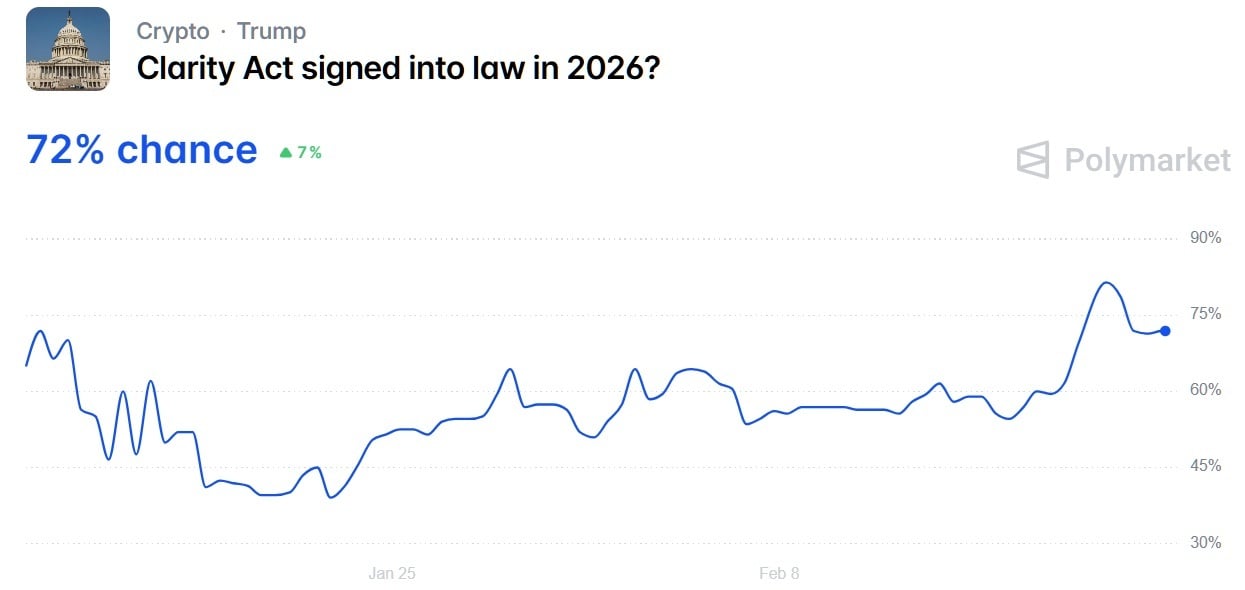
Kalshi prediction markets reflect a similar but more measured outlook on broader crypto market structure legislation. Contracts indicate an 85% probability the measure becomes law before 2027, a 63% chance before June, and a 48% likelihood before May. Although those figures suggest traders expect eventual approval, they fall short of Garlinghouse’s near-term conviction, particularly regarding an April timeline. The divergence highlights the gap between industry leadership optimism and market-based probability pricing.
The main obstacle remains Senate disagreement over stablecoin reward provisions, particularly whether crypto platforms can offer incentives to customers transferring funds from traditional banks. Garlinghouse framed the debate as part of a broader shift in how legacy financial institutions view digital assets and blockchain infrastructure. He highlighted that major banks increasingly want defined rules so they can compete directly with crypto-native firms under the same regulatory standards. The Ripple chief opined:
“I love that. That means the traditional financial industry is coming into the crypto industry more and more, and they want to make sure for them to compete, they have those clear rules of the road.”
He also observed shifting sentiment among major banks, remarking: “The tides have changed significantly … I think as you zoom out and look over the next 10 years, that’s going to continue.” With administration pressure intensifying and cross-industry backing strengthening, Garlinghouse’s outlook signals mounting optimism that regulatory clarity for the crypto sector could arrive in the near term.

 crypto.news

 u.today


 cointelegraph.com