


Digital asset treasury companies have mostly lagged the cryptocurrencies they hold, with only four of the 20 largest trading above the value of their token reserves, according to a new analysis by DWF Ventures.
DWF Ventures compared the share prices of publicly traded crypto treasury companies with the performance of the tokens they hold. It found that most of the 20 largest companies trade at a market-value-to-net-asset-value ratio, or mNAV, below 1, meaning their shares are valued at less than their crypto holdings.
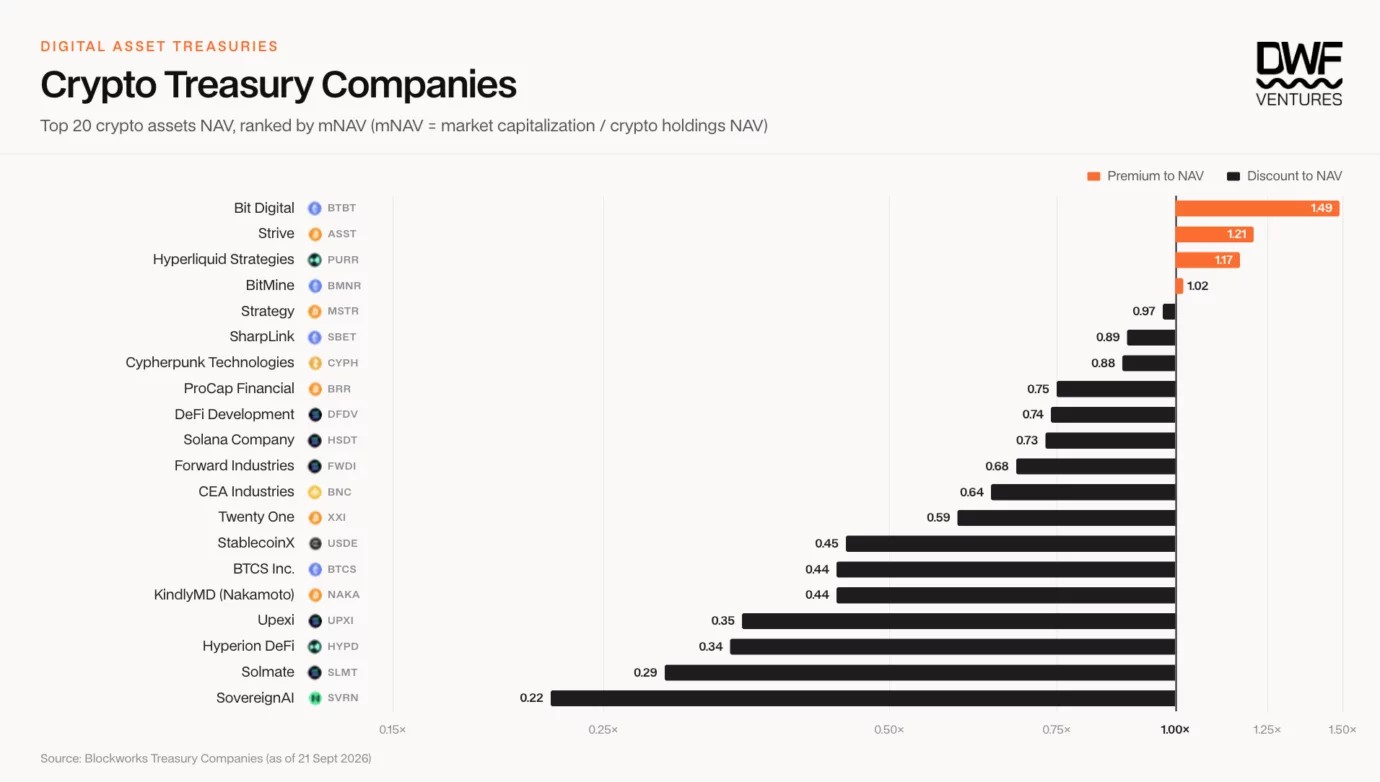
The calculation excludes debt and preferred stock, according to the analysis. Investors therefore need to examine those obligations separately before treating a low mNAV as a discount on everything a company owns.
Crypto treasury stocks have mostly trailed direct holdings
Since the companies began their treasury strategies, buying and holding the underlying token has generally produced a better return than buying their shares, the analysis found. Even where a stock came out ahead, its excess return was usually small compared with the additional risks attached to owning a company.
A treasury share does not track a token in the same way an exchange-traded fund is designed to. Its price also depends on when management buys crypto, how it raises cash, how many new shares it issues, and whether investors expect the company to expand its holdings.
The difference has been visible over shorter periods. Since July, the analysis found that some treasury stocks outperformed their tokens by 15% to 40% as their mNAV ratios climbed from roughly 0.5–0.8 to 0.7–1.0. Hyperliquid-focused PURR and Zcash-focused CYPH recorded returns 31% and 38% above their respective tokens during that period.
According to the analysis, their token holdings per share changed little over those months. Much of the stock gains instead came as investors paid more for exposure to the companies while crypto prices rose. The authors found that the underlying token remained the stronger performer across most periods longer than three months.
A recent U.S. example shows how quickly a treasury stock can move. On Sep. 20, crypto.news reported Strategy’s one-month gain of 47.65% through the Sep. 18 close, a period in which Bitcoin also recovered. The stock’s return over that window does not establish how it has performed against Bitcoin since the company began buying the asset.
A premium lets crypto treasuries buy more tokens per share
The analysis identifies token holdings per share as a central measure of a treasury company’s progress. When a firm’s stock trades above the value of its crypto reserves, it can sell shares, use the proceeds to buy tokens, and potentially increase the amount backing each existing share.
That process becomes harder when mNAV falls below 1. Selling new common shares at a discount can dilute existing investors, while waiting to raise funds may slow further purchases. Companies can also use convertible debt or preferred shares, though each financing method brings terms that common shareholders must weigh.
Strategy has used convertible debt as part of its Bitcoin financing, according to the analysis. Convertible holders may exchange their claims for shares if the stock reaches the agreed terms; until then, the company must manage the obligations attached to its capital structure. The analysis cautions that preferred dividends and other commitments can put pressure on reserves if financing becomes more difficult.
Recent U.S. filings show how differently treasury operators can respond to those demands. As covered in Strategy’s September update, the company bought no Bitcoin and sold no shares through its at-the-market program during the reported week. It instead spent $176.3 million repurchasing STRC preferred shares and doubled its digital credit securities repurchase authorization to $2 billion.
Strive took another route. A Sep. 14 report on its latest Bitcoin purchase said the U.S.-listed company bought 469 $BTC for about $36.6 million using proceeds from SATA preferred stock, bringing its holdings to 25,000 $BTC as of Sep. 11. Its SEC filing gave investors both the purchase amount and the security used to fund it.
Operating income can change the comparison
The analysis says companies can also seek returns from staking, mining, or businesses outside their token reserves. Such income may increase resources available to shareholders without selling the principal crypto holding, although the result depends on operating costs and execution.
For Bit Digital, the analysis points to its cloud infrastructure business, White Fiber, as a reason its shares maintained a premium while the value of its digital assets fell. White Fiber accounted for more than 89% of Bit Digital’s second-quarter revenue, according to the earnings information cited in the analysis.
Ether treasury companies offer another example through staking. BitMine had more than 5.06 million $ETH staked out of holdings approaching 5.98 million $ETH, according to its Sep. 21 treasury update. Staking can earn additional $ETH, but shareholders still own a company whose share price can move differently from Ether.
The analysis also cited SharpLink’s announced $200 million allocation to stETH and a $125 million onchain yield fund with Galaxy. For Zcash-focused CYPH, it pointed to a mining fleet that the company said received more than 18% of the network’s emissions. Each activity gives investors an operating decision to assess alongside the quantity of tokens held.
Access has changed as well. The analysis argues that treasury stocks once drew a premium partly because some institutions could buy listed shares more easily than crypto directly. With more regulated funds and custody options available, its authors expect investors to place more weight on operators, financing terms, and business income when valuing one treasury company against another.

 coindesk.com
 thecryptobasic.com
 beincrypto.com