
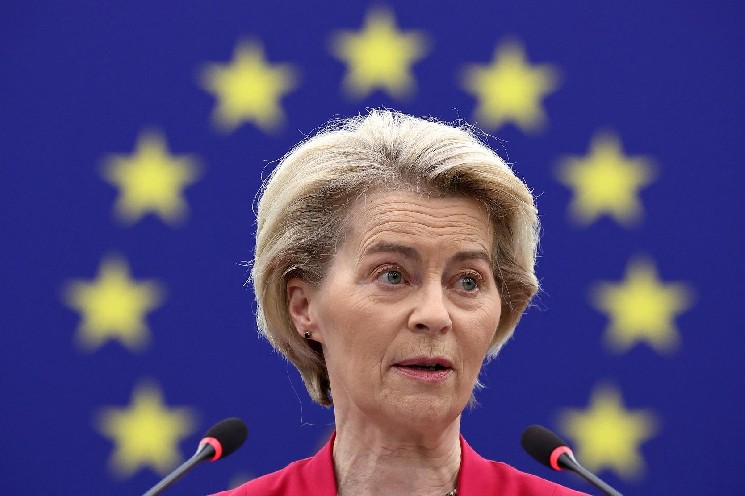

European Commission President Ursula von der Leyen stood before French business leaders late last month and described trillions of euros in household savings held in bank accounts as “sitting idle.” Europe, she continued, needs to “put these savings to work for its companies.”
Her concern is valid, by some measures. European companies struggle to obtain the capital needed to grow their businesses, while households keep a large share of their wealth in bank deposits.
Yet the phrase “sitting idle” reveals an assumption about who those savings actually belong to, and whether individuals can be entrusted to assess risk and make their own decisions about how to manage their money. The European project can and should make capital investment more attractive, but when such initiatives begin to encroach on the concept of private ownership, there is a danger that the state may deign itself a better judge of what people do with their own money than the people themselves.
Europe Has A Real Capital Problem
Europe’s financing gap deserves to be taken seriously. The European Commission’s Savings and Investments Union strategy cites the Draghi report’s estimate that the EU needs an additional €750 billion to €800 billion in annual investment by 2030. Banks remain central to the European economy, but early-stage technology companies need equity capital and deep markets that can absorb risk. Many promising firms still cross the Atlantic to scale or sell themselves to larger foreign companies.
European households also save more of their income than Americans while placing far less of it in capital markets. In a November 2024 speech, European Central Bank President Christine Lagarde stated that the rate of household savings was about 13% in Europe compared to 8% in the U.S. She said Europeans held about €11.5 trillion in cash and deposits in 2023, equal to 1/3 of household financial assets.
The opportunity cost for economic growth may indeed be substantial. European Central Bank analysis estimates that matching the American ratio of deposits to financial assets could redirect up to €8 trillion into the European market. Europe has identified a bottleneck between savers and businesses, and repairing it could therotically enrich households while helping European firms grow.
What Brussels Is Actually Proposing
The language around “mobilizing” savings has invited fears that Brussels plans to seize deposits. The published policy does not support that claim. The Commission’s September 2025 recommendation on Savings and Investment Accounts asks member states to create simple investment accounts that give retail savers access to shares, bonds and regulated funds. It recommends no minimum opening balance, permits multiple accounts and allows assets to move between providers without triggering a taxable event.
Instead, the Commission intends to attract capital investment with favorable tax treatment through deductions, exemptions, deferrals or a uniform tax rate. Member states are encouraged to pair those incentives with simple accounts and broad provider access. Nothing in the account recommendation requires a household to open one. Providers are encouraged to offer diversified investments across asset classes and geographies, with options that support European priorities such as digital infrastructure, defense, and “green” infrastructure. The recommendation excludes most crypto assets from these accounts, although financial instruments with crypto exposure could qualify under existing rules.
A Bank Deposit Is Already Doing A Job
However, calling deposits idle makes sense only from the perspective of the investment Europe wants. A deposit appears inactive because it has yet to become equity in a startup, a bond issued by a European manufacturer or a fund holding European securities. The household holding it may have an entirely different objective.
A bank deposit provides liquidity, stability and optionality. It may represent next month’s rent, savings for medical or caretaking needs, or a cushion that lets a family survive unemployment. It also appears as a liability on a bank’s balance sheet and supports the banking system’s lending and liquidity functions. The return may be low, particularly after inflation, but low yield can be the price a saver knowingly pays for immediate access to funds and lower volatility.
The ECB’s own evidence helps explain this mentality. Lagarde reported that 45% of European consumers lacked confidence that financial advice served their best interests. European retail investors in mutual funds paid almost 60% more in fees than their American counterparts. A household responding to high fees, unknown risk, and distrust has made a choice under imperfect conditions. Better markets could make slow and steady progress at changing minds, but describing peoples’ hard-won savings in a negative light as “idle” obscures the institutional failures that produced this attitude.
Bitcoin Makes The Ownership Question Concrete
Bitcoin can’t solve Europe’s immediate shortage of equity financing. It can’t help Europe catch up in the race to develop cutting edge technology, at which it now trails considerably behind. But bitcoin is relevant to this discussion because of the way it provides for money that is separate from any state or government.
A bitcoin owner holds the keys required to authorize a transaction. The Bitcoin Network has no central issuer or account administrator with power to redirect balances toward an approved industrial objective. Governments can regulate exchanges, tax gains and prosecute crimes. They can also compel people through ordinary legal and physical force. The protocol itself provides no administrative lever for reallocating coins because officials believe another use would be more productive.
That architecture gives technological form to an old idea. Savings are deferred consumption created by labor, judgment and restraint. Their owner may invest them, spend them, lend them or hold them untouched. Bitcoin allows that decision to remain with the holder when it is kept in self-custody, as long as the holder is responsible enough and comfortable with the technology.
Bitcoin’s price is less volatile than it used to be, but still more volatile than many would be comfortable with as their only savings vehicle. On the other hand, volatility and the risk of permanent loss of purchasing-power are different things. Savers need the freedom to decide how much volatility they are comfortable with, given that with that volatility comes a lower risk of inflation and confiscatory policy interventions.
Europe Should Compete For Its Citizens’ Capital
If we were to steelman the position of the Savings and Investments Union, we would find it easy to support its proposals for simplified investment accounts, lower fund fees, consistent rules, and better risk disclosures to give households the confidence and access they need to markets that have previously been fragmented and hard to engage with. And, if European companies offer attractive returns and Europe protects property rights, household capital will have reasons to invest their savings.
However, defense of private property rights in Europe have been historically inconsistent at best. In extreme cases (which nonetheless manifest at least every few decades), countries confiscate savings directly out of accounts, or even round up millions of people, move them out of their homes, and take their belongings. That is to say, if Europeans need more savings in order to feel comfortable, they come by it honestly. To build trust in markets, strong financial engineering is necessary but not sufficient. Cultivating a culture of individual liberty and respect for private property would do much more to bring the attitudes of European savers in line with their counterparts in the U.S. It would do the European Commission good to recognize the need for this cultural transformation, and take steps to move it along, and even recognizing bitcoin as part of the picture.
Von der Leyen’s phrase captured the urgency of Europe’s capital shortage, but it also exposed a need for a public conversation about why trust in European markets is relatively low. A strong investment case earns capital by offering terms savers accept. Savings are accumulated choices. Europe may compete for them. The last word should belong to the people who did the work.

 cryptobriefing.com
 financemagnates.com

 coinpedia.org
 coindesk.com