


 5
5
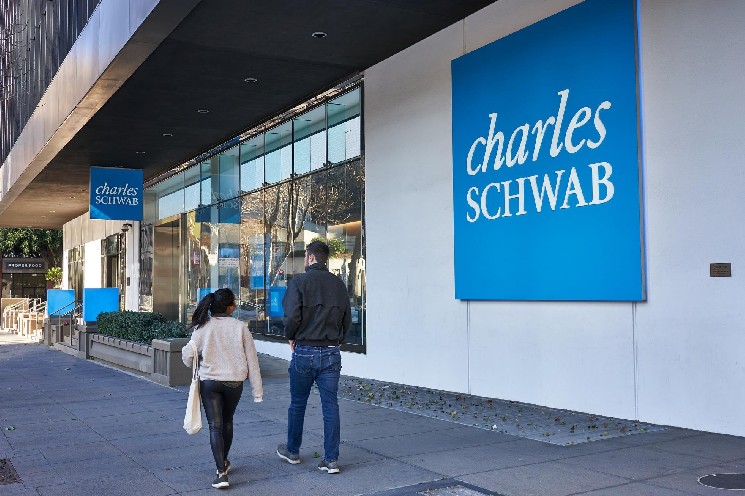
The most consequential crypto launch of 2026 happened with almost no ceremony. On May 13, Charles Schwab began rolling out spot trading in bitcoin and ether to retail clients, inside the half-year window CEO Rick Wurster had promised, at a flat 75 basis points per trade, custodied at Schwab's own bank with Paxos providing sub-custody and execution. By the July earnings call the rollout was "going as planned", a crypto transfers pilot was starting, and Schwab had taken an equity stake in Paxos. The firm behind it reported $13.1 trillion in client assets and 39.8 million brokerage accounts in the same release.
Crypto's retail distribution question, who onboards the next hundred million American holders, was just answered by the largest pool of retail wealth in the country, quietly, mid-drawdown, at a price that undercuts the industry that built the asset class.
The machine attached to that answer is worth pausing on. Schwab's second quarter set records across the franchise: $7.1 billion of revenue, up 21%, 11.9 million daily average trades, up 57%, and $120 billion of core net new assets in the quarter. Wurster attributes the trading surge to young investors and AI-driven engagement he expects to persist. That is the funnel crypto now sits inside: a firm gathering more net new money in one quarter than the entire spot bitcoin ETF complex holds.
Launching into a bear market is the tell
Schwab shipped into weakness. Bitcoin sits near $63,000, the total crypto market around $2.25 trillion, and industry spot volumes fell 25% quarter over quarter in Q2. A momentum-chasing product slips its date in that tape. Schwab launched anyway, because the decision was infrastructure: its clients already hold about $25 billion of crypto ETPs, roughly a fifth of that entire market, and Wurster spent a year repeating what they told him. Clients want crypto "alongside their stocks, bonds and cash, not off to the side on a different app," and, on the Q1 call, they had been begging Schwab to launch so they could consolidate holdings held elsewhere. Elsewhere has a name, and it reported earnings on July 30.
The rollout mechanics were deliberately unglamorous. A waitlist opened in April behind an employee pilot; the launch details specified bitcoin and ether only, no deposits or withdrawals of coins at the start, no SIPC coverage, two states excluded, custody at Charles Schwab Premier Bank with Paxos executing underneath. Nothing about the design chases a cycle. Everything about it converts crypto into a line item on a statement that also shows the client's index funds, which was the entire request: Wurster's clients wanted consolidation, and consolidation is a custody feature, delivered in a custody wrapper.
The price war arrived with the incumbents
Watch the fee ladder collapse. Coinbase's consumer business generated $452 million of transaction revenue on $25.8 billion of consumer volume last quarter, an implied take rate around 1.75%, by my arithmetic on its own disclosures. Fidelity charges a 1% spread on its crypto trades. Schwab set 75 basis points. Morgan Stanley's E*Trade, which launched three coins on July 16 through Zerohash, set 50. Even Vanguard, the last refusenik, reversed itself in December to allow third-party crypto ETFs and is now hiring a digital-assets head. Brokerages price crypto like an asset class, a few dozen basis points and falling. Exchanges priced it like an event.
The compression is already in Coinbase's print: a $359.5 million loss, a third consecutive revenue miss, consumer transaction revenue down 30% year on year. Some of that is the market cycle. The structural part is that every dollar of crypto bought at Schwab for 75 basis points, or at E*Trade for 50, is a dollar that used to be bought somewhere for 175. Zerohash's CEO called the direction months ago: every bank with a trading or wealth arm will offer crypto as a spot product. The take rate that funded crypto's native industry was a distribution premium, and the distribution just changed hands.
The E*Trade launch deserves its own line, because it shows how fast the incumbents iterate on each other. Morgan Stanley picked Zerohash as infrastructure, invested in the firm at a billion-dollar valuation, and went live July 16 with bitcoin, ether and solana, one more coin than Schwab, at 50 basis points, one-third cheaper, five days before Schwab's earnings call. E*Trade's head pitched it as clients wanting to invest, trade, bank and plan in one place. The wirehouses spent a decade dismissing crypto as unsuitable; they have now begun competing on its price and shelf like any other product, which is what absorption actually looks like.
The ETF, the coin and the same login
The obvious question, whether direct coin trading cannibalizes the ETFs, misreads where both now live. BlackRock's IBIT holds about $49 billion, and US spot bitcoin ETFs together hold around $78 billion, well off their peak after the drawdown, with the funds holding over 1.2 million bitcoin, almost 6% of supply. At Schwab, the ETF and the coin now sit in the same account, behind the same login, priced by the same firm. The wrapper choice becomes a tax and custody question, ETFs for IRAs, coins for those who want transfers and eventually self-custody, rather than a venue choice. The entity that loses in that arrangement is whichever standalone app no longer holds the login, which is why the transfers pilot matters more than the trading launch: once coins can move in and out of Schwab, the consolidation Wurster's clients requested, bring your crypto "back to Schwab... they trust us," begins in earnest.
What is still missing tells you what comes next
Two coins, no New York or Louisiana, no staking, no stablecoin, yet. Wurster has said Schwab has been exploring its own path on stablecoins while talking with the bank consortia, and the competitive pressure is visible one shelf over: Fidelity's crypto lineup now includes solana and its own Fidelity Digital Dollar stablecoin sitting beside bitcoin and ether. The brokerage stack is reassembling the exchange stack piece by piece: trading first, transfers second, yield and dollar tokens after. Each addition pulls another exchange function inside the brokerage perimeter, where it gets priced like brokerage.
Even Vanguard's capitulation follows the pattern in miniature. The firm that built its identity on refusing crypto reversed in December to allow third-party bitcoin, ether, XRP and solana funds on its platform, no memecoin products, no house offerings, while insisting it has no plans to launch its own. Then, in July, it posted a job for a head of digital assets to draft a multiyear roadmap. Fidelity, the earliest mover, already runs crypto IRAs and custody through its own national trust bank. The refusal tier of American wealth management has emptied out. What remains is a pricing tier, and it compresses quarterly.
Schwab's ambitions past trading are already on the record, delivered in Wurster's characteristic key of unhurried inevitability. He has discussed working with bank consortia on stablecoins while exploring Schwab's own path, and he has been openly skeptical of tokenized equities, asking what problem tokenization solves for assets that already trade for free, before adding on the July call that if clients want securities in another form, Schwab will be there. That is the incumbent playbook in one sentence: adopt nothing early, refuse nothing permanently, and let the client's account be the place every format eventually lands.
There is an irony worth savoring: Schwab's own investor-education pages once warned that crypto's entire value could disappear. Institutions do not adopt beliefs; they adopt products, once the products clear compliance and the clients hold $25 billion of them anyway. The exchanges spent fifteen years teaching Americans to buy bitcoin. What Schwab's launch settles is who gets paid for the next fifteen: the answer is whoever already holds the rest of the customer's money, at whatever price makes the standalone app look expensive. Crypto wanted to disrupt the brokerage industry. The brokerage industry has responded by absorbing crypto at 75 basis points, and calling it Tuesday. Coinbase, to its credit, saw this coming: subscriptions and services are now nearly half its revenue, and it holds a record 10.3% of global trading share even while losing money. The exchange's future is institutional plumbing and stablecoin economics. The retail future belongs to whoever already has the retail, and at $13 trillion of client assets, that argument settled itself the day the toggle went live.

 coindesk.com

 cryptopolitan.com
 bitcoinworld.co.in
 coinedition.com