


 5
5
Buying the dip in SpaceX (NASDAQ: SPCX) on the day Elon Musk lost his trillionaire status has yet to pay off, with the stock still trading below its June 23 level despite a recent rally.
Based on SpaceX’s August 7 closing price of $133.11, the investment would have declined by about 15% from the June 23 reference price of roughly $156, bringing its total value to approximately $852.
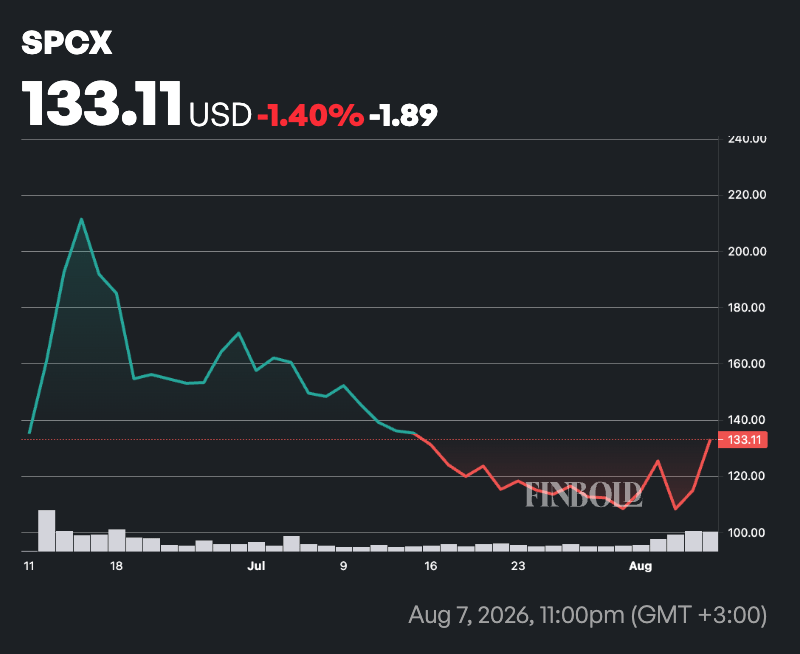
Notably, shares surged 15.83% in the latest trading session, marking their strongest single-day gain since the weeks following the IPO. The rally added more than $300 billion in market value and lifted the company’s valuation to about $1.74 trillion.
SpaceX post IPO rally
SpaceX shares entered the market on June 12 at an IPO price of $135 before opening near $150 and quickly climbing to an intraday high of $225.64 on June 16.
The rally briefly pushed the company’s valuation toward the $3 trillion mark and lifted Musk’s estimated net worth above $1 trillion. Some estimates placed his fortune as high as $1.45 trillion during the post-IPO surge.
However, the momentum reversed sharply as technology stocks came under pressure from rising Treasury yields, concerns over artificial intelligence spending, and widespread profit-taking following the IPO euphoria.
The sell-off intensified on June 22 when SpaceX plunged 16.4% in a single session. The decline erased an estimated $240 billion from Musk’s fortune and contributed to a broader loss of roughly $600 billion in market value from the stock’s peak.
By June 23, SpaceX had surrendered most of its post-IPO gains, pushing Musk’s net worth back below the trillion-dollar threshold.
SpaceX remained volatile throughout July, with shares at one point falling to around $105. The company’s market capitalization also dropped into the $1.4 trillion to $1.5 trillion range.
Investor concerns centered on rising capital expenditures, dilution risks linked to acquisitions, a large post-IPO bond offering, and the upcoming expiration of share lockups.
SpaceX impressive earnings
Despite the pressure, SpaceX delivered strong second-quarter results. Revenue surged 92% year over year to $7.8 billion, beating expectations of about $6.9 billion. Adjusted EBITDA jumped 191% to $3.5 billion, while the net loss narrowed to $541 million from roughly $1 billion a year earlier.
Starlink continued to drive growth, generating $4.29 billion in connectivity revenue and reaching 12 million subscribers after adding 1.7 million users during the quarter. The company’s AI segment contributed $2.56 billion in revenue, while its space operations generated $962 million.
However, capital expenditures climbed to $18.3 billion, including $15.8 billion dedicated to AI infrastructure, a figure that initially weighed on investor sentiment.
At the same time, sentiment improved during the first week of August after the expiration of a major lockup period failed to trigger the heavy selling many investors had expected.

 beincrypto.com
 coinedition.com

 bitcoinworld.co.in
 cointelegraph.com
