

 1
1
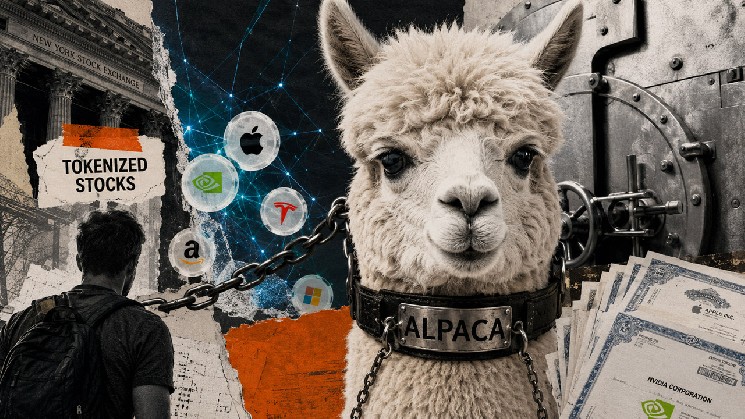
Alpaca says it custodies more than $1.5 billion of shares backing tokenized equities, which, by public tracker measurements, would represent most of the market.
With DTCC preparing to launch its own tokenization service in October and the SEC warning that third-party stock tokens can expose investors to additional ownership and intermediary risks, the numbers reveal a concentrated brokerage layer beneath a market promoted as decentralized.
Tokenization is the practice of representing a real-world asset as a digital token on a blockchain, so that owning the token stands in for owning, or at least tracking, the thing itself. Applied to equities, it means a version of Apple or Nvidia stock that exists in a crypto wallet, trades on crypto exchanges around the clock, and moves between buyers in minutes without touching a traditional brokerage account.
A buyer from basically anywhere in the world can hold exposure to US companies through the same app they use for Bitcoin, at any hour, in fractional amounts, and the market has grown into hundreds of tokenized assets spread across Solana, Ethereum, and several other chains, issued by competing platforms and sold through exchanges that never close.
The sales pitch attached to all of this was disintermediation, the removal of all the intermediaries who stand between an investor and a share. Follow any of these tokens back toward the actual stock market, though, and the trail converges on a single California brokerage most people have never heard of.
Alpaca, a self-clearing broker-dealer founded in 2015, says it clears or custodies roughly 94% of tokenized US stocks and ETFs and holds more than $1.5 billion of the underlying shares behind them. On July 16, it raised $135 million led by Peak XV, with debt from Kraken's parent Payward and from BMO lifting the package to $435 million. A market designed to reduce intermediaries has produced a dominant new one.
The machine behind tokenized stocks
A tokenized stock only works if someone with a brokerage license buys the real share, holds it under US custody rules, and keeps the token supply matched to the inventory. Very few established brokers wanted that business when crypto platforms came asking, so the issuers who built this market, including Kraken's xStocks, Dinari, and Ondo, routed through the broker willing to take them.
Alpaca became the common counterparty by showing up, and its role has now grown far beyond just warehousing shares.
A company spokesperson told CryptoSlate that Alpaca holds the underlying stocks one-to-one, executes and clears the trades, and runs real-time minting and redemption through its Instant Tokenization Network, the system that converts a brokerage position into an onchain token and back.
It processes the corporate actions on those shares, meaning dividends, splits, and similar events, for every partner. It also supplies stock lending, short locates, and insured cash sweeps to the issuers and their market makers. Market makers are the trading firms that keep token prices aligned with the real stock, and it has partnered with Broadridge to bring proxy voting and shareholder governance to tokenized equities.
The client list the spokesperson cited includes Binance, Kraken, Ondo, and Dinari, which covers most of the product families a retail buyer will actually encounter.
Alpaca's own clarification of the $1.5 billion confirmed the number while also making it much more complicated.
The spokesperson said the number, measured as of July 2026, counts only the stocks backing tokens live and in circulation, excluding the equities Alpaca custodies for ordinary brokerage clients. That definition invites a direct comparison with public data, and the comparison gets murky pretty fast.
RWA.xyz measured roughly $1.85 billion in distributed tokenized-stock value in early July, while CoinGecko counted closer to $487 million at the end of the first quarter, a spread that reflects how differently the dashboards measure the data.
Set Alpaca's figure against the larger tracker number and the company appears to back around four-fifths of the measured market, though tokens classified elsewhere, institutionally held products the trackers never see, and timing gaps between minting and dashboard updates all blur the denominator.
Until those definitions are reconciled, the 94% share and any precise percentage rest on the company's own measuring system, and neither Alpaca nor the trackers have published a reconciliation that would let an outsider check the math.
What the token in your wallet actually is
The concentration would be a curiosity if token holders owned what they think they own. The SEC's January statement on tokenized securities drew the relevant line: a token sponsored by the issuing company can carry the legal rights of the share, while a third-party token, the kind that dominates today's market, may give its holder only economic exposure plus a new risk: the failure of the intermediary standing between the token and the stock.
Holders of most Alpaca-backed products currently receive no voting rights and no direct dividend entitlement, and their claim runs to the token issuer under its contract terms before it ever reaches the share. The Broadridge governance work is a tacit acknowledgment that these protections don't yet travel with the token.
The biggest stress test for the tokenized stock market happened in June, when SpaceX priced the largest IPO in history and Binance, Bybit, Bitget and MEXC had sold more than $1 billion in tokenized pre-IPO access through xStocks, including about $557 million on Binance alone.
But the shares never arrived, the campaigns were canceled on listing day, and every buyer was refunded. The breakdown happened at the allocation layer where shares are sourced, upstream of Alpaca's custody desk, placing the fault with the issuer that took the orders. Nonetheless, it still showed that a token is a promise about inventory, and that the promise depends on a chain of intermediaries the holder can't see.
Asked whether an issuer could leave, the company said the arrangements aren't designed to lock anyone in, that transferring the underlying positions through DTC takes days, and that the real timeline is set by rebuilding API integrations and coordinating minting and redemption cutovers with market makers.
Those market makers, the spokesperson noted, are also on Alpaca. An issuer contemplating a migration would be leaving the broker that serves its liquidity providers too, which is the kind of gravity that keeps a market consolidated long after the exits are formally open.
October belongs to both Alpaca and DTCC
October will be a very important month for both of these companies. The Depository Trust and Clearing Corporation (DTCC) is the settlement backbone of the American stock market, the entity that stands behind almost every US share trade. Through its Depository Trust Company (DTC) subsidiary, it holds the actual securities in custody, more than $114 trillion of them, with its subsidiaries settling $4.7 quadrillion in transactions during 2025. Owning a US stock, at the deepest level, means DTC has your share recorded on its books.
In October, the company launches its Tokenization Service, which lets those DTC-held securities be issued directly as tokens and converted back and forth between traditional and tokenized form, delivered to a participant's chosen wallet.
The first production trades on July 15, run with more than 30 firms including BlackRock, Goldman Sachs and JPMorgan, were the trial run for this, and October is when the service opens commercially, under a three-year SEC authorization granted in December 2025, beginning with the Russell 1000, major ETFs and US Treasuries.
That launch will effectively reorder the market this article has been describing. A token issued through DTC carries the same voting rights, dividends, and legal ownership as the share it represents, because it originates inside the system that records who owns what, and it lands first on the large-cap names that drive most tokenized-stock demand.
Tokenized Apple or Nvidia, issued by the depository itself with full shareholder protections attached, will become available to the same institutions that have kept their distance from the third-party products. The version of tokenization common today, built outside that system and offering economic exposure with a contractual claim short of ownership, suddenly has an official competitor covering the most sought-after stocks.
October looks dangerous for Alpaca, and the company's account of its own position all but confirms it.
The spokesperson said Alpaca has been self-clearing at DTCC since 2024, sits among the 50-plus firms on the industry working group that designed the tokenization service, and was among the July 15 participants converting a traditional equity entitlement into a DTCC token.
When Ondo debuted the first tokenized stocks built on those entitlements, Alpaca powered the demonstration end-to-end, minting the DTCC tokens through its own network and custodying and redeeming them through its wallet infrastructure. On the spokesperson's framing, DTCC's service supplies the settlement layer, while the functions that let tokenized stocks trade in size, meaning clearing, margin, stock loan and locates, remain a broker's business, and Alpaca has already shown in production that the two layers work together.
That framing should be tested in October, since every DTC participant will in principle gain the same access, and the working-group seat that helped Alpaca shape the service also shows competitors exactly what to build.
Three outcomes are possible here: DTCC entrenches Alpaca as the gateway issuers use to reach it, competitors match that connectivity and erode the early lead, or two markets settle in parallel, with official rights-carrying tokens serving regulated institutions and third-party tokens serving everyone offshore.
The strongest claim the evidence supports now is pretty narrow: tokenized stocks are genuinely decentralized at the layer where investors hold and trade them, and unusually concentrated at the layer where they reconnect to the American market.
One company set the terms of its own dominance, helped write the rules of the settlement system meant to challenge it, and holds the shares whichever way October breaks. The blockchain changed how a stock reaches a buyer, and left the broker underneath it larger than before.


 coinfomania.com
 cryptopolitan.com