


 1
1
KAST, a stablecoin-powered card and neobank that raised $80 million in a Series A round in March at a $600 million valuation, spent the past week defending itself on Crypto Twitter after ether.fi co-founder and CEO Mike Silagadze called the company "Kasthole scammer" in a post that had gathered roughly 400,000 views by the morning of July 7.
The exchange was conducted entirely in public replies and quote-tweets between the two CEOs. Silagadze also urged crypto users to review KAST’s terms of service, which state that depositing stablecoins or crypto on the platform legally transfers ownership of those assets to the company in exchange for a repayable balance.
Outcry over the card’s terms of service adds to the ongoing backlash over KAST’s points system. KAST users received emails on July 2 stating that points accumulated in the company's rewards program would convert into "tokenized equity" rather than a token. KAST had previously described the points as converting one-to-one to a future token, with a token-generation event targeted for the second or third quarter of 2026.
KAST CEO Responds
KAST CEO Raagulan Pathy addressed the change directly in a post the next morning, on July 3. He wrote that KAST's top 100 users each hold more than 1 million points, and that "unlike pretty much everyone else, we won't be keeping the equity to ourselves and airdropping a shitcoin to our users."
Pathy said KAST would instead give point holders "equivalency in an equity-linked instrument, using the latest share price investors paid," with details of the transition targeted for the fourth quarter, and said the company would run programs allowing users to cash out as equity is bought back periodically.
Two days later, on the morning of July 5, pseudonymous trader Nikita, who posts as 0xVishnya, published a comparison of five crypto cards used for an identical purchase in Europe. The test found an $8.48 all-in cost after cashback on ether.fi, versus $8.58 on Kraken, $8.63 on Plasma, $8.82 on Wirex and $9.03 on KAST — a gap 0xVishnya described as 6.5% between the cheapest and priciest card, driven by differences in FX spread, fees and cashback.
Silagadze quote-tweeted the test seven minutes later, writing that the ether.fi product is "absurdly better than anything else," with "no hidden fees, no lies about cashback, no forcing users to stake some shitcoin," while adding "we suck at marketing tho." Later that day, Pathy quote-tweeted a chart of ether.fi's token, $ETHFI, posted by another account, captioning it: "'We're not very good at marketing'… dumping on retail doesn't count?" $ETHFI trades around $0.43 — down roughly 95% from its 2025 all-time high of $8.53, according to CoinGecko.
The following morning, July 6, Silagadze replied directly to Pathy: "Are you for real? You want to talk shit because our token is down in this market? Your whole business is scamming your customers. You're a con artist."
Pathy responded later that day with a GIF of South Park character Eric Cartman and no caption. Silagadze then quote-tweeted that reply with the caption "Kasthole scammer," a post that had gathered more than 800 likes and roughly 190 reposts by the following morning.
Controversial Deposit Terms
Silagadze posted a screenshot of KAST's terms and conditions, dated Dec. 1, 2025, that treated a user's deposit as an unconditional transfer of ownership, with no language in that clause about KAST owing anything back.
"When a user transfers Virtual Assets (such as cryptocurrencies or stablecoins) into KAST, the transfer is treated as a sale of the Virtual Asset to KAST," the terms and conditions said. "For clarity, once a user sells their Virtual Assets to KAST, the user no longer retains any ownership interest in those Virtual Assets. Ownership of the Virtual Assets transfers to KAST, and the assets are thereafter managed at the KAST corporate treasury level."
As written, the clause described a one-way transfer: once crypto reached KAST, it became the company's property, and the section made no mention of a corresponding right for users to reclaim that value.
The Defiant verified via the Wayback Machine that those were, in fact, the terms listed on KAST's website as recently as June 25th.
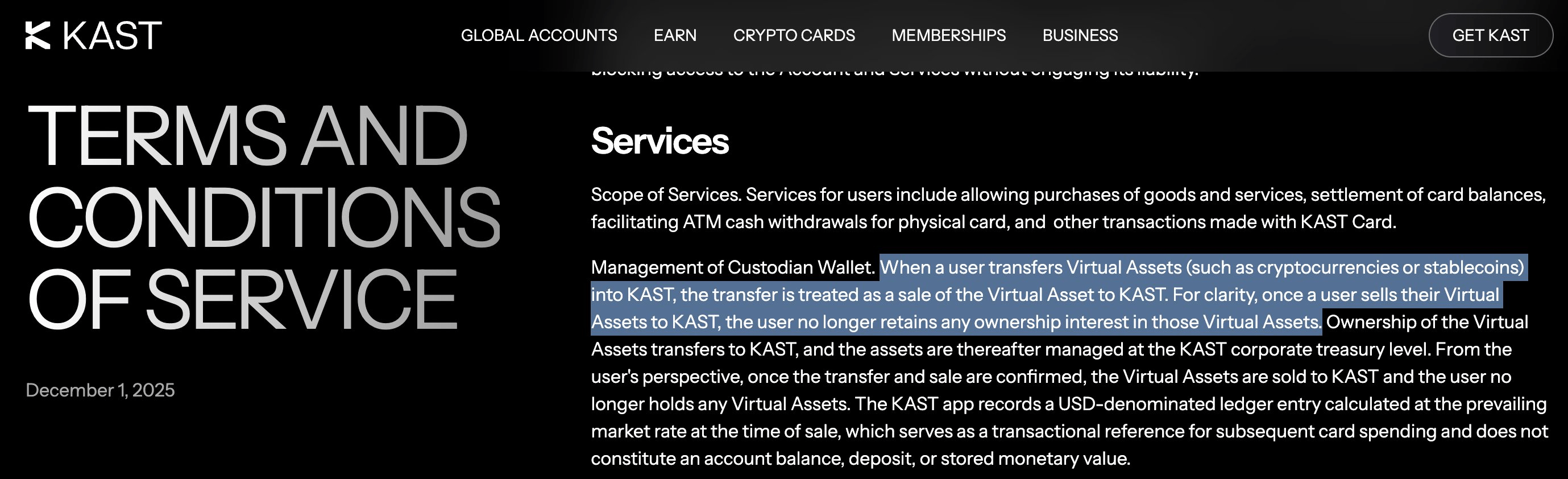
But as of press time on July 7, the terms have been updated. The company still calls the deposit a "sale," but the clause now pairs that with an explicit promise to repay users for what they haven't spent:
"While transferring Virtual Assets (such as cryptocurrencies or stablecoins) into KAST is treated as a sale to KAST, you retain an affirmative right to redeem or withdraw the unspent balance of the resulting payment obligation at any time, subject to our standard withdrawal procedures, compliance and fraud checks, minimum limits, and applicable fees. For the avoidance of doubt, this right exists only with respect to the portion of the balance that remains outstanding and unspent. Once any portion of the balance is spent (including via a card transaction) or otherwise settled, KAST's payment obligation and your contractual right under this section are extinguished with respect to that portion and do not revive."
The legal structure is the same as before, KAST still classifies every deposit as a sale of the underlying crypto, and ownership still transfers to the company. What's new is that KAST now spells out a specific, contractual debt back to the user: it owes them the value of whatever they haven't spent, and they can demand it at any time. That obligation disappears the moment the balance is spent or otherwise settled, and doesn't return.
The same section caps KAST's total liability at $500 and states the company is incorporated in Anjouan, Comoros, with disputes governed by Seychelles law and arbitrated in Singapore.
Pathy responded on July 7 with a thread clarifying that user funds are held in custody with BitGo and Fireblocks, that users retain "a binding payment obligation" and the right to redeem unspent balances at any time, and that KAST's terms had been updated "to make this very clear." He also pointed to the company's $80 million Series A, co-led by QED Investors and Left Lane Capital, which followed a $10 million seed round in December 2024 led by HSG and Peak XV Partners, saying the raise involved months of due diligence from a "Big4" accounting firm.
Unusual Terms
Research account Decentralisedco laid out why KAST's structure differs from competitors like ether.fi, Avici and Plasma One, which the account said use the same card-issuing stack but settle transactions through user-controlled smart contracts or licensed banking partners rather than taking ownership of deposits.
Because KAST books incoming stablecoins as its own asset, the account argued, the company can earn yield on idle customer balances — estimated at 4-5% annually on T-bill-backed instruments — in addition to standard card interchange fees, a structure the account said isn't available to rivals that don't take custody of user funds this way.
Other users pile on
Several other accounts weighed in with separate complaints once the terms-of-service issue began trending. Trader Matt Casto wrote that KAST had encouraged card spending to earn point multipliers, and questioned the timing of the pivot away from a token so soon after the Series A closed. Pseudonymous account MasterChiefNFTs listed a series of grievances, including repeated delays to the token launch — originally slated for the fourth quarter of 2025 — and the discontinuation of a 4% cashback tied to Movement's MOVE token, which has fallen more than 90% from its late-2024 high following a market-maker dumping scandal.
Investor Simon Dedic wrote that KAST's structure effectively makes a transfer "a taxable event on top of" losing ownership of assets. 0xArhat said he stopped using KAST after the company asked for proof of payment on a $1,500 transfer, and now uses Plasma and ether.fi cards instead.

 theblock.co
 bitcoinworld.co.in