

 1
1


 22
22
SpaceX's highly anticipated public market debut has spawned a fast-growing crypto shadow market that is allowing retail traders around the world to speculate on the company's valuation months before its shares reach public markets.
Here’s what’s behind the hype.
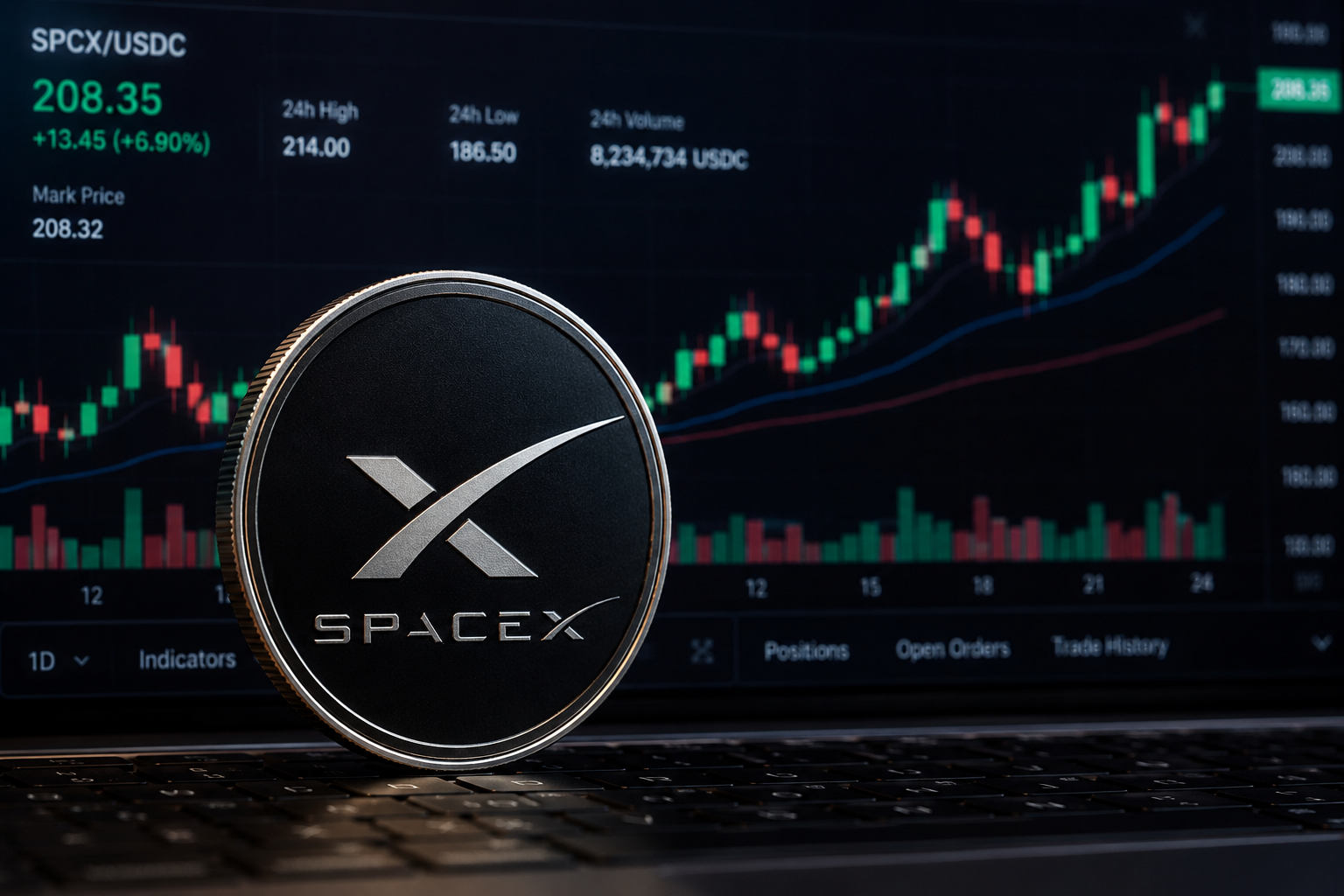
According to Forbes, decentralised derivatives platform Trade.xyz recently launched SPCX-$USDC, a perpetual futures contract on Hyperliquid that tracks an implied SpaceX valuation despite having no connection to the company itself.
The product opened with a reference price of $150, implying a valuation of roughly $1.78 trillion, before speculative activity pushed it as high as $216 shortly after launch.
Interest in these products has emerged as SpaceX continues to attract attention from investors worldwide.
Bloomberg reports that the company is targeting a valuation of about $1.8 trillion while seeking to raise as much as $75 billion, figures that have spurred demand from investors who otherwise have little access to private-company shares.
Why SpaceX has become the center of pre-IPO speculation
For years, access to SpaceX equity has largely been limited to venture capital firms, institutional investors, sovereign wealth funds, and wealthy individuals participating in secondary markets.
That exclusivity has become more pronounced as the company remains private while expanding its Falcon 9 launch business, growing the Starlink satellite network, and advancing development of Starship.
According to industry reports, the combination of strong revenue growth, technological prominence, and Elon Musk's public profile has created intense interest among retail investors seeking exposure before an eventual stock market debut.
Unable to purchase shares directly, traders are now turning to crypto markets offering synthetic alternatives.
Some recent developments have added to the hype, especially after reports surfaced that SpaceX's IPO filing disclosed holdings of 18,712 Bitcoin worth roughly $1.42 billion at current prices, making the company one of the largest corporate Bitcoin holders.
Many industry pundits argue that crypto investors have begun viewing SpaceX as both an aerospace company and a potential Bitcoin proxy.
How crypto traders are betting on SpaceX before its IPO
According to Forbes, the Hyperliquid-powered SPCX-$USDC contract is structured as a perpetual future settled entirely in $USDC stablecoins.
Traders can take leveraged long or short positions based on SpaceX's implied valuation without purchasing actual shares or receiving any ownership rights.
Unlike traditional equity investments, the contract does not grant voting rights, dividend claims, access to company disclosures, or any legal interest in SpaceX.
Pricing instead relies on oracle-fed market data and trader activity.
Alongside synthetic derivatives, another segment of the market has attempted to create more direct exposure through tokenized Special Purpose Vehicles, or SPVs.
These platforms purchase private shares through secondary markets and place them into offshore structures before issuing blockchain tokens tied to those holdings.
In both instances, these instruments are designed to dismantle the traditional regulatory and financial barriers that have historically kept retail investors locked out of high-growth corporate enterprises before they go public.
However, this trend did not begin with the SpaceX IPO.
According to reports cited by Castle Labs, a similar perpetual contract tracking AI chipmaker Cerebras, traded at $340 shortly before the company's Nasdaq debut, while Cerebras shares opened at $350.
Supporters of synthetic pre-IPO products argue that the episode demonstrated how crypto markets can generate independent price discovery before a public listing.
The massive demand for these markets has attracted some of the crypto industry’s largest players to cash in on the hype.
Exchanges including Binance, Bitget, and OKX have introduced similar products in recent months as interest in private technology companies continues to increase.
Regulators face new questions as the markets expand
While platforms race to meet demand for SpaceX-linked products, the rise of synthetic private-company trading has created a difficult regulatory challenge.
According to Forbes, some regulators have expressed concern that products tied to private companies may expose retail traders to substantial information gaps because those firms are not required to publish the same disclosures as publicly traded corporations.
Regulatory agencies also face the question of whether a crypto derivative referencing a private company's valuation should be treated as a security, a derivative product, or an entirely new category of financial instrument.
While most of these platforms heavily restrict access for US users, regulators such as the SEC and CFTC are continuing to monitor synthetic equity products closely.
Some legal experts have warned that enforcement actions could force platforms to delist certain contracts if regulators determine they fall under existing securities or derivatives laws.
This legal uncertainty may also extend beyond regulators in certain scenarios.
For instance, SpaceX has historically exercised tight control over the transfer of its private shares.
Any action targeting unauthorised SPVs or secondary-market structures could affect tokenized products that rely on those holdings for backing.
What lies ahead for the crypto shadow market?
Industry analysts estimate that blockchain-based pre-IPO markets have grown into a multi-billion-dollar ecosystem as retail investors search for ways to access companies that remain private for long periods.
While regulatory crackdowns remain an ever-present threat that could push these platforms deeper into the decentralised underground, the fundamental driver behind this movement shows no signs of slowing down.
The immense demand for SpaceX bets has shown strong appetite for democratised access to the world’s most valuable private companies.
Whether through compliance or absolute censorship resistance, that precedent could continue fueling demand across this market for years to come.

 coindesk.com

 en.bitcoinsistemi.com