

Ripple has earned a place among the top 10 companies in the Prime Unicorn Index, putting it alongside major private firms such as SpaceX.
The data from Lagniappe Labs shows that Ripple is the only crypto company in the top 10, which also includes heavyweights such as OpenAI, Anthropic, and SpaceX. This confirms Ripple’s growing position in the U.S. private market.
Key Points
- Ripple ranks sixth in the Prime Unicorn Index with a $26.09 billion valuation and 5% weighting.
- SpaceX led the index at $1.253 trillion, while OpenAI followed with a $917.31 billion valuation.
- The Prime Unicorn Index tracks 232 U.S. private companies valued above $1 billion.
- Ripple launched a $750 million buyback in March 2026, valuing the company at $50 billion.
- The index uses secondary market and verified transaction data, explaining Ripple’s lower valuation.
The Prime Unicorn Index
The Prime Unicorn Index from Lagniappe Labs tracks the share price performance of U.S. private companies worth at least $1 billion. Notably, the index uses a modified market capitalization model and acts as a benchmark for financial products tied to private companies.
It has posted annualized volatility of 19.75% over one year, 16.12% in three years, and 16.23% across its full history.
According to Lagniappe Labs, the index includes U.S. venture-backed private companies valued at $1 billion or more. The base date for the index is Jan. 20, 2021, while the official launch date is Jan. 17, 2024. The index undergoes reconstitution every January, April, July, and October.
At present, the Prime Unicorn Index contains 232 companies and uses a modified market cap weighting system. The combined market value of all companies in the index stands at $3.433 trillion.
Ripple Secures Top 10 Spot
As of April 15, 2026, SpaceX held the top spot in the Prime Unicorn Index, boasting a valuation of $1.253 trillion and a 10% weighting. OpenAI followed with a valuation of $917.31 billion and a 9% weighting, while Anthropic ranked third with $332.37 billion and an 8% weighting.
Databricks took fourth place with a valuation of $152.34 billion. Anduril Industries ranked fifth with a valuation of $58.19 billion and a 6% weighting. Ripple Labs secured sixth place, holding a market value of $26.09 billion and a 5% weighting.
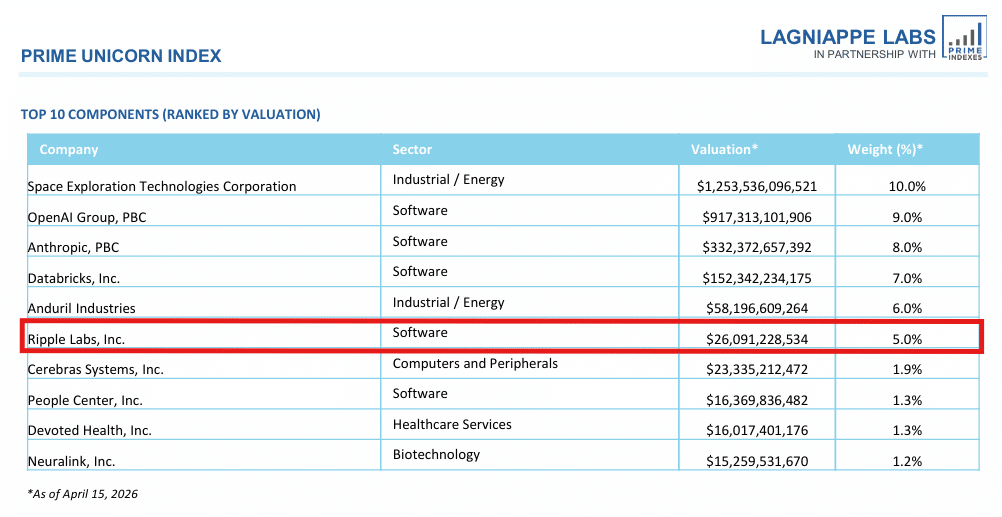
Cerebras Systems came next with a valuation of $23.33 billion and a 1.9% weighting. People Center posted a valuation of $16.36 billion with a 1.3% weighting, while Devoted Health holds $16.01 billion. Neuralink completed the top 10 with a valuation of $15.25 billion.
Ripple’s Valuation Over the Years
Being a private company, Ripple’s valuation comes from funding rounds, tender offers, secondary market activity, and share buybacks instead of public stock trading.
In 2019, Ripple raised $200 million in its Series C round at a valuation of about $10 billion. Around early 2024, the company carried out a tender offer and buyback that valued it between $11 billion and $11.3 billion.
On Nov. 5, 2025, Ripple closed a $500 million late-stage strategic funding round involving investors such as Pantera, Citadel Securities, and Galaxy. The deal valued the company at $40 billion post-money and included partial secondary share sales.
In March 2026, Ripple launched a $750 million share buyback and tender offer that valued the company at $50 billion, marking a 25% increase from the November 2025 valuation. The tender offer continued through April 2026.
Why the Index Shows Ripple at a Lower Valuation
While Ripple’s latest buyback valued the company at $50 billion, the Prime Unicorn Index placed Ripple’s valuation at around $26 billion in the second quarter of 2026.
The difference is due to the way the Prime Unicorn Index calculates company values. Notably, the index mainly relies on secondary market trading data and verified primary and secondary transactions. Ripple’s $50 billion figure, however, came directly from the company’s own tender offer and buyback pricing.

 coindesk.com

 cryptobriefing.com


 crypto.news
