


 4
4
Artificial intelligence continues to raise fears about the future of jobs as AI startup Anthropic launched 10 new AI agents for banks, insurers, and financial firms.
The launch has triggered fresh debate online about whether AI could replace entry-level finance workers, analysts, and even some software-related jobs. Concerns intensified after users on X claimed the tools could automate tasks usually handled by first-year Wall Street analysts.
At the same time, others argue that fears of an “AI job apocalypse” are exaggerated. They point to history and recent economic research showing that technology often changes jobs rather than eliminating work.
Anthropic Introduces 10 AI Finance Agents
Anthropic unveiled the new AI agents during an event in New York City. The company said the agents are designed to automate common finance tasks such as:
- Building pitchbooks
- Screening KYC files
- Reviewing valuations
- Closing monthly financial books
- Conducting financial analysis
According to Anthropic, the AI agents combine three major components:
- Skills — instructions and finance-specific knowledge
- Connectors — access to company data and software tools
- Subagents — additional Claude AI models assigned to specialized tasks
The company said firms can customize the agents to match their own risk policies, approval systems, and financial models. Anthropic also noted that financial services have become its second-largest source of enterprise revenue after the technology sector.
Concerns Over Entry-Level Finance Jobs
The launch quickly sparked fears online that junior finance roles may be at risk. One X user wrote: “Anthropic just automated the first-year analyst job at every bank on Wall Street.”
Others compared the launch to what some users called the “Claude Cowork SaaSpocalypse.”
Those concerns partly stem from earlier market reactions linked to Anthropic products. Reports claimed that when Anthropic launched Claude Cowork in February, SaaS companies reportedly lost more than $285 million in market value.
Some users also speculated that Indian IT and software firms such as Infosys and TCS could face pressure if AI agents reduce demand for outsourced business services.
How the AI Agents Work
Anthropic said the agents can operate in two different ways. The first option is through plugins inside Claude Cowork or Claude Code, where the AI works alongside human employees using familiar desktop software.
For example, a pitchbook agent could automatically generate:
- An Excel comparables model
- A PowerPoint presentation
- An Outlook cover note
The second option is through Claude Managed Agents on Anthropic’s platform. These agents can work autonomously over longer workflows, including overnight operations and handling entire deal books.
Anthropic emphasized that humans remain involved in the process. Users are expected to review, edit, and approve work before anything is sent to clients or officially filed.
The company also expanded integrations with Microsoft 365 and introduced new connectors, including a Moody’s MCP app for financial professionals.
Coinbase CEO Says AI Is Already Changing Workplaces
The debate around AI and jobs intensified further after Brian Armstrong announced that crypto exchange Coinbase would reduce its workforce by around 14%. In an internal email shared publicly, Armstrong said two major forces pushed the company toward restructuring:
- Weak market conditions
- Rapid advances in AI
Armstrong explained that AI tools are dramatically increasing productivity inside the company.
He said engineers can now complete projects in days that previously required weeks of work from entire teams. He also noted that non-technical workers are increasingly using AI to build production-level software.
According to Armstrong, Coinbase plans to become more “AI-native” by:
- Reducing management layers
- Increasing team efficiency
- Building smaller AI-assisted teams
- Using employees to supervise fleets of AI agents
He described the shift as an “inflection point” not just for Coinbase, but for companies across industries. Despite the layoffs, Armstrong argued the changes were necessary to make Coinbase “leaner, faster, and more efficient.”
Is an AI Job Apocalypse Really Coming?
While AI announcements continue to fuel anxiety, some economists and investors argue that fears of mass permanent unemployment are overstated.
An article published by venture capital firm Andreessen Horowitz (a16z) titled “The AI Job Apocalypse Is a Complete Fantasy” argues that concerns about AI replacing humans rely on what economists call the “lump-of-labor fallacy.”
The idea assumes there is a fixed amount of work available. According to the article, history shows that the opposite usually happens when technology improves productivity.
The report points to several examples:
- Farm mechanization reduced farming jobs in the U.S. from roughly one-third of employment to about 2%. Meanwhile, millions of new jobs emerged in factories, services, healthcare, and technology.
- Electrification transformed manufacturing and created entirely new industries.
- Software tools like Excel reduced repetitive accounting tasks but helped create more advanced financial analysis roles.
The article argues that as AI lowers the cost of cognitive work, humans may shift toward higher-value tasks rather than becoming obsolete.
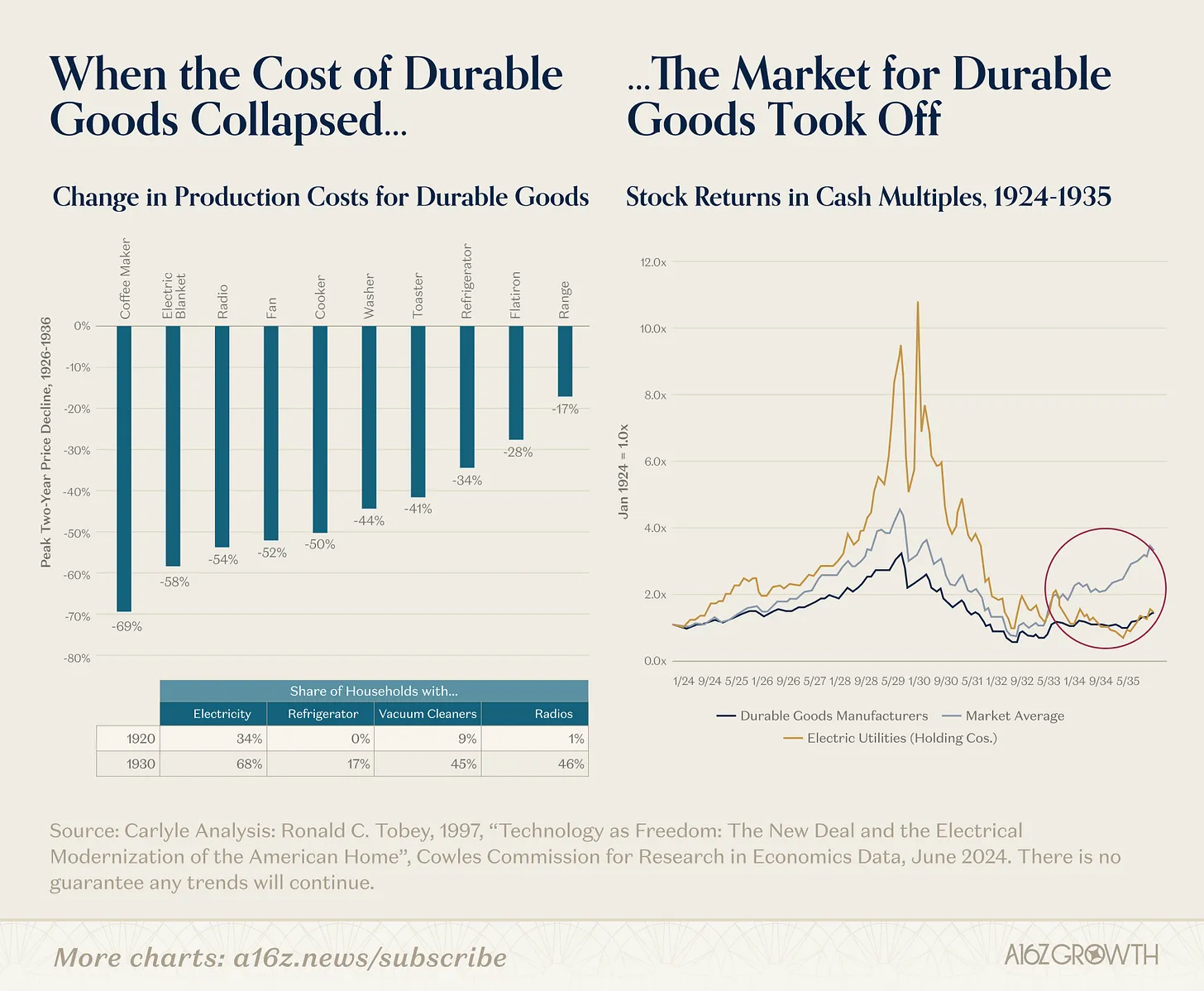
Source: a16z
Research Shows Limited Overall Impact So Far
Recent academic studies also suggest that AI’s effect on total employment remains limited for now. Several studies cited in the report found:
- Most firms reported little or no net employment change from AI adoption
- Routine clerical roles face the highest risk of automation
- Analytical and managerial jobs are more likely to be enhanced by AI rather than replaced
Researchers from institutions including the National Bureau of Economic Research, the Federal Reserve Bank of Atlanta, and Yale Budget Lab concluded that current labor market disruption from AI remains modest overall.
However, some studies found that entry-level positions with high exposure to AI tools are becoming harder to secure.
AI May Reshape Jobs Rather Than Eliminate Them
The growing consensus among many economists is that AI will likely remove some repetitive tasks while creating demand for new skills and industries. The article argues that productivity gains historically lead to:
- More economic growth
- New industries
- New types of work
- Higher demand for skilled labor
Instead of replacing humans entirely, AI may increasingly act as an augmentation tool that allows workers to become more productive.
For now, the launch of Anthropic’s finance agents and Coinbase’s AI-driven restructuring shows that businesses are rapidly adapting to AI. But whether this leads to widespread unemployment or simply a major reshaping of work remains one of the biggest questions facing the global economy.
Related: DOJ and CFTC Investigate $2.6B Suspicious Bets on Oil Prices for Insider Trading

 thedefiant.io
 coindesk.com
 bitcoinworld.co.in + 1 more