


 3
3
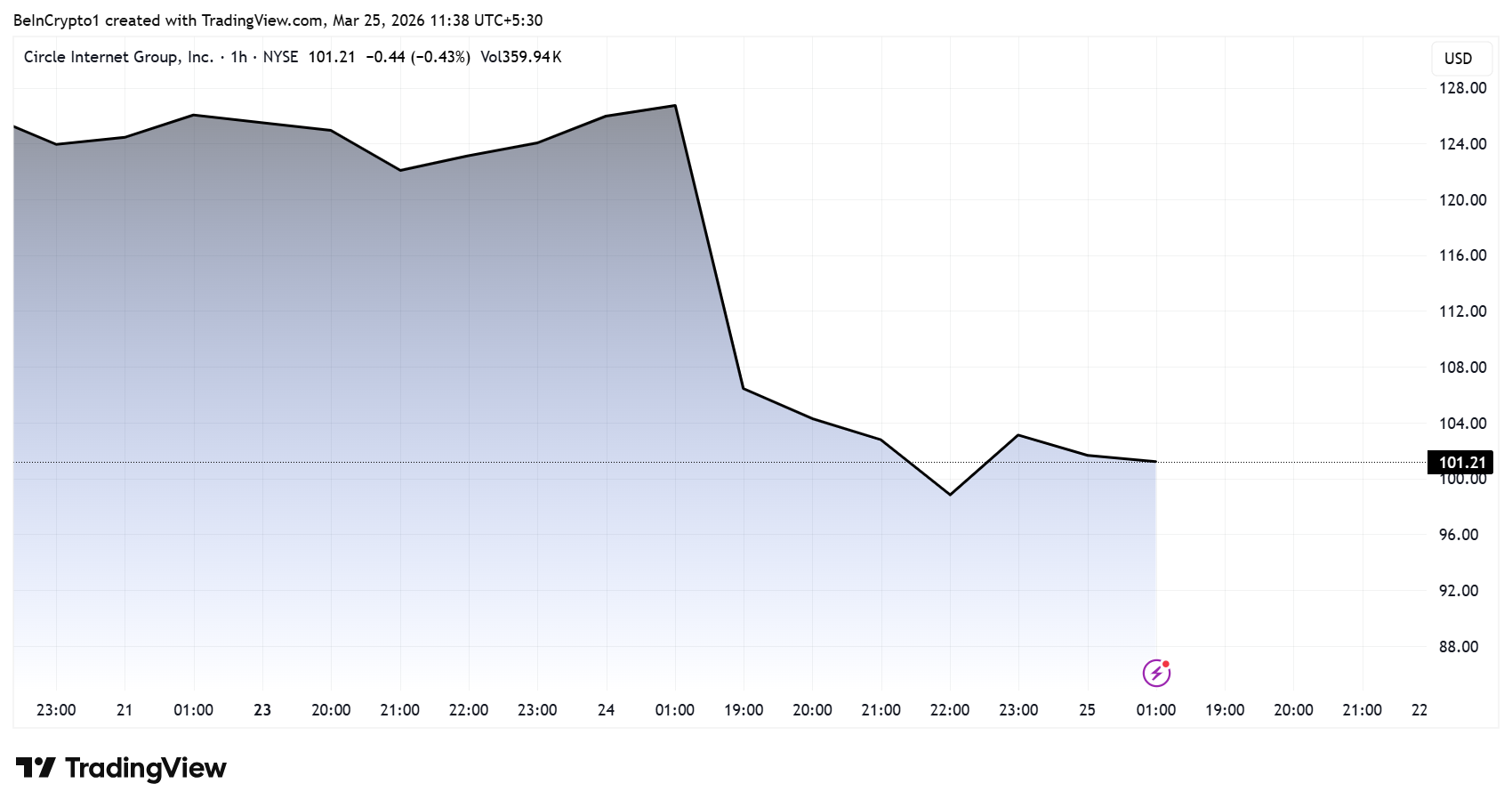
Circle Internet Group (CRCL) dropped 20% on March 24 after the Clarity Act’s draft language banned passive stablecoin yield, erasing an estimated $4.6 billion in market value.
The sell-off hit as three forces converged on Circle simultaneously. A yield ban rattled investors, rival Tether ($USDT) announced a Big Four audit, and 16 $USDC business wallets were frozen.
What the Clarity Act Actually Does
The Digital Asset Market Clarity Act stalled in the Senate Banking Committee since January over one fight. Can stablecoin holders earn passive yield?
On March 20, Senators Thom Tillis (R-NC) and Angela Alsobrooks (D-MD) announced an agreement with the White House. The draft text reached industry stakeholders by Monday.
The language bans platforms, exchanges, and brokers from offering yield on stablecoin balances. Only activity-based rewards tied to transactions or governance remain permitted. The SEC, CFTC, and Treasury have 12 months to write anti-evasion rules.
Banks lobbied aggressively for this outcome. The American Bankers Association argued stablecoin yield programs threatened trillions in deposit flight.
Mizuho analyst Dan Dolev warned the ban could reduce the near-term use case for Circle. Coinbase (COIN) fell roughly 10% in sympathy as stablecoin-related revenue represents about 20% of its total income.
The Contrarian Case
However, Circle earned 96% of its revenue from interest on USD Coin ($USDC) reserves as of Q3 2025. That concentration has ranged between 95% and 99% since 2022, according to its S-1 filing. Those reserves sit largely in US Treasury bills.
The Clarity Act does not touch that income stream. It bans platforms from passing yield to users. Circle itself still collects every dollar of reserve interest.
Before this draft, Circle faced growing pressure to share reserve income with holders. DeFi protocols offering passive APY on $USDC intensified that expectation. The yield ban removes it entirely.
Analyst Simon Dedic pushed back against the bearish consensus.
“This is massively bullish for Circle. Their entire business model is built on keeping the yield generated by their $USDC supply. The Clarity Act essentially gives them a regulatory moat…,” wrote Dedic.
Former Fox journalist Eleanor Terrett noted the passive yield ban had been publicly telegraphed for months. The sharp stock reaction surprised many observers.
This is interesting because if you’ve been following this story, it’s been well reported that yield on passive stablecoin balances was a nonstarter from the beginning and unlikely to make it into the final deal. I think the @tether audit news may be playing into the drop as well,… https://t.co/8W6tCaiHFe
— Eleanor Terrett (@EleanorTerrett) March 24, 2026
Tether, ARK, and the Wallet Freeze
Meanwhile, Tether announced it had signed a Big Four accounting firm to conduct its first full independent audit. The firm was not named. $USDT’s market cap currently exceeds $184 billion.
For years, Circle positioned itself as the more transparent alternative. Tether had relied only on quarterly attestations from BDO Italia. A completed Big Four audit would narrow that credibility gap significantly.
Tether CFO Simon McWilliams said the firm was selected through a competitive process. The audit will cover assets, liabilities, and internal controls.
ARK Invest sold $5.9 million in CRCL shares on March 20, four days before the draft leaked publicly. The timing raised eyebrows.
BREAKING: $CRCL is down 16% intraday, wiping out $5.6 billion in market value after Congress proposed banning stablecoin yield.
— Bull Theory (@BullTheoryio) March 24, 2026
The sell-off is tied to leaked stablecoin legislation that would ban platforms from offering yield on stablecoins "directly or indirectly", blocking… pic.twitter.com/BrLAPnWjSp
However, ARK then bought $16.3 million in CRCL on March 24 after the crash. The reversal suggests portfolio rebalancing, not a directional bet.
Separately, on-chain investigator ZachXBT reported Circle froze $USDC balances in 16 hot wallets belonging to exchanges, casinos, and forex firms.
The freeze stemmed from an undisclosed US civil case. ZachXBT criticized Circle for failing to verify the wallets before acting. The incident amplified negative sentiment and revived concerns about centralization in $USDC.
The Clarity Act is not law yet. The Senate Banking Committee markup is targeted for late April, and DeFi provisions remain unresolved.
DeFi protocols are already redesigning rewards to align with compliant activity-based structures. Whether $USDC can maintain demand without passive yield will determine if March 24 was an overreaction or the start of a longer repricing.
The post Why Circle’s 20% Crash Might Be a Massive Bull Trap appeared first on BeInCrypto.

 theblock.co
 cryptopolitan.com
 en.bitcoinsistemi.com