

 1
1
At the beginning of March, 2026, Gold appeared like a perfect investment due to both the positive momentum the commodity has been enjoying for months and its status as a ‘safe haven’ asset amidst the latest geopolitical escalation.
Despite the apparently positive outlook, purchasing $1,000 worth of the yellow metal at the start of the month would have been a losing bet. Specifically, on Monday, March 2, gold climbed as high as $5,390 as the war started with a joint bombing of Iran by the U.S. and Israel and was projected to last approximately four weeks.
At press time on Monday, March 23, however, the commodity is changing hands at $4,225, meaning it had fallen 21.61% and that every ounce lost approximately $1,165 over the three weeks.
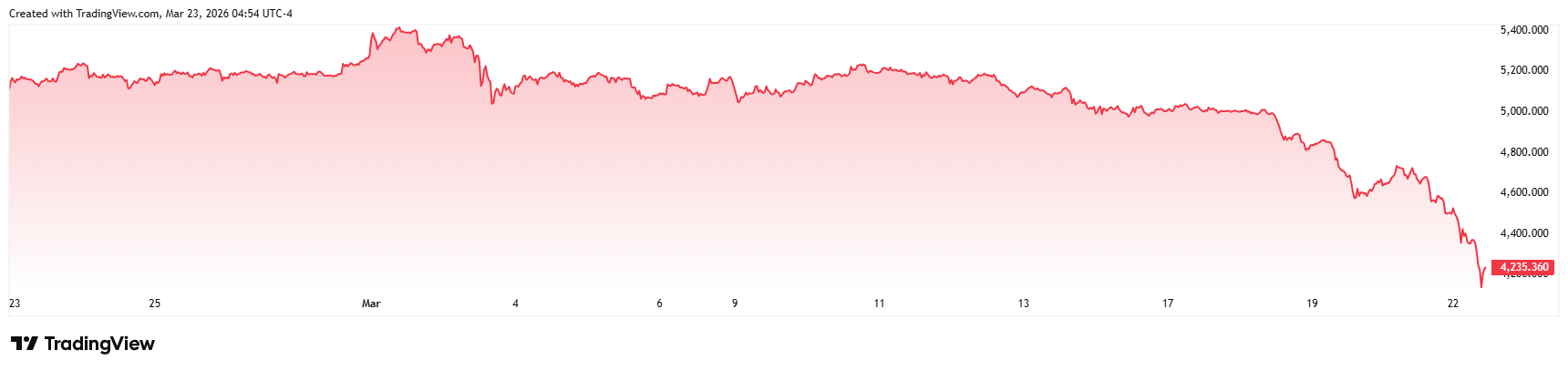
Under such circumstances, purchasing $1,000 worth of the ‘safe haven’ asset on the first trading day following the start of the war would have led to $216.10 in losses and would have left investors, by press time, with $783.90.
Gold price crashed more on geopolitical risks than stocks or Bitcoin
Elsewhere, perhaps the most surprising aspect of gold’s performance is that an investment in assets traditionally considered more susceptible to risk would not have incurred comparable losses.
For example, the benchmark S&P 500 stock market index is down 5.45% since March 2, meaning a $1,000 investment made on the first Monday of the month would have fallen to $945.50.
Bitcoin (BTC) – long argued to be ‘digital gold’ despite belonging to an exceptionally volatile asset class – performed even better and is, in fact, up 2.63% in the last three weeks. Thus, $1,000 invested in the world’s premier cryptocurrency would have risen to $1,026.30.
Why Gold is crashing in March
Lastly, gold’s counterintuitive performance can. arguably, be linked primarily to its performance in recent years. Traditionally, the commodity has maintained a mostly slow and steady upward path, ensuring an extra layer of stability.
Recent years have, however, completely altered the situation, and the precious metal arguably became a crowded trade as numerous investors, ranging in scale and type from central banks to retail traders, began purchasing it.
For example, despite the crushing crash in March, a $1,000 investment made at the start of 2026 would still, at press time, be worth $982. A purchase of gold of the same scale made 12 months ago would be worth $1,396.20.
Thus, the commodity’s success might have made it very susceptible to a correction, while the speed of its rally means that, even after the 21.61% drop in the last three weeks, it is yet to present a value buying opportunity that might end the downturn.
Featured image via Shutterstock

 en.cryptonomist.ch

 coingape.com
 coindesk.com